
Calculate wavelength from wave velocity and frequency (or period) using the universal wave equation λ = v / f = v · T. Pick a medium, enter any one of wavelength, period, or frequency, and the rest update live.
f = v / λ = 1 / T. Frequency is the default primary (500 THz visible light in vacuum).| Unit | Symbol | Value |
|---|
| Quantity | Symbol | Value | Unit |
|---|
| Property | Value |
|---|
| Quantity | Value |
|---|
| # | Wavelength | Frequency | Velocity | Time |
|---|
-
Select a citation style above. Click the citation text to select it all, then copy.
ADVERTISEMENT









Founder & CEO, Toolraxy
Faiq Ur Rahman is a web designer, digital product developer, and founder of Toolraxy, a growing platform of web-based calculators and utility tools. He specializes in building structured, user-friendly tools focused on health, finance, productivity, and everyday problem-solving.
User Ratings:
ADVERTISEMENT
ADVERTISEMENT
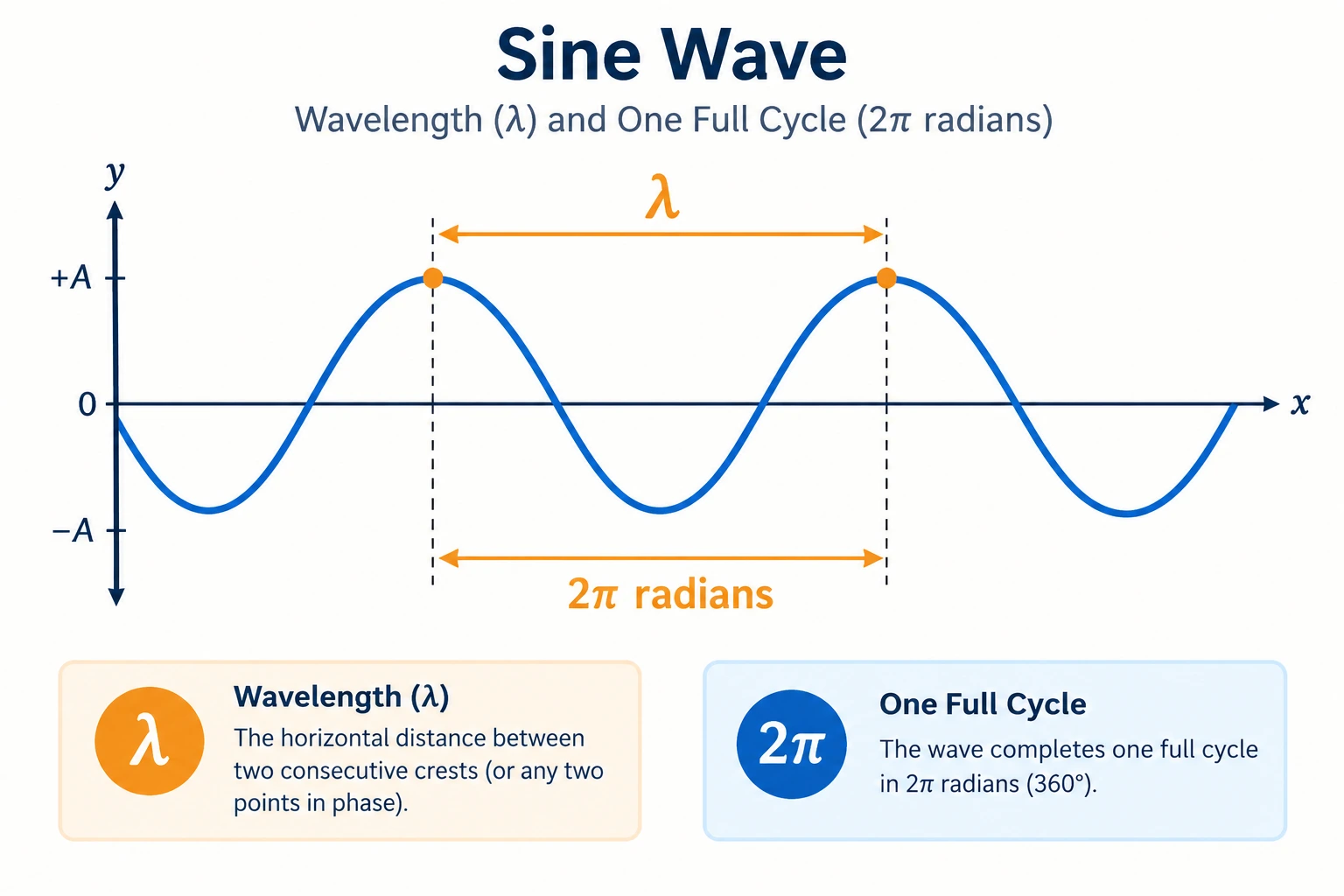
Wavelength is the spatial period of a wave: the distance between two consecutive crests, or between any two points in phase. It is measured in metres in SI, and in nanometres for visible light. The wave equation ties it to speed and frequency: λ = v / f.
For electromagnetic waves in vacuum, speed is locked to the speed of light, so wavelength and frequency are strictly reciprocal. The National Institute of Standards and Technology fixes that speed at exactly 299,792,458 m/s as a defined constant, which is why the tool can classify a vacuum-light result into an EM band with confidence. For mechanical waves, speed depends on the medium: sound crawls through air at roughly 343 m/s at 20 °C but races through steel at near 5,960 m/s. The speed of sound in air is a standard reference value that most acoustic work starts from. If you need the inverse problem, finding frequency from a known wavelength, the frequency calculator handles the same equation solved the other way.
Pick a medium or leave the custom speed, then enter the one wave property you already know. The field you edit becomes the primary input and the other two are computed instantly. The order below matches what most people do in practice.
Choose a medium preset from the dropdown, or leave it on custom and type your own wave speed.
Confirm the wave speed unit (m/s, km/h, ft/s, or mph); the preset fills this automatically.
Enter the frequency, and pick its unit (Hz, kHz, MHz, GHz, THz, or RPM).
Alternatively, enter wavelength or period; the tool detects which field you touched last.
Read the hero result and the all-units table beneath it.
Check the band banner to see whether the result falls in radio, microwave, infrared, visible, UV, X-ray, or gamma territory.
The tool’s colour coding tells you what is happening: blue is the anchor (wave speed), red is the field you are editing, and green is computed. When you change a unit mid-calculation, the value converts in place rather than resetting.
Wavelength equals wave speed divided by frequency: λ = v / f. Since frequency is the reciprocal of period, the same relationship reads λ = v × T. Rearranged, frequency is f = v / λ, and period is T = 1 / f. Angular frequency and wave number connect to the same three quantities.
Formula: λ = v / f = v × T
f = v / λ
T = 1 / f
ω = 2πf
k = 2π / λ
Here λ is wavelength in metres, v is wave speed in m/s, f is frequency in hertz, and T is period in seconds. The wave number k is the spatial analogue of angular frequency: it counts radians per metre instead of radians per second. For electromagnetic waves, the photon energy E = hf uses the Planck constant fixed at 6.62607015 × 10⁻³⁴ J·s; the tool computes it automatically when the medium is vacuum light. Unit switching is supported for every input: wave speed in four units, wavelength in nine units from ångström to kilometre, frequency in six units, and period in eight units from femtosecond to hour. If you already have the angular frequency and want the linear frequency, the angular frequency converter bridges the two.
A laser diode emits at 500 THz in vacuum. What is its wavelength, and where does it sit in the visible spectrum?
Step one: look up the speed of light in vacuum. v = 299,792,458 m/s.
Step two: divide speed by frequency. λ = 299,792,458 ÷ 500 × 10¹² = 5.9958 × 10⁻⁷ m.
Step three: convert to nanometres. 5.9958 × 10⁻⁷ × 10⁹ = 599.6 nm.
Step four: compute the period. T = 1 ÷ 500 × 10¹² = 2.0 × 10⁻¹⁵ s, or 2.0 fs.
Step five: compute photon energy. E = hf = 6.62607015 × 10⁻³⁴ × 500 × 10¹² = 3.313 × 10⁻¹⁹ J, or about 2.07 eV.
The result is 599.6 nm, which sits in the yellow-orange part of the visible band. A 500 THz source is a common green-to-yellow laser pointer wavelength. If you then fire that beam into glass, the frequency stays at 500 THz but the wavelength shortens to about 667 nm because the speed drops to roughly 200,000,000 m/s. The band banner still reads “visible” because the classification depends on the medium; switching the preset to glass updates the wavelength but the physical colour stays the same.
Waves are commonly described by three key properties: wave velocity, wavelength, and frequency. These properties help explain how waves travel and repeat through a medium.
Wave velocity ((v)) describes the speed and direction in which a wave travels through a medium. It is measured in meters per second (m/s). For more information about speed and velocity, explore our Speed Calculator.
Wavelength ((\lambda)) is the distance between two consecutive points in the same phase of a wave, such as two adjacent crests or troughs. It is usually measured in meters (m) and can vary depending on the wave and the medium.
Frequency ((f)) indicates how many complete wave cycles pass a fixed point each second. In mechanical waves, it corresponds to the oscillation frequency of the particles in the medium. Frequency is measured in hertz (Hz), where 1 Hz equals one cycle per second. Learn more with our Frequency Calculator.
The table lists the standard EM bands and their approximate frequency boundaries. Values are rounded ranges from reference charts; the exact boundaries differ slightly between standards bodies, and some sources place the visible band from 380 to 750 nm.
| EM band | Approximate frequency range |
|---|---|
| Radio | below 3 GHz |
| Microwave | 3 GHz – 300 GHz |
| Infrared | 300 GHz – 400 THz |
| Visible light | 400 THz – 790 THz (380–750 nm) |
| Ultraviolet | 790 THz – 30 PHz |
| X-ray | 30 PHz – 30 EHz |
| Gamma ray | above 30 EHz |
The visible band is the narrowest slice of the whole spectrum, which is why the human eye is a poor detector for most of the electromagnetic world. The National Institute of Standards and Technology publishes a reference spectrum chart that most engineering tables trace back to, and the National Cancer Institute gives the clinical definition of visible light as 380–750 nm.
The table lists wave speeds for the tool’s built-in presets. Values are reference ranges at standard conditions; actual speeds vary with temperature, pressure, composition, and microstructure.
| Medium | Wave speed (m/s) |
|---|---|
| Light in vacuum | 299,792,458 (exact) |
| Light in water | 225,000,000 |
| Sound in air at 20 °C | 343 |
| Sound in helium | 965 |
| Sound in freshwater | 1,480 |
| Sound in seawater | 1,520 |
| Sound in human tissue | 1,540 |
| Sound in concrete | 3,200 |
| Sound in steel | 5,960 |
| Sound in aluminum | 6,420 |
Two patterns stand out. Electromagnetic waves in a medium always travel slower than in vacuum, and acoustic waves in solids travel roughly ten to twenty times faster than in air. The speed of sound in seawater is around 1,500 m/s and rises with salinity and pressure, which is why sonar ranging uses a temperature-dependent profile rather than a fixed number. The NDT reference table lists longitudinal velocities for engineering materials and warns that the actual value depends on alloy, porosity, and grain orientation.
Four inputs move the result: the medium’s wave speed, the frequency you supply, the period you supply, and which field the tool treats as primary. The first is physical; the last is a user choice.
A faster medium lengthens the wavelength for a fixed frequency. Light in vacuum at 500 THz gives 599.6 nm; in glass at the same frequency it gives about 667 nm only if you confuse the medium, but physically the glass wavelength shortens, not lengthens check the direction carefully.
Higher frequency shortens the wavelength in a fixed medium. Doubling f halves λ.
Higher period lengthens the wavelength because T and f are reciprocal. A 2 fs period corresponds to 500 THz in vacuum.
Temperature changes acoustic speed, which shifts wavelength. Sound in air at 30 °C runs at about 349 m/s, roughly 2% faster than at 20 °C, so a fixed-frequency tone gets about 2% longer.
Salinity and pressure change seawater sound speed, so sonar wavelengths drift with depth. A 1,520 m/s nominal value is a surface reference, not a global constant.
The primary field you edit decides which quantity is held constant. If you edit frequency, wavelength and period are computed; if you edit wavelength, frequency is computed and period follows.
In power-mode style, the reference quantity is the one you care about. For antenna design, wavelength is usually the driver. For RF channel planning, frequency is the driver. The RF wavelength calculator is the specialised tool for that antenna-side hand-off.
λ = v / f. Wavelength equals wave speed divided by frequency. If you know the period instead, λ = v × T, because frequency and period are reciprocals.
Divide the wave speed by the frequency in hertz. A 500 THz wave in vacuum gives 299,792,458 ÷ 5 × 10¹⁴ = 5.996 × 10⁻⁷ m, or 599.6 nm.
Visible light spans roughly 380–750 nm, which corresponds to about 400–790 THz in vacuum. Violet sits at the short-wavelength end and red at the long-wavelength end.
Yes, wavelength shortens because the speed of light drops to about 225,000,000 m/s in water. Frequency stays at the same value, so the colour does not change.
Rearrange to f = v / λ. Divide the wave speed by the wavelength in metres; a 0.125 m Wi-Fi wavelength at 2.4 GHz checks out as 3 × 10⁸ ÷ 0.125 = 2.4 × 10⁹ Hz.
About 12.5 cm in air. The exact value is 299,792,458 ÷ 2.4 × 10⁹ = 0.1249 m, which is why quarter-wave antennas for 2.4 GHz are roughly 3.1 cm.
Sound wavelength uses the speed of sound in the medium (343 m/s in air, about 1,500 m/s in water), while light wavelength uses the speed of light. At the same frequency, sound wavelengths are millions of times shorter than light wavelengths.
Period is the time for one cycle, wavelength is the distance for one cycle, and speed links them: λ = v × T. A 2 fs period at 500 THz in vacuum corresponds to 599.6 nm.
Yes, for a first estimate. Enter the frequency and read the vacuum wavelength, then multiply by the velocity factor of your feed line (typically 0.66–0.95) to get the physical wavelength in the cable.
Wave number is k = 2π / λ, measured in radians per metre. It is the spatial analogue of angular frequency, and the tool computes it alongside wavelength in the derived-quantities panel.
Datasheets usually quote wavelength in a specific medium or at a specific temperature. A laser diode’s 500 THz rating is a vacuum figure; in glass the wavelength is shorter by the refractive index, and the datasheet may or may not state which value it lists.
Wave speed in m/s, km/h, ft/s, or mph; wavelength in nm, m, cm, mm, µm, Å, in, ft, or km; frequency in THz, Hz, kHz, MHz, GHz, or RPM; period in fs, s, ms, µs, ns, ps, min, or h.
Wave-speed values are reference figures at standard conditions. Real media vary with temperature, pressure, composition, and microstructure. Do not use this calculator as the sole basis for safety-critical acoustic, optical, or RF design; verify against the manufacturer’s data or a calibrated measurement.
The National Institute of Standards and Technology lists the speed of light in vacuum as exactly 299,792,458 m/s, the value the calculator uses for every vacuum-light preset.
The University of Michigan reference page gives the speed of sound in air at 20 °C as 343 m/s, the default value for the acoustic air preset.
The NIST spectrum reference supplies the frequency boundaries used to classify radio, microwave, infrared, visible, ultraviolet, X-ray, and gamma bands in the band banner and the EM table.
The National Cancer Institute defines visible light as electromagnetic radiation with wavelengths between approximately 380 and 750 nm, the range used in the visible-light FAQ and the band classifier.
The Particle Data Group publishes the Planck constant as 6.62607015 × 10⁻³⁴ J·s, the value behind the photon-energy output for vacuum-light calculations.
The NDT reference table lists longitudinal sound velocities for engineering solids, including steel at 5,960 m/s, aluminium at 6,420 m/s, and copper at 5,010 m/s, which are the values behind the solid-medium presets.
The CK-12 wave-speed reference explains the relationship v = λf and its reciprocal forms λ = v / f and T = 1 / f, the algebra used in the formula section.
ADVERTISEMENT
ADVERTISEMENT