
Compute angular velocity, tangential velocity, centripetal acceleration, centripetal force, period, and frequency for uniform circular motion.
v = ω × r · a_c = v² / r = ω² × r · F_c = m × a_c · T = 2π / ω · f = 1 / T| Quantity | Symbol | Value | Unit |
|---|
| Property | Value |
|---|
| Quantity | Value |
|---|
| # | a_c (m/s²) | F_c (N) | Input | Time |
|---|
-
Select a citation style above. Click the citation text to select it all, then copy.
ADVERTISEMENT








Founder & CEO, Toolraxy
Faiq Ur Rahman is a web designer, digital product developer, and founder of Toolraxy, a growing platform of web-based calculators and utility tools. He specializes in building structured, user-friendly tools focused on health, finance, productivity, and everyday problem-solving.
User Ratings:
ADVERTISEMENT
ADVERTISEMENT
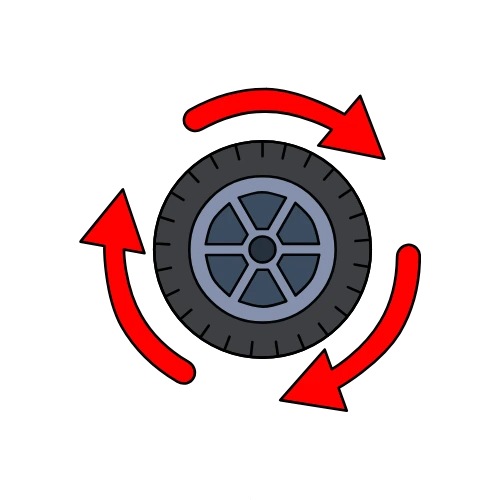
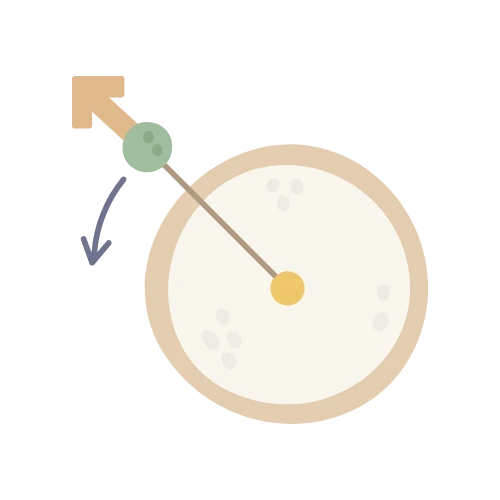
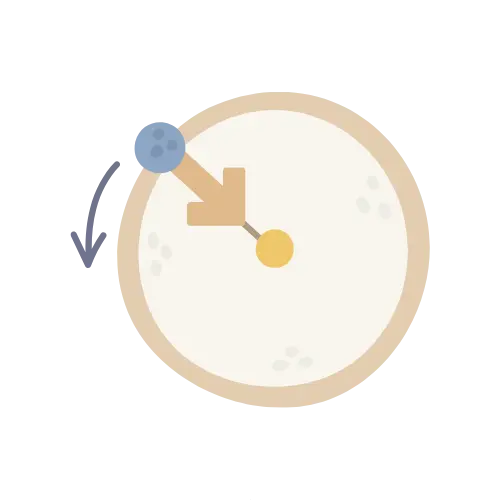
Uniform circular motion is motion along a circular path at constant speed. The direction of velocity changes continuously, so the object accelerates toward the center of the circle even though its speed is constant. That inward acceleration is called centripetal acceleration, and the net inward force that produces it is centripetal force.
The key idea is that “centripetal” describes a direction, not a new kind of force. Tension, gravity, friction, or a normal force can all supply the inward force. In a car turning on a flat road, static friction points toward the center of the turn. In a satellite orbit, gravity does the same job. The calculator does not ask what supplies the force; it computes the magnitude required for the motion you describe. That distinction matters because the formula F_c = m v² / r tells you the net inward force needed, not which physical interaction provides it.
Choose the input mode that matches what you already know: angular velocity, tangential velocity, period, or frequency. Enter mass and radius with their units, then read the acceleration and force in the results panel. Mass is optional for acceleration but required for force; leave it at 1 kg if you only need kinematics.
Pick a mode under “Known speed quantity.”
Enter the radius and choose its unit.
Enter mass if you need centripetal force.
Type the known speed quantity and choose its unit.
Read a_c in the red hero panel and F_c in the quick grid.
Open “All quantities” for RPM, g-force, period, and frequency.
Check “Calculation details” to see every converted SI value.
Press Enter in any field to record the calculation in the history table.
The calculator uses a_c = v² / r = ω² r and F_c = m a_c, with v = ω r, T = 2π / ω, and f = 1 / T. Every input is converted to SI before calculation, then displayed with the unit you chose. If you change a unit menu, the numeric value stays the same but its meaning changes, so re-check the result after switching units.
In whiteboard terms, acceleration scales with the square of speed and inversely with radius. Double the speed and the required inward acceleration quadruples. Halve the radius and the required acceleration doubles at the same speed. Force adds mass on top of that: a heavier object needs more inward force to follow the same path. Angular velocity and tangential velocity are linked by v = ω r, so a larger radius means a higher tangential speed for the same rotation rate. Period and frequency are reciprocals: a 0.5 s period means 2 Hz.
A 0.75 kg object moves in a circle of radius 0.35 m with angular velocity 4.2 rad/s. The calculator returns v = 1.47 m/s, a_c = 6.174 m/s², F_c = 4.631 N, T = 1.4960 s, and f = 0.6685 Hz. The equivalent g-force is 0.6296 g, and the rotation rate is about 40.1 RPM.
The acceleration is about 0.63 g, roughly the inward push you feel in a gently turning car. The force is small under 5 N because the mass is under 1 kg. If you doubled the angular velocity to 8.4 rad/s while keeping the radius fixed, the acceleration would quadruple to about 24.7 m/s² and the force would rise to about 18.5 N. That squared relationship is the most important thing to notice in circular motion: speed changes dominate the result.
Centripetal acceleration is a kinematic quantity: it describes how the velocity direction changes and depends only on speed and radius. Centripetal force is dynamic: it is the mass times that acceleration and depends on the object. A 1 kg mass and a 10 kg mass on the same path at the same speed have the same a_c but ten times different F_c.
The calculator separates the two in the results. The hero panel shows a_c because it is the purest measure of the motion. The quick grid puts F_c beside it so you can see the effect of mass immediately. If you only need acceleration, you can leave mass at 1 kg and ignore the force column. If you are sizing a tether, a track, or a centrifuge, the force is the number that matters.
Centripetal acceleration is the inward acceleration of an object moving in a circle at constant speed. It equals v² / r and points toward the center of the circle. Even though the speed is constant, the velocity direction changes, so the object is accelerating.
Angular velocity measures how fast the angle changes, in rad/s, deg/s, rev/s, or RPM. Tangential velocity measures how fast the object moves along the circle, in m/s, km/h, ft/s, or mph. They are linked by v = ω r.
The calculator treats force as a magnitude. A negative result would mean the mass or radius was entered as negative, which is not physical for this model. Centripetal force points inward by definition, so the meaningful output is a positive magnitude.
The calculator cannot compute centripetal acceleration because a_c = v² / r would divide by zero. It shows “Enter valid mass, radius and speed to compute circular motion.” A zero radius is a point, not a circle, so the model does not apply.
Mass is only used to compute centripetal force. You can leave it at 1 kg and ignore the force output; acceleration does not depend on mass. The field is there so the same tool can solve force problems without a second page.
Multiply RPM by 2π / 60, which is about 0.10472. For example, 60 RPM equals about 6.283 rad/s. The calculator does this conversion automatically when you select RPM in the angular velocity unit menu.
Centripetal force is a role, not a separate interaction. It is the net inward force required to keep an object in circular motion. Tension, gravity, friction, or a normal force can play that role. The calculator gives the magnitude of the required net inward force.
G-force is centripetal acceleration divided by standard gravity, a_c / 9.80665. A benchtop centrifuge at 10,000 RPM with a 0.10 m radius produces roughly 11,000 g at the sample. The calculator shows this value in the “Equivalent g-force” row.
If angular velocity is zero, tangential velocity is zero and centripetal acceleration is zero. The object is not moving in a circle; it is stationary. The message is the tool’s way of saying the inputs describe a point at rest, not a rotation.
Period is the time for one full revolution, in seconds. Frequency is the number of revolutions per second, in hertz. They are reciprocals: T = 1 / f. A 0.25 s period is 4 Hz.
This calculator is a physics tool, not a medical or engineering safety authority. The g-force values and tolerance ranges discussed on this page come from published NASA and FAA documents, but individual tolerance varies with direction, duration, restraint, and health. Do not use this page to design a human-rated centrifuge, vehicle, or amusement ride without a qualified engineer and the applicable standards.
NASA. NASA-STD-3001, Volume 2, Revision D: Human Factors, Habitability, and Environmental Health. NASA Technical Standards, 2023. The sustained translational acceleration limits in Table 6.5-2 and Figure 6.5-2 inform the g-force context in this page. Retrieved from nasa.gov.
Federal Aviation Administration. AM 63-30, Part 2: Human Tolerance to High Dorso-Ventral Acceleration. FAA Office of Aerospace Medicine. The report describes 12 g exposures lasting 10–30 seconds and notes limits for head movement and speech. Retrieved from faa.gov.
National Institute of Standards and Technology. “Everything You Want to Know About SI (But Were Afraid to Ask).” NIST, 2008, updated 2025. The article describes NIST Special Publication 811 and its conversion-factor appendix. Retrieved from nist.gov.
ADVERTISEMENT
ADVERTISEMENT