What Is a Simple Pendulum?
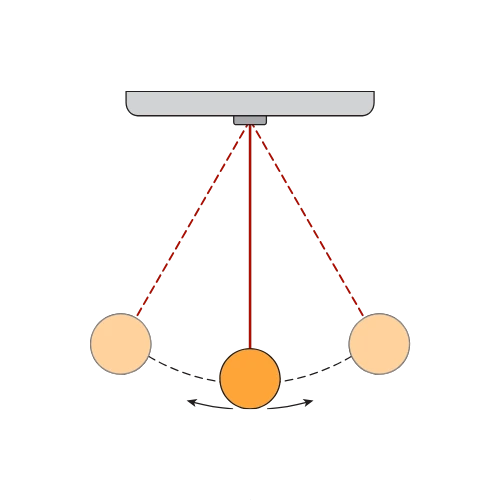
A simple pendulum is a point mass suspended from a fixed pivot by a massless string, swinging under gravity with a period that depends only on its length and the local gravitational acceleration. The OpenStax University Physics treatment defines the period as T = 2π√(L/g) for small angular amplitudes, typically under about 15°. The mass of the bob drops out entirely. A heavier bob feels a larger gravitational restoring force, but it also has more inertia, and the two effects cancel. That independence is why a pendulum can keep time without knowing the weight of its bob. Real pendulums have string mass, air resistance, and a finite bob, but the simple model remains the starting point for clock design, gravimetry, and physics teaching.

How Do You Find the Period of a Pendulum?
You find the period by dividing the length by gravity, taking the square root, and multiplying by 2π. The calculator automates that sequence and lets you work backward from period or frequency when you already know the timing you need.
“For a more complete analysis of oscillatory motion, use our Simple Harmonic Motion Calculator to calculate angular frequency, period, displacement, velocity, and acceleration for mass-spring and pendulum systems.”
Enter the local gravitational acceleration. Earth sea level is 9.80665 m/s², but the field accepts ft/s² and multiples of Earth g.
Choose which quantity you want to drive the calculation: length, period, or frequency.
Type a positive value into that field. The tool highlights it in red and marks the other two as computed.
Read the period in the hero panel and the frequency in the context row. The full table below shows length, period, frequency, and gravity in multiple units.
Change the gravity value if you are modelling a different planet, a high-altitude location, or a hypothetical environment.
Use the derived-quantities table to see angular frequency, oscillations per hour, and oscillations per day.
Pendulum Period Formula: T = 2π√(L/g)
The period of a simple pendulum is the time for one complete back-and-forth swing. The formula assumes a small angular amplitude, a massless string, and a point-mass bob. It is exact only in the limit of zero amplitude, but it stays within about 1% of the true period for swings under roughly 15°.
Formula: T = 2π√(L / g)
Then:
Formula: f = 1 / T
Formula: ω = 2π / T = √(g / L)
Formula: L = g · T² / (4π²)
Formula: g = 4π² · L / T²
The calculator uses the first equation when length is the primary input, the fourth when period is primary, and the reciprocal relationship when frequency is primary. Gravity is read from its own field and converted to m/s² before use. The pendulum formula is the small-angle solution. It does not apply a correction for wide swings. At 30°, the true period is roughly 4.5% longer than the formula predicts, and at 45° the gap reaches about 10%, according to the University of Michigan small-angle table. The tool’s pendulum mode is therefore a small-angle calculator, not a large-amplitude solver.
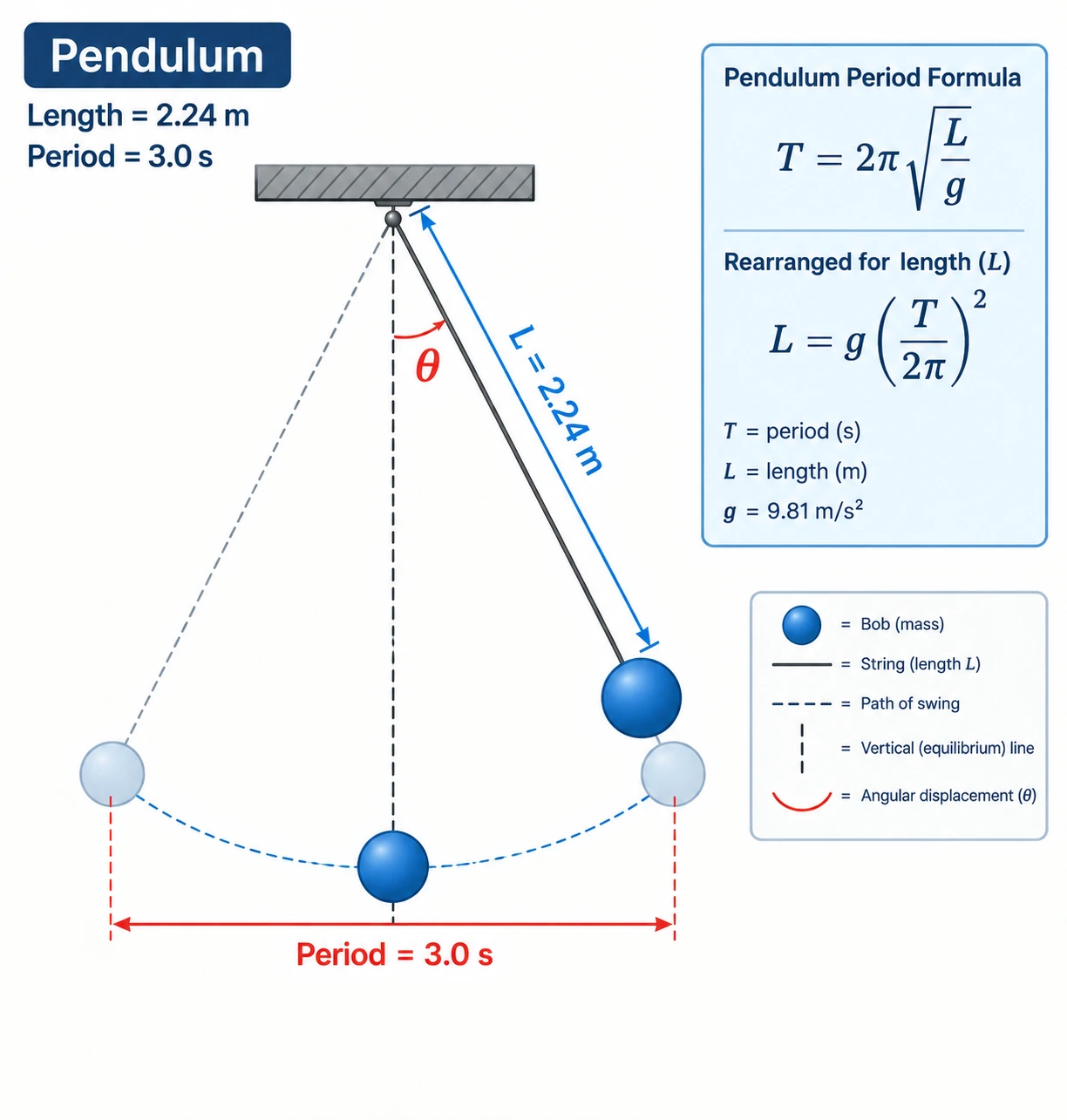
Finding the Length for a 3-Second Period
A clockmaker wants a pendulum that completes one full swing every 3.0 seconds. The clock will run at sea level, so g = 9.80665 m/s². The question is what length to cut the rod.
Start with the rearranged formula: L = g · T² / (4π²).
Square the period: 3.0² = 9.0.
Multiply by gravity: 9.80665 × 9.0 = 88.25985.
The denominator is 4π² ≈ 39.4784.
Divide: 88.25985 / 39.4784 ≈ 2.2356 m.
So the rod needs to be about 2.24 meters long. The calculator would return that length automatically if you typed 3.0 into the period field. It would also report the frequency: f = 1/3 ≈ 0.3333 Hz, or about 20 oscillations per minute. The angular frequency would be 2π/3 ≈ 2.094 rad/s. If the clock instead needed a 2-second period, the length would drop to roughly 0.994 m, the classic seconds pendulum.

Pendulum Lengths and Periods in Real Systems
The table below lists pendulum-like systems you might encounter, with their approximate lengths and periods at Earth gravity. The values are reference points from published sources or standard definitions. They are not outputs of the calculator unless you enter the same length and gravity.
Simple Pendulum vs Physical Pendulum
A simple pendulum treats the bob as a point mass on a massless string. A physical pendulum treats the swinging body as an extended rigid object with a moment of inertia and a center of mass offset from the pivot. The simple model is a special case of the physical model where all the mass sits at the end of a massless rod.
The simple model wins when the bob is small relative to the string and the string mass is negligible. A lab pendulum with a steel ball on a fine thread fits. The physical model wins when the swinging body has significant extent: a uniform rod, a clock pendulum with a heavy bob and a visible rod, or a compound object hung from a pivot. The calculator implements the simple pendulum only. If you need the physical pendulum period, compute the equivalent length L_eq = I/(md) and enter that into the length field. The tool will then return the correct small-angle period for the physical pendulum.
What Factors Affect Pendulum Period?
The period is set by length and gravity in the simple model. Mass and amplitude drop out, provided the swing stays small. Real-world deviations come from the assumptions the model makes. The list below covers the factors that move a measured period away from the formula.
Length: raising L increases the period. The relationship is a square root, so quadrupling length doubles the period.
Gravity: raising g decreases the period. A pendulum on the Moon swings more slowly than the same pendulum on Earth.
Amplitude: the simple formula ignores it, but real periods grow with wide swings. At 30°, the true period is about 4.5% longer than the formula. Pendulum motion is an example of periodic motion, whereas a launched object’s path can be analyzed using our Projectile Motion Calculator to determine its trajectory, range, and time of flight.
String mass: a heavy string adds inertia near the pivot and slightly lengthens the period. A light thread minimizes the effect.
Bob size: a large bob has its own moment of inertia and makes the pendulum physical rather than simple. The formula underestimates the period if the bob is large relative to the string.
Air resistance and friction: damping removes energy and shrinks amplitude over time. Light damping also lowers the frequency slightly.
Temperature: a metal rod expands when heated, so a clock pendulum runs slow in warm weather unless compensated.
Frequently Asked Questions
What is a seconds pendulum?
A seconds pendulum has a period of exactly 2 seconds, one second for each direction. At standard Earth gravity, its length is about 0.994 m. Grandfather clocks use this length because the escapement advances one tooth per second.
Does the mass of the bob affect the period?
No. In the simple pendulum model, mass cancels out. A heavier bob has more gravitational restoring force but also more inertia, so the period stays the same. Real bobs that are large relative to the string can shift the period because they make the pendulum physical rather than simple.
How do I find the length for a specific period?
Rearrange the formula: L = g · T² / (4π²). For a 2-second period on Earth, that gives about 0.994 m. The calculator does the rearrangement automatically if you type the period into the period field.
Why does my measured period differ from the calculator?
The most common reasons are a swing angle above 15°, a length measured to the wrong point on the bob, or a string heavy enough to add inertia. Air resistance and pivot friction also lengthen the measured period slightly.
What is the difference between period and frequency?
Period is the time for one full cycle. Frequency is the number of cycles per second. They are reciprocals: f = 1/T. A pendulum with a 2-second period has a frequency of 0.5 Hz.
Can I use this calculator for a pendulum on the Moon?
Yes. Enter the Moon’s gravitational acceleration, about 1.62 m/s², into the gravity field. The same length will produce a longer period than on Earth.
How does length change the period?
Period scales with the square root of length. Doubling the length multiplies the period by about 1.41. Quadrupling the length doubles the period.
What counts as a small angle for a pendulum?
Under about 15°, the sine of the angle differs from the angle in radians by roughly 1%, so the formula stays close. At 30° the error is about 4.5%, and at 45° it reaches about 10%.
Disclaimer
This calculator is an educational and preliminary-estimate tool. It uses the small-angle simple pendulum formula and does not account for large-amplitude corrections, physical pendulum inertia, damping, or driving forces. Do not use it as the sole basis for safety-critical timing, structural, or geophysical decisions. For clock design or precision measurement, validate the result against a physical model or a qualified engineer’s analysis.