
Compute angular acceleration from torque and moment of inertia, or from a change in angular velocity over time, with results in rad/s², deg/s² and rev/s².
α = τ / I, where τ is torque in N·m and I is moment of inertia in kg·m². This is the fundamental definition of angular acceleration.α = τ / I. The direction of α matches the direction of net torque, following the right-hand rule. The optional radius lets the calculator also report tangential acceleration (a_t = α × r) and the equivalent force (F = τ / r).α = (ω − ω₀) / Δt. Average angular acceleration over the interval. If Δt is very short, this approaches the instantaneous α, assuming uniform angular acceleration.| Unit | Symbol | Value |
|---|
| Property | Value |
|---|
| Quantity | Value |
|---|
| # | α (rad/s²) | Input | Time |
|---|
-
Select a citation style above. Click the citation text to select it all, then copy.
ADVERTISEMENT









Founder & CEO, Toolraxy
Faiq Ur Rahman is a web designer, digital product developer, and founder of Toolraxy, a growing platform of web-based calculators and utility tools. He specializes in building structured, user-friendly tools focused on health, finance, productivity, and everyday problem-solving.
User Ratings:
ADVERTISEMENT
ADVERTISEMENT
Angular acceleration (α) is the time rate of change of angular velocity. In SI units it’s measured in radians per second squared (rad/s²), and it describes how quickly a rotating object’s spin rate is increasing or decreasing. The symbol is the Greek letter alpha, and the quantity is a pseudovector in three dimensions, its direction follows the right-hand rule and points along the axis of rotation . In two-dimensional problems, a positive α means counterclockwise angular speed is increasing (or clockwise speed is decreasing), while a negative α means the opposite .
Practitioners encounter angular acceleration in two distinct contexts. The first is dynamics: you know the torque applied to a shaft and the moment of inertia of what’s bolted to it, and you need to know how fast it will spin up. Motor sizing, flywheel design, and robotics joint control all live here. The second is kinematics: you measure or specify a starting spin rate and an ending spin rate over some time window, and you need the average α. This is common in testing, troubleshooting, and physics coursework. The calculator handles both, and the units span the gap between SI (rad/s²) and the shop-floor language of RPM per second or revolutions per second squared.
Pick torque mode, enter the torque and moment of inertia in whatever units you have on hand, and press nothing, the result appears as you type. Here’s the sequence:
Select Torque & inertia in the calculation method section.
Enter the torque value (τ). The default is 10 N·m, but you can switch to lb·ft, lb·in, kgf·m, or dyn·cm.
Enter the moment of inertia (I). Use the presets if you want a starting point: small disk (0.5), bicycle wheel (2), flywheel (10), or large rotor (50) kg·m².
Optionally add a radius to the applied force if you need tangential acceleration or the equivalent force at that radius.
Read the large output: α in rad/s², with the verdict banner explaining whether the acceleration is small, moderate, or high.
Check the unit table below for the same α expressed in deg/s², rev/s², rev/min², RPM/s, and RPM/min.
Copy or share the summary if you need the numbers elsewhere.
The core relationship is one line: α = τ / I, where τ is net torque in newton-meters and I is moment of inertia in kilogram-meter squared. This is Newton’s second law for rotation, the rotational twin of F = ma . A second route exists when you don’t know the torque but you do know how the spin rate changed: α = (ω − ω₀) / Δt, where ω and ω₀ are final and initial angular velocities in rad/s, and Δt is the time interval in seconds .
The tool’s internal conversion layer does the unit work before the division. Torque in lb·ft gets multiplied by 1.3558 to reach N·m; inertia in lb·ft² gets multiplied by 0.04214 to reach kg·m². Angular velocity in RPM gets multiplied by 2π/60 to reach rad/s. No rounding happens until display, so the underlying α is computed at full double precision. The output unit table then multiplies that single rad/s² value by the appropriate factor for each row, 180/π for deg/s², 1/(2π) for rev/s², and so on. The tool does not model friction, air resistance, or variable torque. It assumes the torque and inertia you entered are the net values relevant to the axis of rotation.
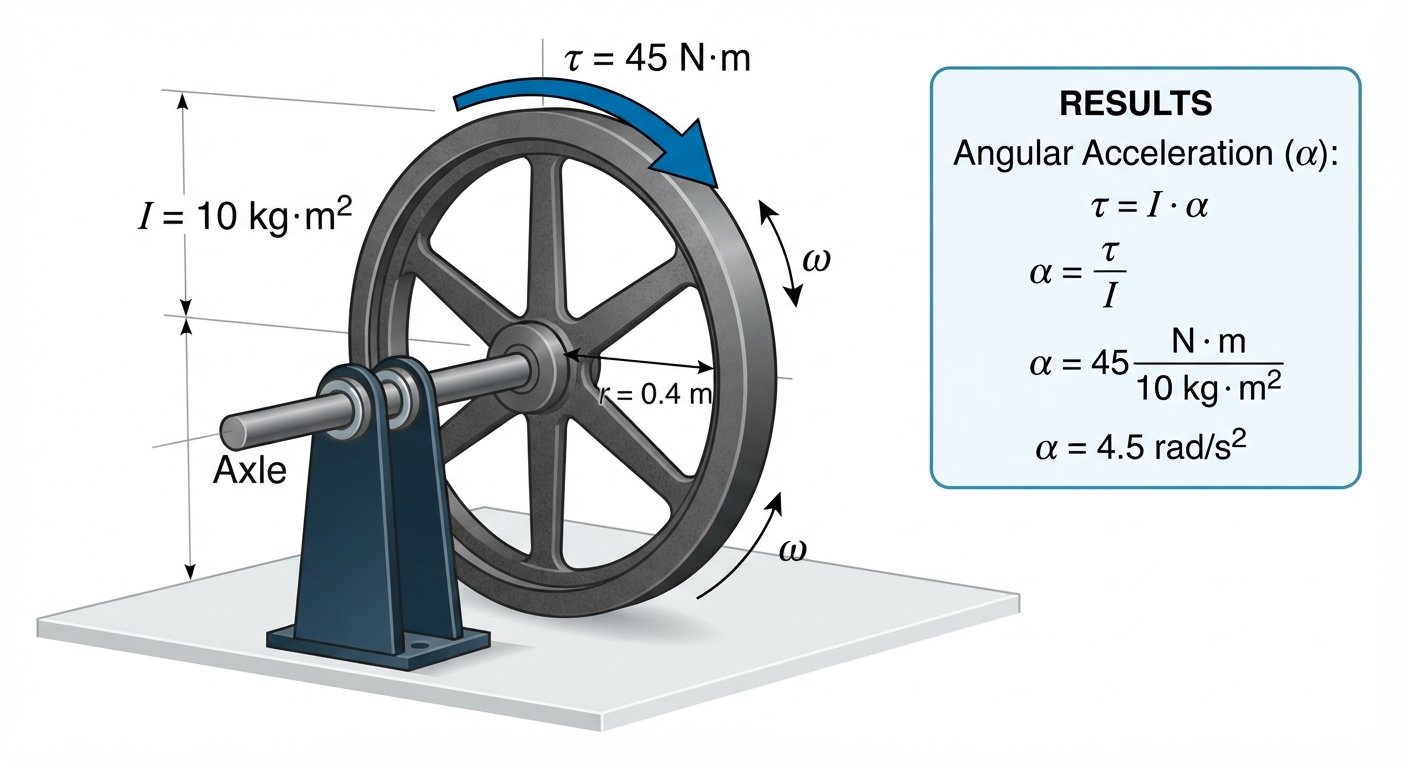
Suppose you’ve got a flywheel with a moment of inertia of 10 kg·m² (one of the presets), and a motor applies 45 N·m of torque through a belt drive. You want to know the angular acceleration and whether it falls within a reasonable range for the drive train.
Set torque mode, enter τ = 45 and I = 10. The tool computes α = 45 / 10 = 4.5 rad/s². The verdict banner reads “moderate angular acceleration”, the spin rate changes noticeably but stays within common mechanical ranges. The unit table shows 257.8 deg/s², 0.716 rev/s², and 42.97 RPM/s. If you want the tangential acceleration at the flywheel rim and you enter a radius of 0.4 m, the derived block adds a_t = 4.5 × 0.4 = 1.8 m/s² and the equivalent force at that radius as 45 / 0.4 = 112.5 N.
Now flip to velocity mode with different numbers. A washing machine drum spins up from rest to 1,200 RPM in 8 seconds, a scenario that appears in real appliance testing . Enter ω₀ = 0 RPM, ω = 1,200 RPM, Δt = 8 s. The tool converts 1,200 RPM to 125.66 rad/s, then α = 125.66 / 8 = 15.71 rad/s². The verdict banner shifts to “high angular acceleration,” which matches the rapid spin-up a drum experiences. The derived block reports angular displacement as 502.65 rad and total revolutions as about 80.
The table below gives order-of-magnitude moment of inertia values for objects you might encounter when using the torque mode. These are not tool outputs, they’re reference ranges drawn from textbook geometry and manufacturer data, useful when you don’t have a measured I and need a defensible starting point. Actual values depend on mass distribution, which is why the ranges are wide.
| Object | Moment of inertia range (kg·m²) |
|---|---|
| Small disk (0.1 m radius, 1 kg) | 0.005–0.01, depends on thickness and density profile |
| Bicycle wheel (rim and tire dominant) | 0.07–0.22, varies with rim depth and tire mass |
| Automotive flywheel (passenger car) | 0.1–0.3, dual-mass units trend higher |
| Industrial flywheel (energy storage) | 10–50, scales with rim mass and radius squared |
| Large electric motor rotor (embedded, 4-pole) | 0.08–0.33, from Siemens 1FE1 series data |
| Washing machine drum (empty) | 0.05–0.15, plastic tubs lower, stainless higher |
The bicycle wheel range reflects the difference between a lightweight climbing wheel and a deep-section aero wheel with a heavy rim. The motor rotor values come from published rotor inertia figures in Siemens’ embedded motor configuration manual, where a 1FE1115 frame lists 0.105 kg·m² and larger frames climb toward 0.33 kg·m² . For flywheels, the range spans everything from a small prototype to a grid-scale unit, which is why the spread is an order of magnitude rather than a tight band.
The core difference is what’s changing: linear acceleration measures how fast straight-line velocity changes (m/s²), while angular acceleration measures how fast rotational velocity changes (rad/s²). They’re connected through the radius, but they aren’t the same quantity and they don’t have the same units. A point on a spinning disk has both, tangential acceleration from the spin rate changing, and centripetal acceleration from the direction changing even at constant speed.
| Dimension | Angular acceleration (α) | Linear acceleration (a) |
|---|---|---|
| What changes | Angular velocity (ω), in rad/s | Linear velocity (v), in m/s |
| SI unit | rad/s² | m/s² |
| Caused by | Net torque (τ) | Net force (F) |
| Inertia analogue | Moment of inertia (I) | Mass (m) |
| Newton’s second law form | τ = Iα | F = ma |
| Connection to the other | a_t = α × r at radius r | α = a_t / r for a point at radius r |
α = τ / I when you know torque and moment of inertia, or α = (ω − ω₀) / Δt when you know the change in angular velocity over time. The first is Newton’s second law for rotation; the second is the kinematic definition of average angular acceleration.
Divide the net torque by the moment of inertia. A 20 N·m torque on a 4 kg·m² rotor gives α = 5 rad/s². The calculator converts your torque and inertia units to SI first, then divides.
The SI unit is radians per second squared (rad/s²). Engineers also use degrees per second squared (deg/s²), revolutions per second squared (rev/s²), and RPM per second (RPM/s). The calculator reports all of these from a single input.
Yes. A negative α means the angular velocity is decreasing in the direction defined as positive, deceleration. It does not necessarily mean the object is spinning backward; it means the spin rate is dropping .
Angular acceleration (α) describes how fast the spin rate changes. Centripetal acceleration (a_c = ω²r) describes the inward acceleration a point experiences because its direction is constantly changing, even at constant spin rate. A point on a disk can have both at once .
Convert the RPM values to rad/s first, then divide by the time interval in seconds. 600 RPM is 62.83 rad/s. If a shaft goes from 0 to 600 RPM in 5 seconds, α = 62.83 / 5 = 12.57 rad/s². The calculator’s velocity mode does the conversion for you.
Industrial flywheels span a wide range, from roughly 10 kg·m² for a small prototype to 50 kg·m² and above for energy storage units. Automotive flywheels sit lower, often 0.1–0.3 kg·m². The tool’s presets (10 and 50) correspond to the industrial end of that range.
This calculator is an educational and preliminary-design tool. It computes angular acceleration from the inputs you provide using the standard formulas τ = Iα and α = Δω/Δt. It does not account for friction, load variation, control system dynamics, material limits, or safety factors. Do not use its output as the sole basis for machinery sizing, structural design, or safety-critical decisions. Verify results against manufacturer data and applicable engineering standards before committing to a design.
The National Institute of Standards and Technology‘s NIST Handbook 44 provides the legal metrology framework for the SI unit conversions used throughout the calculator, though the specific conversion factors here follow the standard definitions of the radian and newton-meter.
The International Organization for Standardization‘s ISO 80000-4:2019 defines the quantities and units of mechanics, including torque and moment of inertia, and is the reference for the SI unit relationships the tool assumes .
OpenStax College Physics provides the textbook derivation of τ = Iα that underpins the torque-mode calculation, along with the rotational kinematics equations used in velocity mode.
Siemens AG‘s 1FE1 embedded motor configuration manual publishes rotor inertia values for its motor series, the source of the large-rotor range cited in the moment of inertia table .
Pearson‘s physics calculator documentation describes the distinction between tangential and centripetal acceleration for a point on a rotating body, referenced in the angular vs linear comparison .
Save My Exams‘ AP Physics 1 revision notes explain the sign convention for angular acceleration and the conditions under which α is positive or negative, used in the FAQ and the factors section
ADVERTISEMENT
ADVERTISEMENT