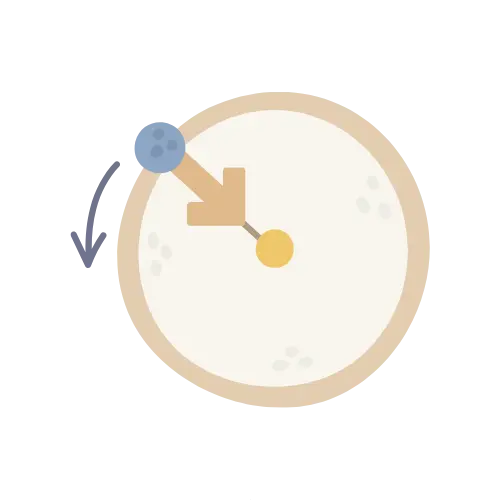

Compute centripetal force from mass, radius and linear velocity, angular velocity, or period. Results in N, kN, lbf and kgf.
F_c = m × v² / r, where v is the tangential speed at radius r. This is the classical form of centripetal force.F_c = m × v² / r, or equivalently F_c = m × ω² × r. Radius must be greater than zero; mass must be non-negative.F_c = m × ω² × r.| Unit | Symbol | Value |
|---|
| Property | Value |
|---|
| Quantity | Value |
|---|
| # | F_c (N) | Input | Time |
|---|
-
Select a citation style above. Click the citation text to select it all, then copy.
ADVERTISEMENT








Founder & CEO, Toolraxy
Faiq Ur Rahman is a web designer, digital product developer, and founder of Toolraxy, a growing platform of web-based calculators and utility tools. He specializes in building structured, user-friendly tools focused on health, finance, productivity, and everyday problem-solving.
User Ratings:
ADVERTISEMENT
ADVERTISEMENT
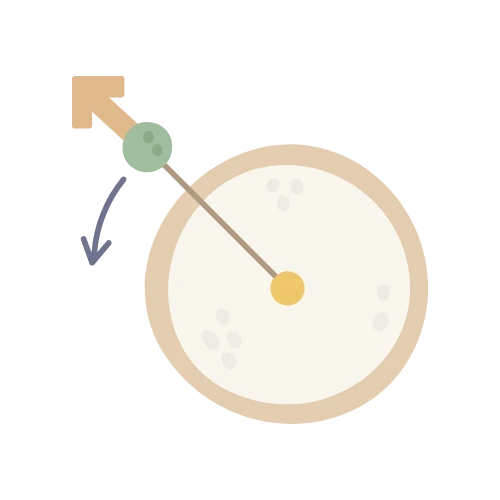
Centripetal force is the net inward force required to keep an object moving in a circular path. It points toward the center of the circle and its magnitude is m × v² / r, where m is mass, v is tangential speed, and r is the circle’s radius . Without it, Newton’s first law takes over and the object travels in a straight line tangent to its path . The term comes from Latin: centrum (center) and petere (to seek).
This is a real force in the inertial frame, unlike centrifugal force, which is an inertial pseudo-force that appears only in a rotating reference frame . The centripetal force is supplied by whatever physical interaction is available: tension in a string, gravity for a satellite, friction for a car tire, the normal force on a banked curve . The calculator computes the required magnitude; identifying which real force supplies it is the physics problem you solve separately.
The formula has two equivalent forms. In terms of linear velocity, F_c = m v² / r. In terms of angular velocity, F_c = m ω² r. Both give the same number when v = ωr . The squared dependence on speed is the practical takeaway: doubling the speed of a turn quadruples the force required to hold it.
Enter mass and radius, choose linear velocity mode, type the tangential speed, and read the force in newtons. The formula is F_c = m × v² / r, and the tool applies it after converting all units to SI. Here is the sequence:
Select Linear velocity in the Calculation method panel.
Enter the mass. The default is 1 kg.
Choose the mass unit: kg, g, lb, oz, or tonnes.
Enter the radius. The default is 1 meter.
Choose the radius unit: m, cm, mm, km, in, or ft.
Enter the linear velocity. The default is 10 m/s.
Choose the velocity unit: m/s, km/h, ft/s, or mph.
Read the centripetal force in newtons from the red headline figure.
Check the Centripetal force in all units table for kN, MN, lbf, kgf, and dynes.
Review Derived quantities for centripetal acceleration, g-force, angular velocity, period, and RPM.
Centripetal force equals mass times the square of tangential speed divided by radius, or equivalently mass times the square of angular velocity times radius. The calculator implements both forms, selecting the right one for each mode:
Formula: F_c = m × v² / r when you know linear velocity.
Formula: F_c = m × ω² × r when you know angular velocity.
Formula: F_c = m × ω² × r with ω = 2π / T when you know the period.
m is mass in kilograms. v is tangential speed in m/s. r is radius in meters. ω is angular velocity in rad/s. T is the period in seconds. The two formulas are algebraically identical when v = ωr, which is the relationship between linear and angular speed for a point on a rotating body .
The period mode converts T to ω first, then applies the angular formula. This matters because period is often the easiest quantity to measure directly, time one full orbit or one full swing, and you have T without needing to know the speed.
A 1 kg ball swings on a 1-meter string at a tangential speed of 10 m/s. Enter 1 in the mass field with kg selected, 1 in the radius field with m selected, and 10 in the linear velocity field with m/s selected. The calculator applies F_c = m × v² / r.
The arithmetic is 1 × (10)² / 1 = 100 newtons. The unit table fills in the rest: 0.1 kN, about 22.48 lbf, and about 10.20 kgf. The derived quantities show a centripetal acceleration of 100 m/s², which is about 10.2 times Earth’s gravity.
The verdict banner calls this moderate centripetal force, placing it in the 10 to 1,000 N band. That band is the tool’s own heuristic, not a published standard. A 100 N force on a 1 kg mass is substantial about the weight of a 10 kg object and is the kind of load a string would need to withstand.
A sanity check confirms the result. The angular velocity is v / r = 10 / 1 = 10 rad/s. The period is 2π / 10 ≈ 0.628 seconds. Applying the angular formula: F_c = 1 × (10)² × 1 = 100 N. Both paths give the same number.

| Scenario | Typical force magnitude and context |
|---|---|
| Ball on a 1 m string at 2 m/s | ~4 N, gentle swing |
| Car tire gripping a 50 m highway curve at 25 m/s | ~7,800 N per 1,000 kg of vehicle, friction-dependent |
| Washing machine drum at 1,200 RPM with 0.3 m radius and 1 kg load | ~4,700 N, typical spin-cycle force |
| Satellite in low Earth orbit | Gravity provides the centripetal force; for a 1 kg mass it is about 9 N |
| Electron in a hydrogen atom (Bohr model) | ~8 × 10⁻⁸ N, electromagnetic force |
Centripetal force depends on mass, radius, and speed, with speed squared dominating the result. The calculator takes those inputs directly; it does not model how a system’s speed changes when you alter its physical properties.
Speed sets force proportionally to its square. Doubling the tangential speed quadruples the centripetal force required .
Radius sets force inversely. A tighter turn (smaller radius) requires more force at the same speed.
Mass sets force linearly. A heavier object needs proportionally more force to follow the same path at the same speed.
Speed input mode changes how you enter the value but not the physics. v, ω, and T all resolve to the same speed before the formula applies.
Source of force determines whether the motion is possible. If the available force (friction, tension, gravity) falls short of m v² / r, the object leaves its circular path . The calculator does not check whether the force is available—it only computes what’s required.
Radius measurement point matters in extended objects. For a rigid body, different points move at different linear speeds; using a single radius assumes a point mass or a specific point of interest.
Centripetal force is the inward pull that keeps an object moving in a circle. Without it, the object would fly off in a straight line tangent to its path. For a ball on a string, the string supplies it; for a car, friction does; for a satellite, gravity does.
Use F_c = m v² / r, where m is mass in kg, v is tangential speed in m/s, and r is radius in meters. The equivalent angular form is F_c = m ω² r. The calculator accepts either speed measure .
The two equivalent forms are F_c = m v² / r and F_c = m ω² r. They’re connected by the relationship v = ωr, which links linear and angular speed for a point on a rotating body .
Convert period to angular velocity with ω = 2π / T, then apply F_c = m ω² r. The calculator’s period mode does this automatically.
No. Centripetal force is the real inward force in an inertial frame; centrifugal force is a pseudo-force that appears in a rotating frame. They have the same magnitude but opposite directions and different physical status .
Whatever real interaction is available: tension in a string, gravity for an orbit, friction for a turning car, the normal force on a banked curve, or the electromagnetic force for an electron in an atom . The calculator computes the required magnitude; identifying the source is the physics problem.
In this calculator, no, the output is a magnitude. In vector terms, the force points toward the center of the circle, and its direction changes continuously as the object moves. The scalar magnitude is always positive.
The formula produces zero force in the linear velocity form, and an invalid result in the angular velocity form. A radius of zero means no circular motion. The calculator’s validation catches this in the angular mode and returns a zero result in the linear mode.
Yes, linearly. A heavier object needs more force to follow the same path at the same speed. The acceleration (v² / r) is independent of mass, but the force is not.
For a satellite in low Earth orbit, gravity supplies the centripetal force. For a 1 kg mass, the force is about 9 N roughly the same as its weight at Earth’s surface, since gravity is only slightly weaker at orbital altitude . The satellite stays in orbit because its tangential speed is high enough that the curved path matches Earth’s curvature.
This calculator performs arithmetic on the values you enter. It does not provide engineering, physics, or safety advice. Results describe the required centripetal force magnitude for uniform circular motion under the assumptions stated in the Limitations section. For design work involving rotating machinery, vehicles, or safety-critical systems, verify results against the applicable standard and a qualified engineer’s judgment.
The definition of centripetal force as the net inward force required for circular motion, and the formula F_c = m v² / r, follow the treatment in the Physics Classroom’s circular motion materials .
The derivation of the centripetal acceleration a_c = v² / r and its relationship to angular velocity through v = ωr is covered in the Saint Anselm College physics notes on centripetal force .
ADVERTISEMENT
ADVERTISEMENT