
Convert between RPM and RCF (relative centrifugal force, ×g), Enter the rotor radius and either RPM or RCF.
RCF = 1.118 × 10⁻⁵ × r × RPM², with r in centimetres. Some rotor manuals list rmin, ravg and rmax; use ravg for average force or rmax for the maximum RCF at the tube bottom.| Quantity | Unit | Value |
|---|
| Property | Value |
|---|
| Quantity | Value |
|---|
| # | RCF (×g) | RPM | Radius | Time |
|---|
-
Select a citation style above. Click the citation text to select it all, then copy.
ADVERTISEMENT







Founder & CEO, Toolraxy
Faiq Ur Rahman is a web designer, digital product developer, and founder of Toolraxy, a growing platform of web-based calculators and utility tools. He specializes in building structured, user-friendly tools focused on health, finance, productivity, and everyday problem-solving.
User Ratings:
ADVERTISEMENT
ADVERTISEMENT
A protocol says “spin at 12,000 ×g” but your centrifuge only displays RPM. Or a paper reports 15,000 RPM, and you need to know what force that actually represents on your rotor. The conversion depends on one number most people forget: the rotor radius. This calculator takes your radius in centimeters, inches, millimeters, or meters, and converts between RPM and RCF in both directions. Type in either field and the other updates.
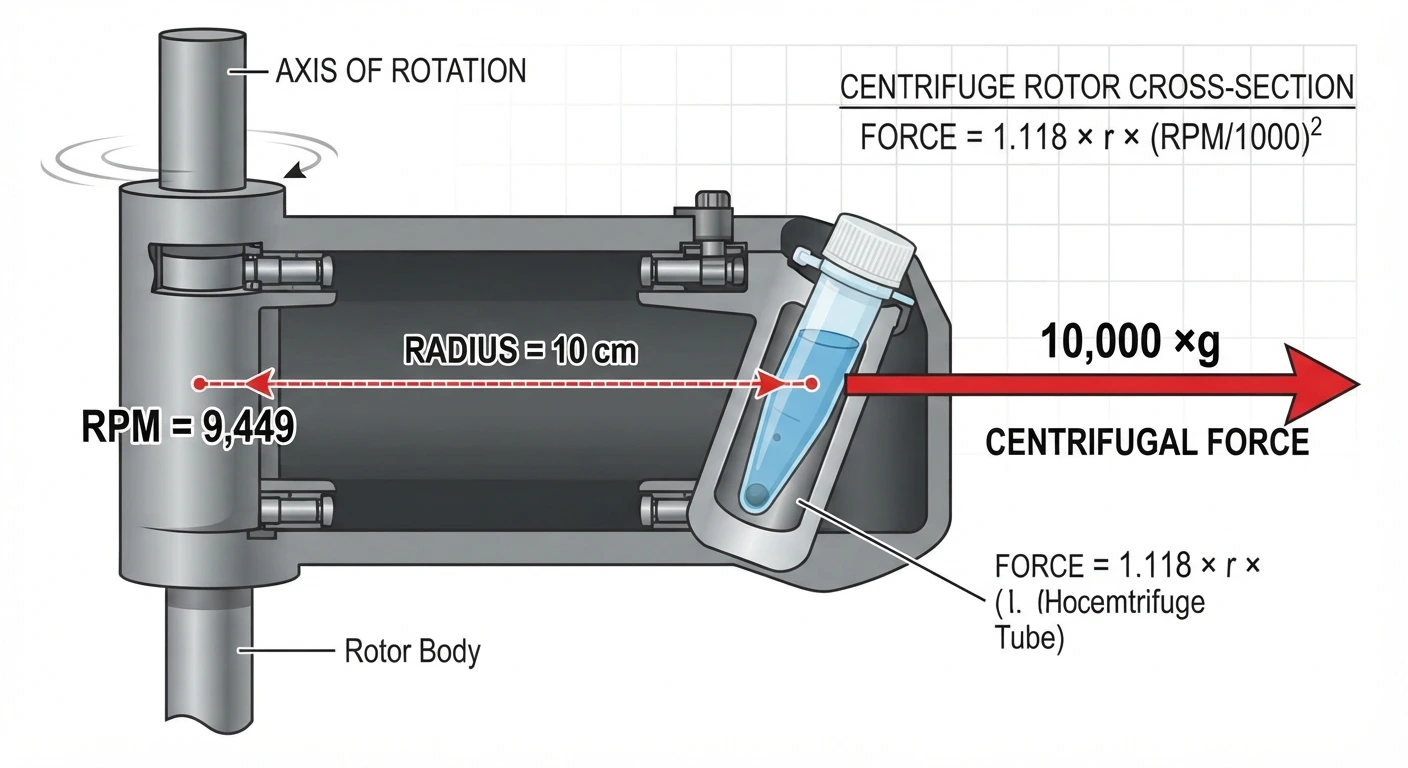
Relative centrifugal force (RCF) is the force applied to a sample in a centrifuge, expressed as a multiple of Earth’s gravity. An RCF of 10,000 ×g means the sample experiences 10,000 times the force of gravity . RCF is the standard way to report centrifugation conditions because it stays constant across different centrifuges and rotors, while RPM does not .
The distinction matters because RPM measures rotational speed, how many full turns the rotor makes per minute but the actual force on a sample depends on how far it sits from the axis of rotation. A sample near the rotor’s edge experiences more force than one near the center, even at the same RPM. The formula RCF = 1.118 × 10⁻⁵ × r × RPM² captures this relationship, where r is the radius in centimeters . The constant 1.118 × 10⁻⁵ comes from dividing the centripetal acceleration (ω²r) by standard gravity (9.80665 m/s²) and handling the unit conversions.
Laboratory protocols increasingly specify RCF rather than RPM for exactly this reason. The journal Autophagy states plainly that “12,000 RPM is not equivalent to 12,000 ×g,” and requests authors report g-force so other labs can reproduce the work on different equipment . When a protocol says “centrifuge at 10,000 ×g,” you need your rotor’s radius to find the matching RPM on your machine.
Enter the rotor radius, then type the RPM value into the right-hand field. The RCF appears in the left-hand field and in the headline figure. The formula is RCF = 1.118 × 10⁻⁵ × r × RPM², with r in centimeters . Here is the sequence:
Enter the rotor radius. The default is 10 cm.
Choose the radius unit: centimeters, millimeters, meters, or inches.
Type the RPM value into the Revolutions per minute field.
The Relative centrifugal force field updates automatically with the ×g value.
Read the RCF from the red headline figure.
Check the Result in all forms table for centripetal acceleration and angular velocity.
Review Derived quantities for tip speed and revolutions per second.
The calculator uses one formula in both directions. To find RCF from RPM: RCF = 1.118 × 10⁻⁵ × r × RPM². To find RPM from RCF: RPM = √(RCF / (1.118 × 10⁻⁵ × r)).
Formula: RCF = 1.118 × 10⁻⁵ × r × RPM²
r is the rotor radius in centimeters. RPM is the rotational speed. The constant 1.118 × 10⁻⁵ is an approximation that combines the 2π conversion from RPM to rad/s, the square of that conversion, and the division by standard gravity . Some sources use 1.12 × 10⁻⁵ or 11.2 × (RPM/1000)² × r; these are equivalent within rounding .
A protocol specifies 10,000 ×g, and your rotor has a 10 cm radius. Enter 10 in the radius field with cm selected, then type 10000 into the RCF field. The calculator solves for RPM.
Rearranging the formula: RPM = √(10,000 / (1.118 × 10⁻⁵ × 10)). The denominator is 1.118 × 10⁻⁵ × 10 = 1.118 × 10⁻⁴. Dividing 10,000 by that gives roughly 89,445,000. The square root is approximately 9,457 RPM.
The unit table confirms: centripetal acceleration is 10,000 × 9.80665 = 98,066.5 m/s², angular velocity is about 990.5 rad/s, and tip speed is about 99 m/s.
The verdict banner calls this medium-speed centrifugation, placing it in the 1,000–20,000 ×g band. That band is the tool’s own heuristic, not a published standard.
A sanity check confirms the result. At 9,457 RPM, the RCF formula gives 1.118 × 10⁻⁵ × 10 × (9,457)². Squaring 9,457 gives about 89.4 million. Multiplying by 10 and then by 1.118 × 10⁻⁵ gives approximately 10,000. The round trip works.
The table below places the calculator’s output range against real centrifugation applications, using RCF bands reported in laboratory equipment documentation and protocol guidelines.
| Application or centrifuge class | Typical RCF range |
|---|---|
| Low-speed centrifuge (cell pelleting, large debris) | Under 1,000 to about 5,000 ×g |
| Medium-speed (mitochondria, chloroplasts) | 1,000 to 20,000 ×g |
| High-speed centrifuge (organelles, membranes, proteins) | 15,000 to 110,000 ×g |
| Ultracentrifuge (ribosomes, viruses, DNA) | 100,000 to 1,000,000 ×g |
| Blood banking protocols | Typically 2,000 to 3,000 RPM, force varies with rotor |
The spread runs from a few thousand ×g for routine cell work to a million ×g for subcellular fractionation. The calculator’s verdict bands map roughly to these categories, though the boundaries are heuristic.
RPM measures rotational speed, how many full turns the rotor completes per minute while RCF measures the actual force applied to the sample as a multiple of gravity. The two are related through the rotor radius, but they are not interchangeable .
The table below isolates the differences that matter when you’re deciding which value to use.
| Dimension | RPM vs RCF (relative centrifugal force) |
|---|---|
| What it measures | RPM: rotational speed of the rotor, in revolutions per minute. RCF: force on the sample, in multiples of Earth’s gravity (×g) . |
| Dependence on equipment | RPM: specific to the machine and rotor; the same RPM produces different forces on different rotors. RCF: independent of the machine; the same ×g produces the same force on any centrifuge with the right RPM . |
| What it tells you about the sample | RPM: only how fast the rotor spins. RCF: how much force the sample actually experiences, which determines sedimentation rate and separation . |
| Reporting standard | RPM: still displayed on most centrifuge control panels. RCF: the preferred unit in protocols and journals because it enables reproducibility across labs . |
| What the calculator does | Converts between the two using the rotor radius. Enter either value and the tool computes the other. The formula is RCF = 1.118 × 10⁻⁵ × r × RPM², with r in cm. |
The practical consequence is that a protocol written in RPM is only reproducible if the rotor is specified. A protocol written in RCF is reproducible on any centrifuge once you know the radius. This is why journals like Autophagy request RCF and why equipment manufacturers publish RCF conversion tables alongside RPM ranges .
RPM is rotational speed how many turns per minute. RCF is the actual force on the sample, expressed as a multiple of gravity. They’re related through rotor radius, but the same RPM produces different forces on different rotors .
Use RCF = 1.118 × 10⁻⁵ × r × RPM², where r is the rotor radius in centimeters. Enter radius and RPM in the calculator, and the RCF appears in the other field .
Rearrange the formula: RPM = √(RCF / (1.118 × 10⁻⁵ × r)). The calculator does this automatically when you type into the RCF field.
Use the distance from the axis to the point of interest. For maximum force, use rmax (tube bottom). For average force, use ravg (tube midpoint). Rotor manuals list these values .
Because RCF is reproducible across different centrifuges. A protocol written in RPM only works on the same rotor; a protocol written in ×g works on any machine once you know the radius .
Routine cell pelleting typically uses 300–500 ×g for a few minutes. Organelle isolation uses higher forces, from 10,000 to 100,000 ×g depending on the organelle .
Ultracentrifuges can reach up to 1,000,000 ×g, used for separating viruses, ribosomes, and macromolecules .
Yes, if you know the rotor radius. The formula is universal; the only input that varies is r. The tool converts between RPM and RCF for any rotor size.
This calculator performs arithmetic on the values you enter. It does not provide laboratory, medical, or safety advice. Results describe the conversion between RPM and RCF for a given radius under the assumptions stated in the Limitations section. For protocol development and clinical applications, verify conversions against your rotor manual and a qualified supervisor’s judgment.
The formula RCF = 1.118 × 10⁻⁵ × r × RPM², with r in centimeters, is the standard conversion published by Thermo Fisher Scientific in its centrifuge best practices documentation .
The explanation that RPM and RCF are not interchangeable, and that RCF is preferred for reproducibility because it accounts for rotor radius, follows the editorial guidance published in the journal Autophagy .
The distinction between RPM as a speed measure and RCF as a force measure, and the dependence of RCF on rotor size, is described in the SpringerLink article on centrifugation in reproductive research .
The range of RCF values for high-speed centrifuges (15,000–110,000 ×g) and ultracentrifuges (100,000–1,000,000 ×g) comes from Drucker Diagnostics’ laboratory centrifuge classification guide .
The note that rotor manuals list rmin, ravg, and rmax, and that force varies along the tube length, appears in the centrifugation appendix published by the Food and Agriculture Organization .
The alternative form of the constant as 11.2 × (RPM/1000)² × r, equivalent to 1.12 × 10⁻⁵ × RPM², is documented in the FAO’s centrifugation notes .
ADVERTISEMENT
ADVERTISEMENT