What Is Centrifugal Force?
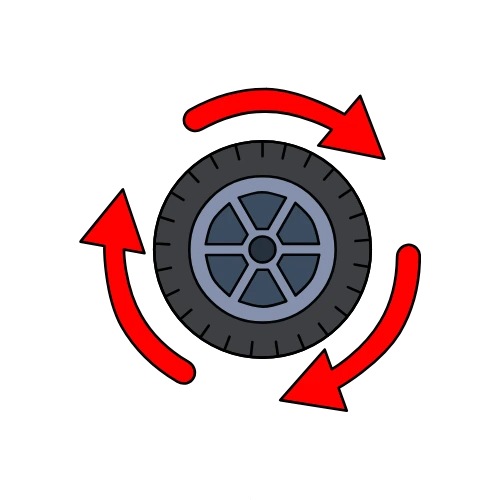
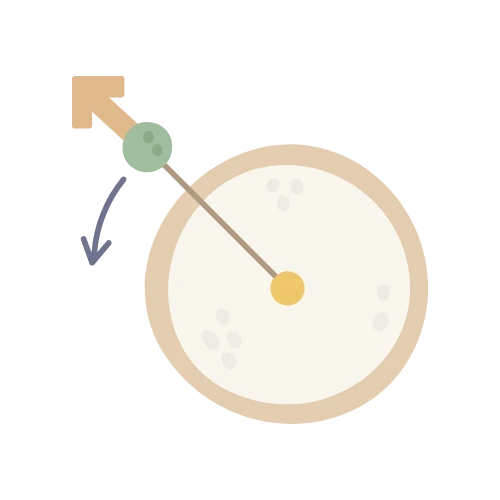
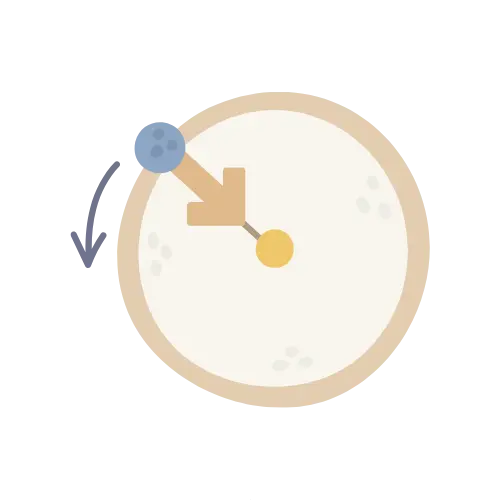
Centrifugal force is the outward-directed inertial force that appears to act on a mass when its motion is described in a rotating reference frame. It is not a real force in the Newtonian sense, no physical agent pushes the object outward. Instead, it is a pseudo-force, a bookkeeping term that arises because the rotating frame is accelerating . In the inertial frame, the only real force on a mass moving in a circle is the inward centripetal force; the sensation of being “flung outward” is inertia trying to carry the object in a straight line while the centripetal force bends its path .
Engineers and technicians still use the centrifugal force concept because it makes rotating-frame calculations intuitive. When you stand in a centrifuge lab and say a sample experiences “500 g,” you’re describing the centrifugal acceleration in the rotor’s frame. The magnitude is the same either way: F = m × ω² × r, where m is mass, ω is angular velocity in rad/s, and r is the distance from the axis of rotation . The formula gives the force needed to keep the mass in circular motion (centripetal) or the apparent outward force in the rotating frame (centrifugal). The number is identical; the interpretation depends on which frame you’re standing in.
Centrifugal Force Formula: Mass, Radius, and Angular Velocity
Centrifugal force equals mass times the square of angular velocity times radius. The calculator implements this in all three speed modes, converting the input to rad/s first:
Formula: F = m × ω² × r
m is mass in kilograms. ω is angular velocity in radians per second. r is the radius in meters. The result is in newtons.
In RPM mode, the tool derives ω = RPM × 2π / 60 before applying the formula. In angular velocity mode, it converts the input unit to rad/s using the factors π/180 for deg/s, 2π for rev/s, and 2π/60 for RPM. In linear velocity mode, it derives ω = v / r, where v is the tangential speed in m/s.
The formula shows the two variables that dominate the result: angular velocity is squared, so doubling RPM quadruples the force. Radius is linear, so doubling radius doubles the force at the same RPM. Mass is also linear. This squared dependence on speed is why high-speed centrifuges are built with such tight tolerances, a small increase in RPM produces a disproportionately large increase in load .
A 1 kg Mass at 1500 RPM on a 0.5 m Radius
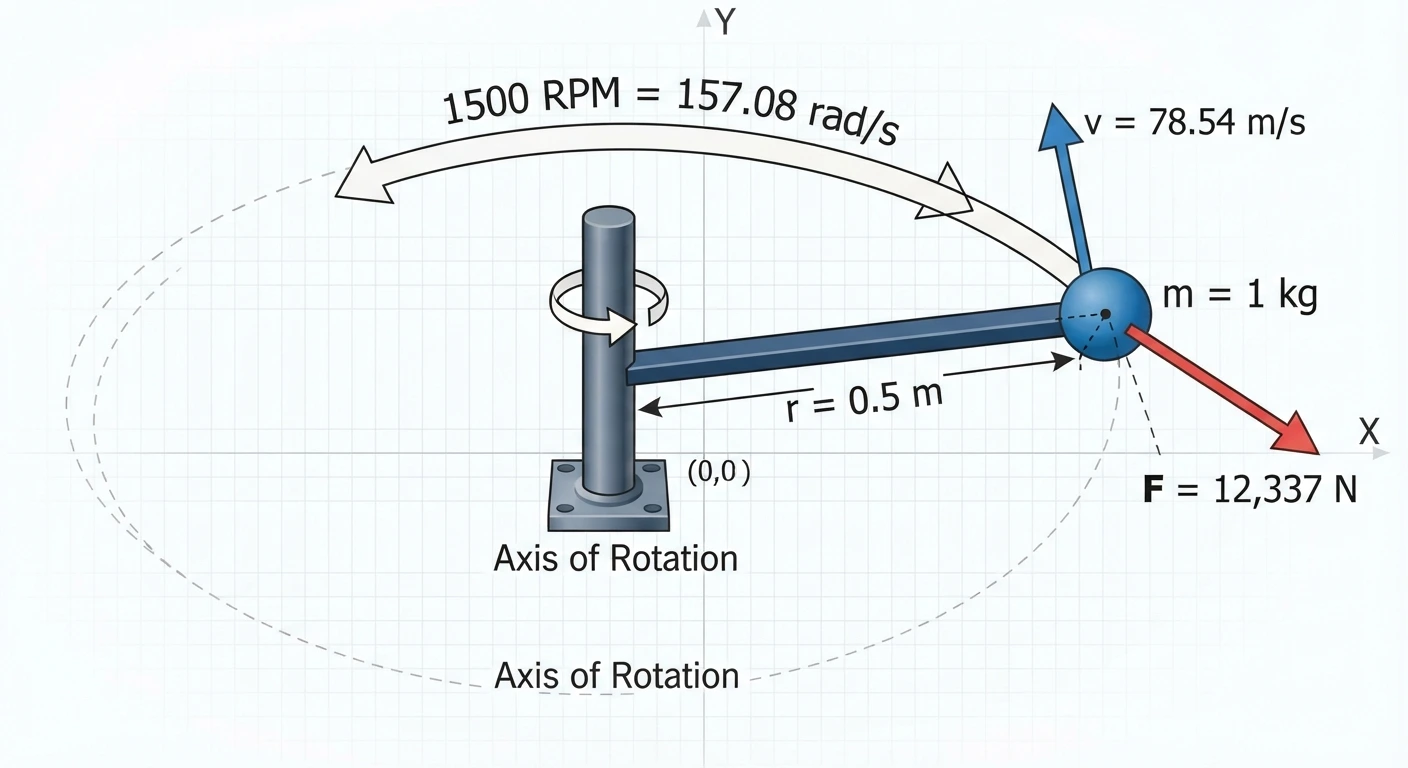
Take a 1 kg mass mounted 0.5 meters from the axis of rotation, spinning at 1500 RPM. Enter 1 in the mass field with kg selected, 0.5 in the radius field with m selected, and 1500 in the RPM field. The calculator converts RPM to angular velocity first.
The conversion is ω = 1500 × 2π / 60 = 50π ≈ 157.08 rad/s. Then the force is F = 1 × (157.08)² × 0.5. Squaring 157.08 gives roughly 24,674. Multiplying by 0.5 gives 12,337 newtons, which is what the headline figure shows.
The unit table fills in the rest: about 12.34 kN, 2,773 lbf, and 1,258 kgf. The derived quantities show a centripetal acceleration of about 12,337 m/s², which is roughly 1,258 times Earth’s gravity, a g-force equivalent of 1,258 g.
The verdict banner calls this a large centrifugal force, placing it in the 1,000 to 100,000 N band. That band is the tool’s own heuristic, not a published safety threshold. A 1.25-tonne equivalent load is substantial for a lab-scale rotor but modest for industrial machinery.
A sanity check confirms the result. The tangential velocity is ω × r = 157.08 × 0.5 ≈ 78.54 m/s. The centripetal acceleration is v² / r = (78.54)² / 0.5 ≈ 12,337 m/s². The force is mass times acceleration: 1 kg × 12,337 m/s² = 12,337 N. Both paths give the same number.

What Factors Affect Centrifugal Force?
Centrifugal force depends on mass, radius, and angular velocity, with angular velocity squared dominating the result. The calculator takes those three inputs directly; it does not model how a system’s speed changes when you alter its physical properties.
Angular velocity sets F proportionally to its square. Doubling RPM quadruples the force, which is why speed control is the primary lever in centrifuge design .
Radius sets F linearly. A mass twice as far from the axis experiences twice the force at the same angular velocity.
Mass sets F linearly. A heavier sample experiences proportionally more force, though the g-force (force per unit mass) remains the same.
Speed input mode changes how you enter the value but not the physics. RPM, rad/s, and linear velocity all resolve to the same ω before the formula applies.
Radius measurement point matters in real rotors. The force varies along the sample tube, and the maximum force occurs at the furthest point from the axis often the tube bottom, not the midpoint .
Rotor geometry affects the radius used in practice. Switching from a small-radius rotor to a large-radius rotor at the same RPM changes the force significantly, which is why protocols often specify RCF (× g) rather than RPM .
Frequently Asked Questions
What is centrifugal force in simple terms?
Centrifugal force is the apparent outward push you feel when you’re in a rotating system, like a car going around a curve. It’s not a real force in the inertial frame, it’s inertia trying to carry you in a straight line while something else forces you to turn.
How do you calculate centrifugal force from RPM?
Convert RPM to angular velocity with ω = RPM × 2π / 60, then apply F = m × ω² × r. A 1 kg mass at 1500 RPM on a 0.5 m radius gives about 12,337 N .
What is the formula for centrifugal force?
F = m × ω² × r, where m is mass in kg, ω is angular velocity in rad/s, and r is radius in meters. The same magnitude is called centripetal force when viewed from an inertial frame .
Is centrifugal force real or fictitious?
It’s a pseudo-force, also called an inertial or fictitious force. It appears only in rotating reference frames. In the inertial frame, the only real force is centripetal, the inward force that keeps the object in its circular path .
What is the difference between centrifugal force and centripetal force?
Centrifugal points outward in a rotating frame; centripetal points inward in an inertial frame. They have the same magnitude mω²r but belong to different frames and have different physical status .
How does RPM affect centrifugal force?
Force scales with the square of RPM. Doubling RPM quadruples the force. A 10% RPM increase produces about a 21% force increase .
What is relative centrifugal force (RCF)?
RCF is the centrifugal acceleration expressed as a multiple of Earth’s gravity, RCF = ω²r / g₀. It’s used in centrifuge protocols because it normalizes for rotor radius, so the same RCF produces the same separation regardless of rotor size .
Can I use this calculator for a centrifuge?
Yes, if you enter the rotor radius and the operating RPM. The tool computes the force magnitude. For protocol work, convert to RCF by dividing the centripetal acceleration by 9.80665 .
What happens if the radius is zero?
The force is zero. A mass at the axis of rotation has no tangential velocity and experiences no centrifugal effect. The calculator returns a valid zero result for r = 0.
Does centrifugal force depend on mass?
The force is proportional to mass, but the g-force (force per unit mass) is independent of mass. A 1 kg sample and a 10 kg sample at the same radius and RPM experience the same g-force, but the 10 kg sample experiences ten times the total force.
Sources:
The definition of centrifugal force as an inertial pseudo-force appearing in rotating frames is documented in the EPFL physics course materials on rotating reference frames .
The distinction between centrifugal and centripetal forces, including their opposite directions and frame dependence, follows the treatment in the cosmos.ru physics notes on accelerated frames of reference .
The centripetal acceleration relationship a = ω²r and the force equation F = mω²r are derived in the ScienceDirect topic overview of centripetal force in centrifugation .
The formula F = mω²r for the force on a particle in a centrifuge, along with the practical example of 5,000 g at 0.4 m radius requiring about 3,345 RPM, appears in the ScienceDirect chapter on centrifugation techniques .
The squared dependence of centrifugal force on rotational speed, and the RCF normalization used in centrifuge practice, are documented in the Japanese Society of Medical Instrumentation paper on centrifugal force calculation .
The guidance to report RCF rather than RPM for reproducibility, and the recommendation to measure radius to the tube bottom rather than the midpoint, comes from the ConductScience RCF/RPM calculator documentation .
The explanation that centrifugal force does not exist in the inertial frame, and that the only real force in circular motion is centripetal, follows the Physics Classroom treatment of the centripetal force requirement .