
Compute the perpendicular force exerted by a surface on an object
Powered by Toolraxy · Physics & mechanics calculator

Founder & CEO, Toolraxy
Faiq Ur Rahman is a web designer, digital product developer, and founder of Toolraxy, a growing platform of web-based calculators and utility tools. He specializes in building structured, user-friendly tools focused on health, finance, productivity, and everyday problem-solving.
User Ratings:
ADVERTISEMENT
ADVERTISEMENT
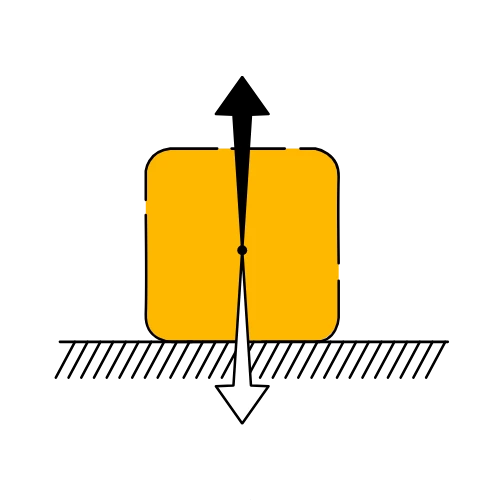
When you place a book on a table, the table pushes upward on the book with a force that keeps it from falling through the surface. That upward push is the normal force, the perpendicular force that surfaces exert on objects in contact with them. It might seem like a simple concept, but the normal force can vary dramatically depending on the scenario: whether the surface is tilted, whether additional forces are applied, or whether the whole system is accelerating.
This normal force calculator computes the perpendicular force exerted by a surface on an object across four common scenarios: horizontal surfaces, inclined planes, objects with external vertical forces, and elevators. Enter the mass and choose your scenario, and the tool handles the rest including automatic unit conversions. Whether you’re a physics student analyzing contact forces, an engineer designing structures, or just curious about the physics of everyday situations, this calculator provides instant, accurate results. All calculations run locally in your browser.
Choose your scenario: Horizontal, Inclined, External Force, or Elevator using the mode buttons.
Enter the mass of the object using the first input field, selecting kilograms, grams, or pounds.
Adjust gravity if needed (the default is Earth’s 9.81 m/s²).
For inclined surfaces: enter the slope angle in degrees.
For external force: specify the applied force, its unit, and direction (upward or downward).
For elevator scenarios: enter the acceleration and choose the direction of acceleration.
Review the normal force in newtons, kilonewtons, pound-force, and kilogram-force.
The calculator applies different formulas depending on the scenario you select. In all cases, the normal force acts perpendicular to the contact surface and balances the perpendicular components of all forces acting on the object.
Horizontal Surface No Additional Forces:
Formula: F_N = m · g
On a horizontal surface with no extra vertical forces, the normal force equals the object’s weight. A 10 kg object on a table experiences F_N = 10 × 9.81 = 98.1 N.
Inclined Surface (Ramp):
Formula: F_N = m · g · cos(θ)
On an incline, only the perpendicular component of gravity contributes to the normal force. The steeper the angle, the smaller the normal force. At 90° (vertical wall), the normal force becomes zero.
External Vertical Force:
Formula: F_N = m · g ± F
When an external vertical force acts on the object, it changes the normal force. An upward force reduces the normal force (F_N = mg − F), while a downward force increases it (F_N = mg + F). If the upward force exceeds the weight, the object loses contact and the normal force becomes zero.
Elevator (Accelerating Frame):
Formula: F_N = m · (g ± a)
In an accelerating elevator, the normal force changes with the acceleration. Accelerating upward increases the normal force (F_N = m(g+a)), while accelerating downward decreases it (F_N = m(g−a)). If the elevator accelerates downward at g, the normal force becomes zero a state of free fall.
All inputs are converted to SI base units before computation, and results are displayed in multiple unit systems.
Consider a 10 kg object. Let’s calculate the normal force in each scenario.
Scenario 1: Horizontal Surface:
F_N = 10 × 9.81 = 98.1 N
Scenario 2: Inclined Surface (30°):
F_N = 10 × 9.81 × cos(30°) = 10 × 9.81 × 0.866 = 84.9 N
Scenario 3: External Force (20 N upward):
F_N = mg − F = 98.1 − 20 = 78.1 N
Scenario 4: Elevator (accelerating upward at 2 m/s²):
F_N = 10 × (9.81 + 2) = 10 × 11.81 = 118.1 N
Interpretation: The same 10 kg object experiences different normal forces depending on the situation. On a horizontal surface, it’s 98.1 N. On a 30° incline, it drops to 84.9 N. With an upward force, it’s 78.1 N. In an upward-accelerating elevator, it rises to 118.1 N. This demonstrates why understanding the normal force is essential for analyzing contact interactions in various contexts.
On a horizontal surface with no extra vertical forces, the normal force equals the object’s weight: F_N = mg. For example, a 10 kg object has a normal force of 98.1 N on a flat surface.
On an incline, the normal force is reduced: F_N = mg·cosθ. At 0° (horizontal), it’s mg. At 90° (vertical wall), it’s zero. The normal force decreases as the angle increases.
Weight is the gravitational force on an object (mg), acting downward. Normal force is the perpendicular force exerted by a surface on an object, acting upward (or perpendicular to the surface). They are equal only on horizontal surfaces with no additional vertical forces.
In an upward-accelerating elevator, the normal force increases: F_N = m(g+a). In a downward-accelerating elevator, the normal force decreases: F_N = m(g−a). If the elevator accelerates downward at g, the normal force becomes zero (free fall).
An upward external force reduces the normal force (F_N = mg − F). A downward external force increases it (F_N = mg + F). If the upward force exceeds the weight, the normal force becomes zero and the object loses contact with the surface.
The SI unit of normal force is the newton (N). Other common units include kilonewtons (kN), pound-force (lbf), and kilogram-force (kgf). The calculator displays results in all these units.
Yes, the normal force can be zero when an object loses contact with a surface. This happens when an upward external force exceeds the weight, when a surface is vertical (90° incline), or when an elevator accelerates downward at g.
Yes, for many surfaces, the maximum static friction force is proportional to the normal force: f_max = μ·F_N, where μ is the coefficient of friction. This is why reducing the normal force (as on an incline) also reduces the available friction.
ADVERTISEMENT
ADVERTISEMENT