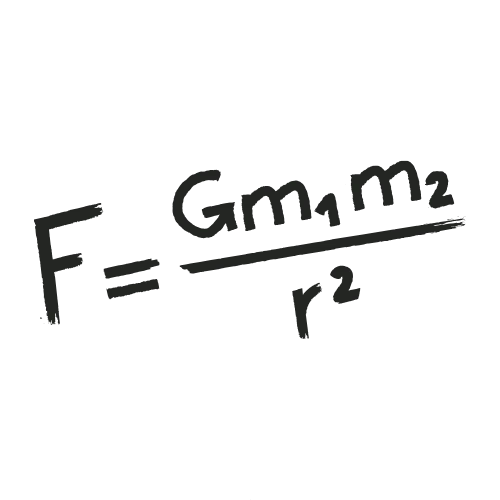

Compute the attractive force between two masses using F = G·m₁·m₂ / r²
Powered by Toolraxy · Physics & astronomy calculator

Founder & CEO, Toolraxy
Faiq Ur Rahman is a web designer, digital product developer, and founder of Toolraxy, a growing platform of web-based calculators and utility tools. He specializes in building structured, user-friendly tools focused on health, finance, productivity, and everyday problem-solving.
User Ratings:
ADVERTISEMENT
ADVERTISEMENT
Every object in the universe attracts every other object with a force that depends on their masses and the distance between them, this is the profound insight Newton published in his Principia over three centuries ago. The gravitational force is what keeps planets in orbit, holds galaxies together, and pulls you toward the Earth right now. Yet for all its cosmic significance, the math is surprisingly simple: multiply the masses, divide by the distance squared, and scale by a tiny constant.
This gravitational force calculator applies Newton’s law of universal gravitation to compute the attractive force between any two masses. Whether you’re calculating the force between the Earth and the Moon, the pull between a person and the planet they’re standing on, or the attraction between two people in the same room, this tool provides instant, accurate results. It handles scientific notation, supports multiple units, and even includes presets for common celestial bodies. All calculations run locally in your browser, keeping your data private.
Enter the mass of the first object in the m₁ field — use the presets for common objects like Earth, Moon, Sun, Mars, or a person.
Enter the mass of the second object in the m₂ field — the same presets are available for both objects.
Specify the distance between the centers of the two objects in the distance field, choosing from meters, kilometers, feet, miles, AU, or light-years.
The gravitational constant G defaults to 6.67430 × 10⁻¹¹ m³/(kg·s²) — you can adjust this value for other gravitational contexts.
Click Calculate or simply wait — the gravitational force appears instantly in newtons, kilonewtons, meganewtons, and pound-force.
Review the output values for both masses, distance, and the force in multiple unit systems.
The calculator applies Newton’s law of universal gravitation, which states that every particle of matter in the universe attracts every other particle with a force that is directly proportional to the product of their masses and inversely proportional to the square of the distance between their centers.
Formula: F = G · (m₁ · m₂) / r²
Where F is the gravitational force in newtons, G is the gravitational constant (6.67430 × 10⁻¹¹ m³/(kg·s²)), m₁ and m₂ are the masses in kilograms, and r is the distance between the centers of the masses in meters.
The force is always attractive — it pulls the two masses toward each other. The direction of the force on each mass is along the line connecting their centers. This inverse-square relationship means that doubling the distance reduces the force by a factor of four, while halving the distance increases the force by a factor of four.
All inputs are converted to SI base units before computation: masses to kilograms and distance to meters. The gravitational constant is provided in its standard SI value.
Let’s calculate the gravitational force between the Earth and a 75 kg person standing on its surface. This is the person’s weight.
Step 1: Identify the masses and distance
m₁ (Earth) = 5.972 × 10²⁴ kg
m₂ (person) = 75 kg
r (Earth’s radius) = 6.371 × 10⁶ m
G = 6.67430 × 10⁻¹¹ m³/(kg·s²)
Step 2: Apply the formula
F = (6.67430 × 10⁻¹¹) × (5.972 × 10²⁴ × 75) / (6.371 × 10⁶)²
Step 3: Calculate
m₁ × m₂ = 5.972 × 10²⁴ × 75 = 4.479 × 10²⁶ kg²
r² = (6.371 × 10⁶)² = 4.059 × 10¹³ m²
F = 6.67430 × 10⁻¹¹ × 4.479 × 10²⁶ / 4.059 × 10¹³
F = 2.989 × 10¹⁶ / 4.059 × 10¹³
F = 736 N
Interpretation: The gravitational force between the Earth and the person is approximately 736 newtons. This is exactly the person’s weight (mg = 75 × 9.81 = 736 N). This confirms that weight is simply the gravitational force exerted by the Earth on an object, a beautiful connection between Newton’s law and everyday experience.
The gravitational force between two 75 kg people standing 1 meter apart is approximately 3.75×10⁻⁷ N, about 40 million times weaker than their weight on Earth. This is why we don’t feel gravitational attraction between everyday objects.
You do attract the Earth with exactly the same force that the Earth attracts you by Newton’s third law, the forces are equal and opposite. However, because your mass is vastly smaller than the Earth’s, your pull on the Earth produces an immeasurably tiny acceleration.
G (the gravitational constant) is a universal constant with a fixed value of 6.67430×10⁻¹¹ m³/(kg·s²). g (the acceleration due to gravity) is a local value that depends on a planet’s mass and radius on Earth, g ≈ 9.81 m/s². The relationship is g = G·M/R² for a planet of mass M and radius R.
Gravitational force follows an inverse-square law, doubling the distance reduces the force by a factor of four, tripling it reduces the force by a factor of nine, and so on. This is why objects on the International Space Station (about 400 km up) still feel about 90% of Earth’s gravity.
No, gravity is always attractive in Newtonian physics. Unlike electromagnetism, which has both attractive and repulsive forces, gravity only pulls objects together. (Note: In Einstein’s general relativity, gravity can have repulsive effects in certain cosmological contexts, but these are beyond the scope of Newton’s law.)
The gravitational force between the Earth and the Sun is approximately 3.54×10²² N. This immense force keeps the Earth in orbit around the Sun at about 30 km/s. The Sun’s mass (1.989×10³⁰ kg) and distance (1.496×10¹¹ m) determine this value.
For Newtonian mechanics, the calculations are exact for the given inputs. However, real-world gravitational interactions may require corrections for general relativity, tidal effects, non-spherical mass distributions, and perturbations from other bodies. The calculator provides the ideal Newtonian value.
The gravitational force between two electrons is approximately 1.75×10⁻⁷⁰ N, absolutely negligible compared to the electrostatic repulsion between them (about 2.3×10⁻²⁸ N, which is 10⁴² times larger). This is why gravity is considered the weakest of the fundamental forces.
ADVERTISEMENT
ADVERTISEMENT