
Convert mass to weight force using F = m · g
Powered by Toolraxy · Physics & mechanics calculator

Founder & CEO, Toolraxy
Faiq Ur Rahman is a web designer, digital product developer, and founder of Toolraxy, a growing platform of web-based calculators and utility tools. He specializes in building structured, user-friendly tools focused on health, finance, productivity, and everyday problem-solving.
User Ratings:
ADVERTISEMENT
ADVERTISEMENT
Have you ever wondered why your weight feels different on a bathroom scale than what you’d get from simply multiplying your mass by a number? The answer lies in the distinction between mass and weight, mass is a measure of how much matter you contain, while weight is the force of gravity acting on that mass. The conversion is straightforward once you know the formula: weight (in newtons) equals mass (in kilograms) times gravitational acceleration.
This kg to newtons calculator does exactly that conversion for you, with support for multiple mass units and gravity presets for different planets. Whether you’re a physics student learning about mass and weight, an engineer calculating loads, or just curious what you’d weigh on Mars, this tool provides instant, accurate results. All calculations run locally in your browser, keeping your data completely private.
Enter the mass of the object using the first input field, then choose kilograms, grams, pounds, or ounces.
Select the gravitational environment: Earth, Moon, Mars, Jupiter, or enter a custom gravity value.
Review the weight force in newtons, kilonewtons, pound-force, and kilogram-force instantly.
Use the Copy button to save a complete summary or Share to send results to others.
The calculator applies the fundamental relationship between mass and weight, which is based on Newton’s second law of motion.
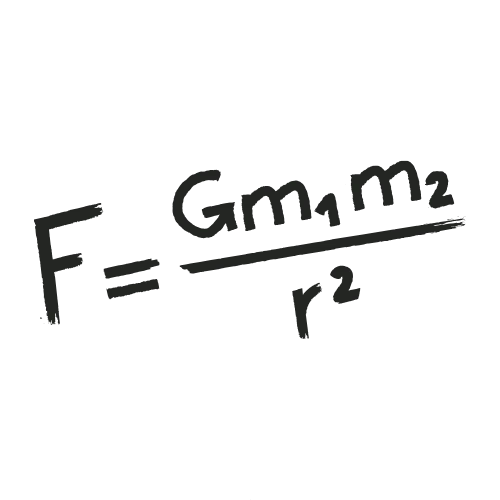
Formula: F = m · g
Where F is the force (weight) in newtons, m is the mass in kilograms, and g is the gravitational acceleration in meters per second squared. On Earth, g = 9.81 m/s², which means a mass of 1 kg weighs approximately 9.81 N.
For other planets, the gravitational acceleration varies:
Moon: 1.62 m/s² (about 1/6 of Earth’s gravity)
Mars: 3.71 m/s² (about 38% of Earth’s gravity)
Jupiter: 24.79 m/s² (about 2.5 times Earth’s gravity)
The calculator converts your input mass to kilograms if you’ve entered it in grams, pounds, or ounces, then multiplies by the selected gravity to give the weight in newtons. Results are also displayed in pound-force (lbf) and kilogram-force (kgf) for convenience.
Let’s calculate the weight of a 70 kg person on Earth, the Moon, and Mars.
Step 1: Earth (g = 9.81 m/s²)
F = 70 kg × 9.81 m/s² = 686.7 N
Step 2: Moon (g = 1.62 m/s²)
F = 70 kg × 1.62 m/s² = 113.4 N
Step 3: Mars (g = 3.71 m/s²)
F = 70 kg × 3.71 m/s² = 259.7 N
Interpretation: The same 70 kg person weighs 686.7 N on Earth, only 113.4 N on the Moon, and 259.7 N on Mars. The mass hasn’t changed, 70 kg is 70 kg everywhere but the weight (the force of gravity pulling on that mass) is dramatically different depending on where you are.
1 kg on Earth weighs approximately 9.81 newtons. This is because Earth’s gravitational acceleration is 9.81 m/s². On the Moon, 1 kg would weigh only 1.62 N.
The formula is F = m × g, where F is the weight in newtons, m is the mass in kilograms, and g is the gravitational acceleration in m/s². On Earth, g = 9.81 m/s².
Yes, to convert newtons to kilograms, divide the force by the gravitational acceleration: m = F/g. On Earth, divide by 9.81. For example, 100 N ÷ 9.81 = 10.19 kg.
Bathroom scales typically display kilograms, but they actually measure the force (weight) and then divide by 9.81 to give you mass in kilograms. So when a scale reads 70 kg, it’s actually measuring about 686.7 N of force and converting it for you.
kg (kilogram) is a unit of mass. kgf (kilogram-force) is a unit of force — it’s the force exerted by 1 kg of mass under standard gravity (9.80665 m/s²). 1 kgf is approximately 9.81 N. The calculator displays both for clarity.
On Mars, gravity is about 38% of Earth’s. A person with a mass of 70 kg would weigh 259.7 N on Mars, compared to 686.7 N on Earth. This means you’d feel about 62% lighter on Mars.
On Jupiter, gravity is about 2.5 times Earth’s. A person with a mass of 70 kg would weigh 1,735.3 N on Jupiter, compared to 686.7 N on Earth. You’d feel about 2.5 times heavier not a comfortable place to visit!
No, weight depends on the gravitational field, so it varies from place to place. The same mass has different weights on different planets, and even different weights at different altitudes on Earth (though the variation is small). Mass, however, is constant everywhere.
ADVERTISEMENT
ADVERTISEMENT