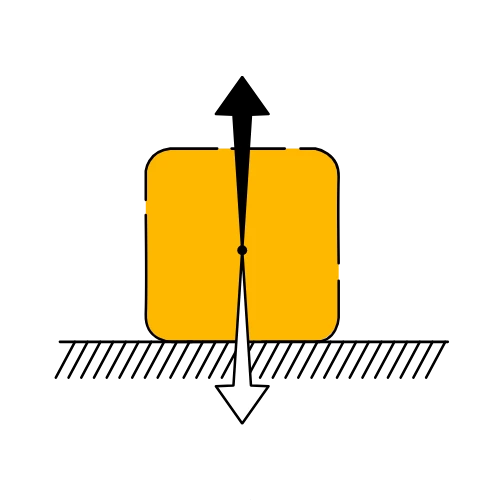

Demonstrate action-reaction force pairs — FA→B = −FB→A
Powered by Toolraxy · Physics & mechanics calculator

Founder & CEO, Toolraxy
Faiq Ur Rahman is a web designer, digital product developer, and founder of Toolraxy, a growing platform of web-based calculators and utility tools. He specializes in building structured, user-friendly tools focused on health, finance, productivity, and everyday problem-solving.
User Ratings:
ADVERTISEMENT
ADVERTISEMENT
When you push against a wall, the wall pushes back with exactly the same force that’s Newton’s third law in action. It’s one of the most intuitive yet misunderstood principles in physics: for every action force, there’s an equal and opposite reaction force. But the key insight is that these forces act on different objects, which is why they can produce very different effects depending on the masses involved.
This Newton’s third law calculator demonstrates the action-reaction force pair between two interacting objects. Enter the masses of two objects and the action force, and the calculator shows the equal and opposite reaction force, along with the resulting accelerations of both objects. Whether you’re a physics student learning about force pairs, an engineer analyzing interactions, or just curious about how the principle works, this tool makes the concept concrete and quantifiable. All calculations run locally in your browser.
Enter the mass of object 1 (the source of the action force) using the first input field.
Enter the mass of object 2 (the target of the action force) in the second card.
Specify the action force — the force exerted by object 1 on object 2.
Review the action force and its equal and opposite reaction force displayed prominently.
Examine the resulting accelerations of both objects — the lighter object accelerates more.
Check the force and acceleration ratios to see how mass differences affect motion.
The calculator applies Newton’s third law, which states that whenever one object exerts a force on a second object, the second object exerts an equal and opposite force on the first. These forces are always equal in magnitude and opposite in direction.
Formula: F₁₂ = −F₂₁
Where F₁₂ is the force exerted by object 1 on object 2 (the action force), and F₂₁ is the force exerted by object 2 on object 1 (the reaction force). The minus sign indicates opposite direction.
The calculator then uses Newton’s second law to find the acceleration of each object:
Formula: a₁ = F₂₁ / m₁ (acceleration of object 1 due to the reaction force)
Formula: a₂ = F₁₂ / m₂ (acceleration of object 2 due to the action force)
The action and reaction forces have equal magnitudes but act on different objects, so the accelerations are inversely proportional to the masses — the lighter object experiences greater acceleration.
Consider a 5 kg object pushing against a 10 kg object with a force of 100 N. What are the action and reaction forces, and what accelerations result?
Step 1: Identify the action force
F₁₂ = 100 N (object 1 on object 2, to the right)
Step 2: Apply Newton’s third law
F₂₁ = −100 N (object 2 on object 1, to the left)
The forces are equal in magnitude (100 N) and opposite in direction.
Step 3: Calculate accelerations
a₁ = F₂₁ / m₁ = −100 / 5 = −20 m/s² (object 1 accelerates left)
a₂ = F₁₂ / m₂ = 100 / 10 = 10 m/s² (object 2 accelerates right)
Step 4: Compare ratios
Force ratio: |F₂₁| / |F₁₂| = 1 : 1 (always equal)
Acceleration ratio: |a₂| / |a₁| = 10 / 20 = 0.5 : 1 (object 1 accelerates twice as much)
Interpretation: The lighter object (5 kg) experiences greater acceleration (20 m/s²) than the heavier object (10 m/s², at 10 m/s²), even though the forces are equal. This demonstrates the inverse relationship between mass and acceleration.
Newton’s third law says that for every action, there is an equal and opposite reaction. Whenever one object pushes or pulls on another, the second object pushes or pulls back with the same amount of force, but in the opposite direction.
No, they act on different objects, so they don’t cancel. Forces can only cancel when they act on the same object. Action-reaction pairs always act on different objects.
When you push a wall, your hand exerts a force on the wall (action), and the wall exerts an equal force back on your hand (reaction). Your hand feels the wall pushing back that’s the reaction force.
When you walk, your foot pushes backward on the ground (action). The ground pushes forward on your foot (reaction), which is what moves you forward. Without the reaction force, you wouldn’t move.
Action and reaction forces occur simultaneously. There’s no time delay, the reaction happens at exactly the same instant as the action. The labels “action” and “reaction” are arbitrary; either force can be called the action.
The forces are equal, so the acceleration of each object depends on its mass (a = F/m). A smaller mass experiences greater acceleration because it has less inertia. This is why a ping-pong ball bounces more than a bowling ball when they collide.
Newton’s first law (inertia) describes what happens when no net force acts objects maintain constant velocity. Newton’s third law describes force pairs, how forces always come in equal and opposite pairs between interacting objects.
No, by definition, action and reaction forces are always equal in magnitude. If they weren’t equal, the law wouldn’t hold. The calculator enforces this by setting the reaction force equal and opposite to the action force.
ADVERTISEMENT
ADVERTISEMENT