
Compute tension in ropes for hanging masses, pulleys, and inclined planes
Powered by Toolraxy · Physics & mechanics calculator

Founder & CEO, Toolraxy
Faiq Ur Rahman is a web designer, digital product developer, and founder of Toolraxy, a growing platform of web-based calculators and utility tools. He specializes in building structured, user-friendly tools focused on health, finance, productivity, and everyday problem-solving.
User Ratings:
ADVERTISEMENT
ADVERTISEMENT
When you hang a picture on the wall, you’re relying on tension to hold it up. When a rock climber dangles from a rope, tension is what keeps them from falling. Tension is the pulling force transmitted through a rope, cable, or chain when it’s pulled tight and understanding how to calculate it is essential for physics students, engineers, and anyone working with mechanical systems.
This tension calculator handles five common physics scenarios: hanging masses, vertical acceleration (elevators and cranes), inclined planes, Atwood machines, and horizontal pulls with friction. Enter your values, select the scenario, and the tool computes the tension in the rope or cable complete with a visual diagram showing all forces at play. Whether you’re studying mechanics, designing a pulley system, or just curious about the physics of tension, this calculator provides instant, accurate results. All calculations run locally in your browser, keeping your data private.
Select your scenario from the five options: Hanging Mass, Vertical Acceleration, Inclined Plane, Atwood Machine, or Horizontal Pull with Friction.
Enter the mass of the object (or objects) using the input fields, selecting kilograms, grams, or pounds.
For vertical acceleration: enter the acceleration value and choose the direction (upward or downward).
For inclined planes: specify the slope angle in degrees.
For the Atwood machine: enter both masses.
For horizontal pull with friction: enter the coefficient of friction between the object and the surface.
Review the tension in newtons, kilonewtons, pound-force, and kilogram-force.
The calculator applies the appropriate physics equation based on the scenario you select. Tension is the force transmitted through a rope, it pulls equally on both ends and is always directed along the rope.
Hanging Mass (Static):
Formula: T = m · g
For a mass hanging motionless from a rope, the tension equals the weight of the mass. Tension in newtons equals mass (in kg) times gravitational acceleration.
Vertical Acceleration (Elevator / Crane):
Formula: T = m · (g + a) (accelerating upward)
Formula: T = m · (g − a) (accelerating downward)
When the system accelerates vertically, tension changes. Accelerating upward increases tension; accelerating downward decreases it. If acceleration equals g (free fall), tension goes to zero.
Inclined Plane (Object on a Slope):
Formula: T = m · g · sin(θ)
For an object resting on a frictionless incline with the rope parallel to the slope, tension equals the component of gravity pulling the object down the slope.
Atwood Machine (Two Masses over a Pulley):
Formula: T = (2 · m₁ · m₂ · g) / (m₁ + m₂)
Formula: a = (m₂ − m₁) · g / (m₁ + m₂)
The Atwood machine consists of two masses connected by a rope over a pulley. The heavier mass accelerates downward, pulling the lighter mass upward. Tension is the same throughout the rope.
Horizontal Pull with Friction:
Formula: T = μ · m · g
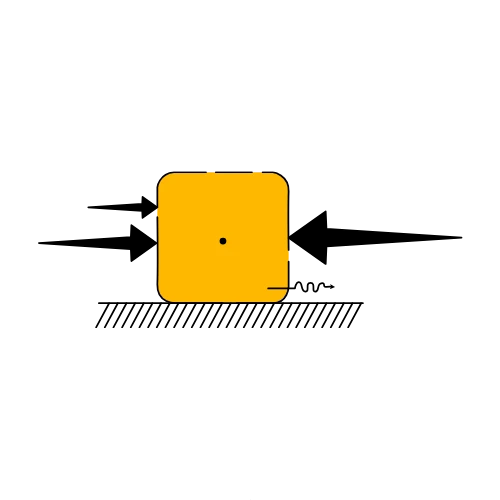
When an object is pulled at constant velocity on a horizontal surface, the tension in the rope equals the force of friction. Friction force equals the coefficient of friction times the normal force (which equals mg on a horizontal surface).
All inputs are converted to SI base units before computation, and results are displayed in multiple unit systems for your convenience.
A 10 kg mass hangs motionless from a rope. What is the tension in the rope?
Step 1: Identify the known values
m = 10 kg
g = 9.81 m/s²
Step 2: Apply the formula
T = m · g = 10 × 9.81 = 98.1 N
Interpretation: The tension in the rope is 98.1 N. This is equal and opposite to the weight of the mass. If the rope were pulled harder, it would break; if pulled less, the mass would fall.
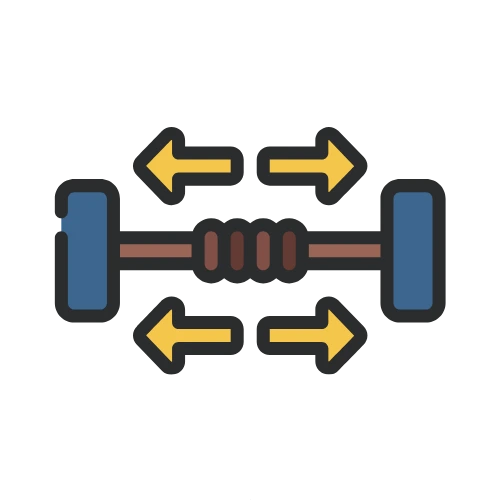
Tension is the pulling force transmitted through a rope, cable, or chain when it is pulled tight. It acts along the length of the connector and pulls equally on both ends. Tension is measured in newtons (N) and is always directed away from the object being pulled.
Tension is a pulling force that stretches an object, while compression is a pushing force that squeezes it. A rope can only handle tension, it can’t be compressed (it goes slack). A rod or beam can handle both tension and compression.
For a stationary hanging mass, the tension equals the weight of the mass: T = mg. For example, a 10 kg mass has a tension of 98.1 N in the rope.
If a mass accelerates upward, tension increases: T = m(g + a). If it accelerates downward, tension decreases: T = m(g − a). If the acceleration equals g (free fall), tension becomes zero.
An Atwood machine consists of two masses connected by a rope over a pulley. The heavier mass accelerates downward, pulling the lighter mass upward. Tension is the same throughout the rope.
When an object is pulled horizontally at constant velocity, the tension equals the friction force: T = μmg, where μ is the coefficient of friction. Without friction, any small force would accelerate the object.
For an object on a frictionless incline with the rope parallel to the slope, the tension equals the component of gravity pulling the object down the slope: T = mg·sinθ. At θ = 0° (horizontal), T = 0. At θ = 90° (vertical), T = mg.
Tension is a magnitude, it’s always positive. However, in some calculations (like an accelerating elevator), the result can be zero (slack rope) but not negative. If you get a negative value, it usually indicates a slack rope or an input error.
ADVERTISEMENT
ADVERTISEMENT