

Build your salad and see the exact calories, protein, carbs, fat, and fiber for every ingredient. Includes vegetables, proteins, cheeses, nuts, seeds, dressings, and fruits.
| Ingredient | Amount | Calories | % of total |
|---|
| Macronutrient | Amount | Calories from macro | % of total calories |
|---|
| Metric | Value | Notes |
|---|
| Metric | Value | Notes |
|---|
-
Select a citation style above. Click the citation text to select it all, then copy.
ADVERTISEMENT











Founder & CEO, Toolraxy
Faiq Ur Rahman is a web designer, digital product developer, and founder of Toolraxy, a growing platform of web-based calculators and utility tools. He specializes in building structured, user-friendly tools focused on health, finance, productivity, and everyday problem-solving.
User Ratings:
ADVERTISEMENT
ADVERTISEMENT
A salad can be 150 calories or 900. The difference usually isn’t the lettuce. It’s the dressing, the cheese, the nuts, and the handful of croutons that felt harmless at the time. This calculator lets you build the exact salad you’re eating, ingredient by ingredient, and see the full nutrition picture before you take a bite. It’s built for anyone tracking calories, managing macros, or just curious why a “healthy” salad left them hungry an hour later. A chicken Caesar with croutons and parmesan adds up fast. A pile of romaine with lemon juice doesn’t. The tool shows you where your salad falls on that spectrum.
Pick your unit system. Choose metric (grams, millilitres) or imperial (ounces, tablespoons, cups). The tool converts your inputs automatically when you switch.
Choose your greens. Select the lettuce or leafy base from the dropdown, then enter the amount in grams or ounces. Romaine is the default at 100 g.
Add vegetables. Enter amounts for tomatoes, cucumber, onion, sweetcorn, bell pepper, carrot, and avocado. Leave anything you’re not using at zero.
Select your protein. Enter grams of chicken, tuna, or chickpeas, or enter the number of boiled eggs. Bacon bits are measured in tablespoons.
Add cheese and toppings. Enter amounts for feta, parmesan, cheddar, mozzarella, almonds, walnuts, cashews, seeds, croutons, coconut, and chia seeds.
Choose a dressing. Pick from 11 options, including olive oil, ranch, Caesar, and vinaigrette. Enter the number of tablespoons you’re using.
Add a custom ingredient if needed. Type the name, amount in grams, and calories per 100 g for anything not listed.
Read the results. The tool updates instantly. Check total calories, the ingredient breakdown, macro split, and calorie density.
The calculator scales every ingredient’s nutrition data to the amount you enter.
Formula: Ingredient calories = (calories per 100 g ÷ 100) × grams used
The same scaling applies to protein, carbohydrates, fat, and fiber. Each ingredient in the database carries five values per 100 g. The tool divides by 100, multiplies by your gram amount, and sums the results across every ingredient in your salad.
Dressing works differently. Each dressing has calorie and macro values per tablespoon. The tool multiplies those values by the number of tablespoons you enter. One tablespoon of olive oil is 119 calories. Four tablespoons is 476.
Eggs and bacon bits have their own conversion logic. One boiled egg equals 50 g. One tablespoon of bacon bits equals 7 g. The tool converts these to grams before scaling.
If you switch from metric to imperial, the tool converts every weight input from grams to ounces using the standard factor of 28.3495 g per ounce. Egg counts and bacon tablespoon amounts stay in their native units.
Say you’re building a chicken Caesar salad for lunch. You start with 120 g of romaine lettuce. You add 150 g of cooked chicken breast, 30 g of grated parmesan, 40 g of croutons, and 3 tablespoons of Caesar dressing.
Here’s how the numbers break down. Romaine at 17 calories per 100 g contributes 20.4 calories. The chicken breast at 109 calories per 100 g adds 163.5 calories. Parmesan at 420 calories per 100 g gives 126 calories. Croutons at 407 calories per 100 g contribute 162.8 calories. Three tablespoons of Caesar dressing at 78 calories each adds 234 calories. The total comes to 706.7 calories, which the tool rounds to 707 kcal.
Protein lands at 44.9 g, driven mostly by the chicken. Carbs total 34.6 g, with the croutons contributing 29.4 g of that. Fat reaches 43.9 g, split between the dressing, parmesan, and chicken.
The verdict banner classifies this as a high-calorie salad. It’s approaching a full restaurant meal. The dressing alone accounts for a third of the calories.
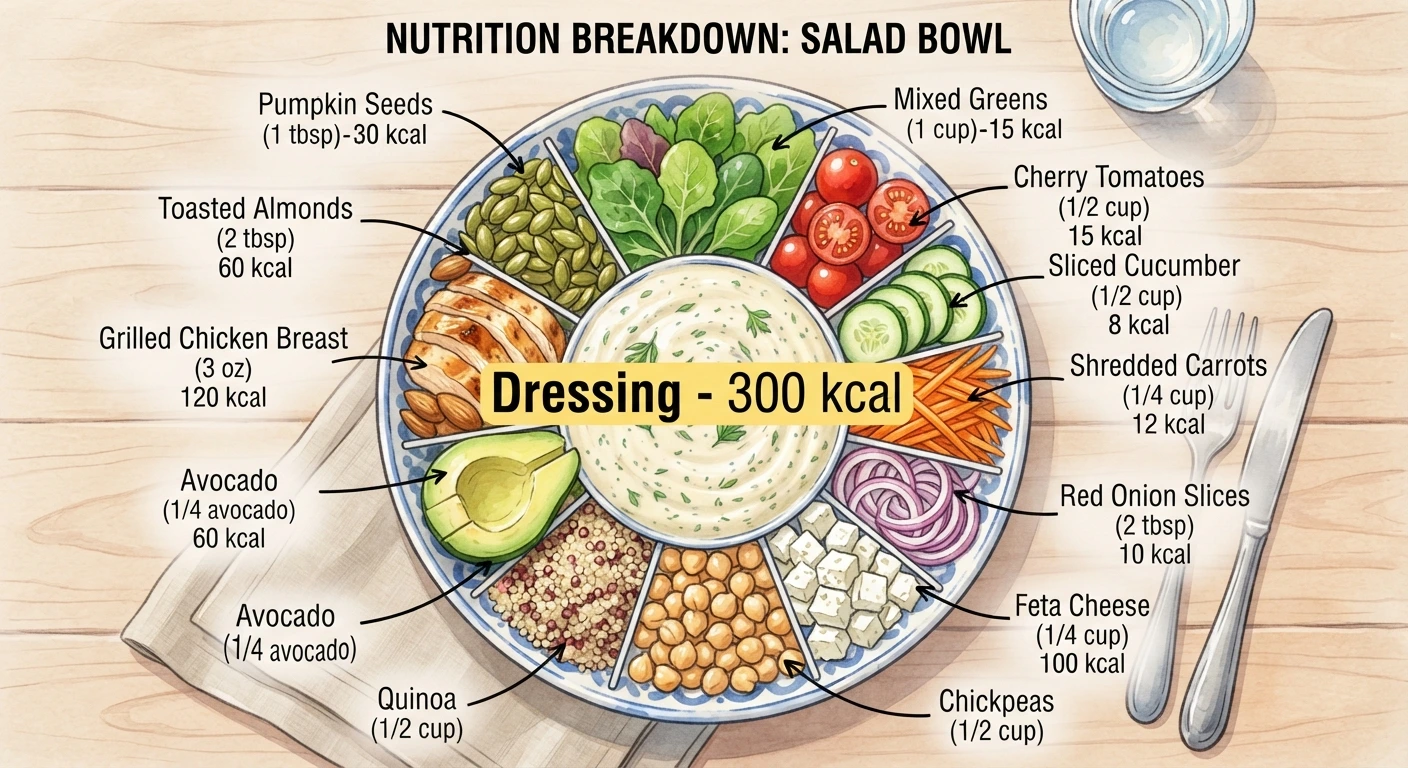
For a side salad, 50 to 150 calories is typical. As a main meal, 300 to 500 calories covers most lunch and dinner salads. Anything under 200 calories works well as a light meal or side. Between 400 and 600 calories, you’re in full-meal territory. Above 700 calories, the salad has more energy than many fast-food items. The range isn’t a judgment. It depends on what the salad is replacing in your day. A 500-calorie salad that keeps you full until dinner beats a 200-calorie salad that sends you to the vending machine at 3 p.m.
The core difference is the base. A salad uses leafy greens as its foundation, while a grain bowl builds on rice, quinoa, farro, or another cooked grain. That single swap changes the calorie profile dramatically.
| Dimension | Leafy Salad | Grain Bowl |
|---|---|---|
| Base ingredient | Romaine, spinach, kale, mixed greens | Quinoa, brown rice, farro, couscous |
| Base calories per 100 g | 14–49 kcal | 110–130 kcal (cooked) |
| Typical total calories | 150–600 kcal | 400–800 kcal |
| Carbohydrate load | Low (5–20 g) | High (40–80 g) |
| Protein potential | High if meat, fish, or legumes added | High if meat, fish, or legumes added |
| Fiber source | Vegetables and leaves | Whole grains and vegetables |
| Best for | Low-calorie volume, light meals | Sustained energy, post-workout meals |
A leafy salad wins when you want volume without many calories. You can eat a massive bowl of romaine, cucumber, and tomato for under 100 calories. That’s hard to beat for satiety per calorie. A grain bowl wins when you need fuel that lasts. The grain base provides slow-digesting carbohydrates and keeps you full for longer. A quinoa bowl with chicken and roasted vegetables can hit 600 calories and hold you for four or five hours.
This calculator supports leafy salads. Every ingredient in the database is a salad component, not a grain base. If you’re building a grain bowl, you’d use the custom ingredient field to enter your cooked grain’s calories per 100 g, but the tool won’t track its full macro profile beyond calories.
Home cooks tracking calories for weight loss use this calculation to build salads that hit a target without overshooting. The situation: you’re packing five lunches for the week and need each one under 450 calories. The inputs that matter most are dressing amount and cheese weight. Dressing is where calories hide. A salad prepped with 2 tablespoons of vinaigrette instead of 4 saves roughly 100 calories per day. A reasonable output for a weight-loss lunch salad is 350–450 calories with 25–35 g of protein.
Anyone ordering at a fast-casual salad restaurant uses this kind of calculation to estimate what’s in the bowl. The situation: the menu lists ingredients but not calories for your custom combination. The inputs that matter are portion sizes, especially cheese and nuts. Restaurant salads routinely use 40–60 g of cheese when 20 g would do. A reasonable estimate for a chain restaurant salad with protein and dressing is 500–700 calories.
Lifters tracking macros use the calculator to hit protein targets without blowing past calorie limits. The situation: you need 40 g of protein at lunch and 600 calories total. The inputs that matter are protein source and added fats. Chicken breast at 150 g gives 33 g of protein for 164 calories. Adding 30 g of parmesan adds 10.7 g of protein but also 126 calories and 8.7 g of fat. A reasonable output for a muscle-building salad is 400–600 calories with 35–50 g of protein.
A side salad runs 50 to 150 calories. A main-meal salad with protein and dressing lands between 300 and 600 calories. Anything above 700 calories is closer to a full restaurant entrée than a light meal. The range depends almost entirely on dressing, cheese, and nuts.
Weigh each ingredient in grams, multiply its calories per 100 g by the weight, and divide by 100. Add the results together. For dressing, multiply the per-tablespoon calorie count by how many tablespoons you used. The calculator does this automatically for every ingredient.
Dressing is usually the culprit. Four tablespoons of ranch is 240 calories. Add cheese, croutons, and nuts, and you can easily pass 700 calories. Weighing your dressing instead of pouring freely is the fastest way to bring the number down.
It can be. A salad with lean protein, plenty of vegetables, and a measured amount of dressing is an excellent weight-loss meal. A salad loaded with cheese, croutons, and creamy dressing is not. The calculator helps you tell the difference before you eat.
Per tablespoon: Italian vinaigrette is about 48 calories, ranch is 60, Caesar is 78, blue cheese is 73, and olive oil is 119. A typical salad uses two to four tablespoons. Measure it. Eyeballing can easily double the amount.
Yes, but very few. Romaine is about 17 calories per 100 g. Iceberg is 14. Spinach is 23. You can eat a large bowl of plain greens for under 50 calories. The calories come from what you add to them.
Lemon juice is about 3 calories per tablespoon. Yogurt-based dressings run around 25 calories per tablespoon. Balsamic vinaigrette is roughly 43. Vinegar-based dressings generally have fewer calories than creamy ones.
It depends on the dressing and extras. Chicken breast is about 109 calories per 100 g. A chicken salad with 150 g of chicken, greens, 2 tablespoons of vinaigrette, and no cheese lands around 350 calories. Add cheese and croutons and it climbs toward 500.
The calculator is built for leafy salads. It doesn’t include cooked grains as a base ingredient. You can enter a grain through the custom ingredient field if you know its calories per 100 g, but the tool won’t track its full protein, carb, and fat breakdown beyond calories.
It’s as accurate as the weights you enter. The per-100g nutrition data comes from published food composition databases. If you weigh your ingredients, the result is reliable. If you estimate by volume, expect a wider margin.
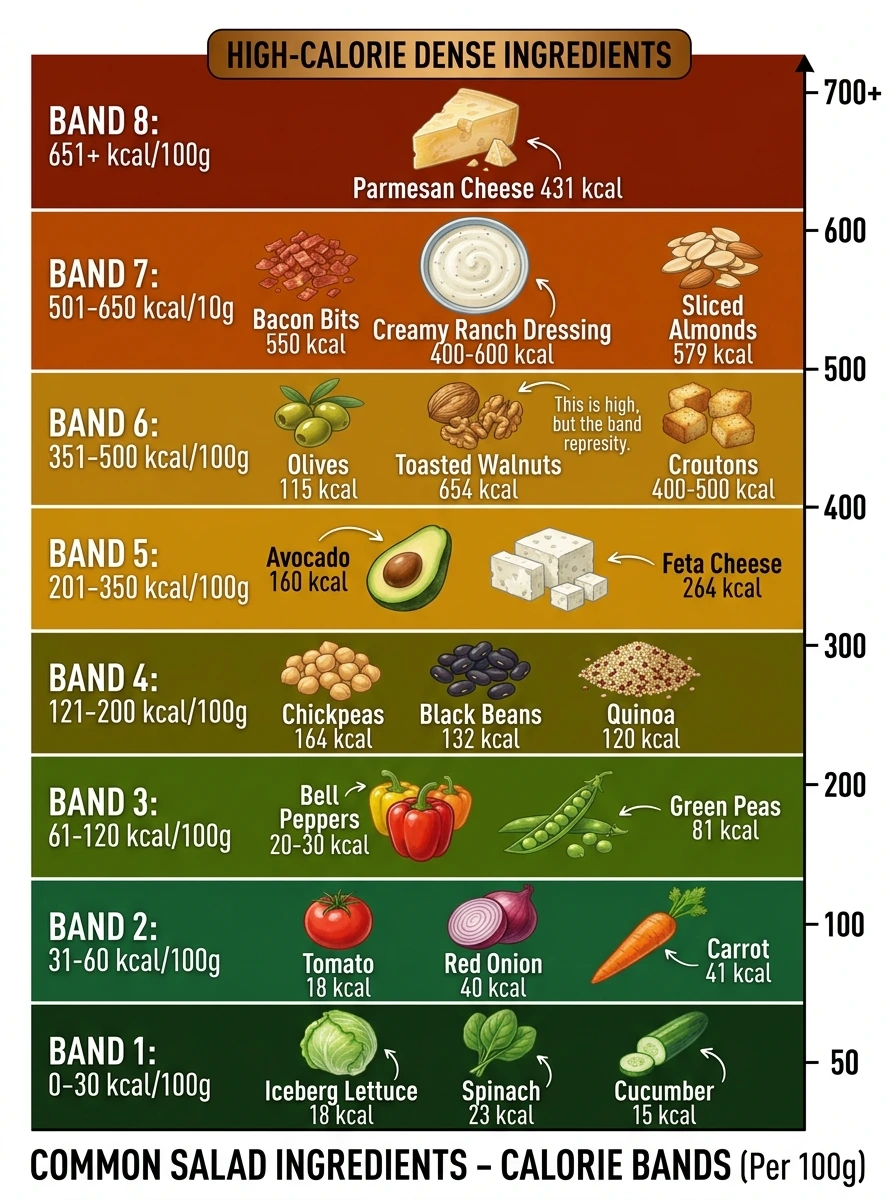
Nuts and seeds are the most calorie-dense. Almonds are 579 calories per 100 g. Walnuts are 654. Desiccated coconut is 660. Cheese is close behind: parmesan is 420, cheddar is 400. Croutons range from 286 to 488 depending on the brand.
This calculator provides estimates based on published nutrition data. Actual calorie and nutrient values vary by brand, preparation method, and ingredient source. It is not a substitute for professional dietary advice. If you have specific health goals or dietary restrictions, consult a registered dietitian or your healthcare provider.
ADVERTISEMENT
ADVERTISEMENT