













Founder & CEO, Toolraxy
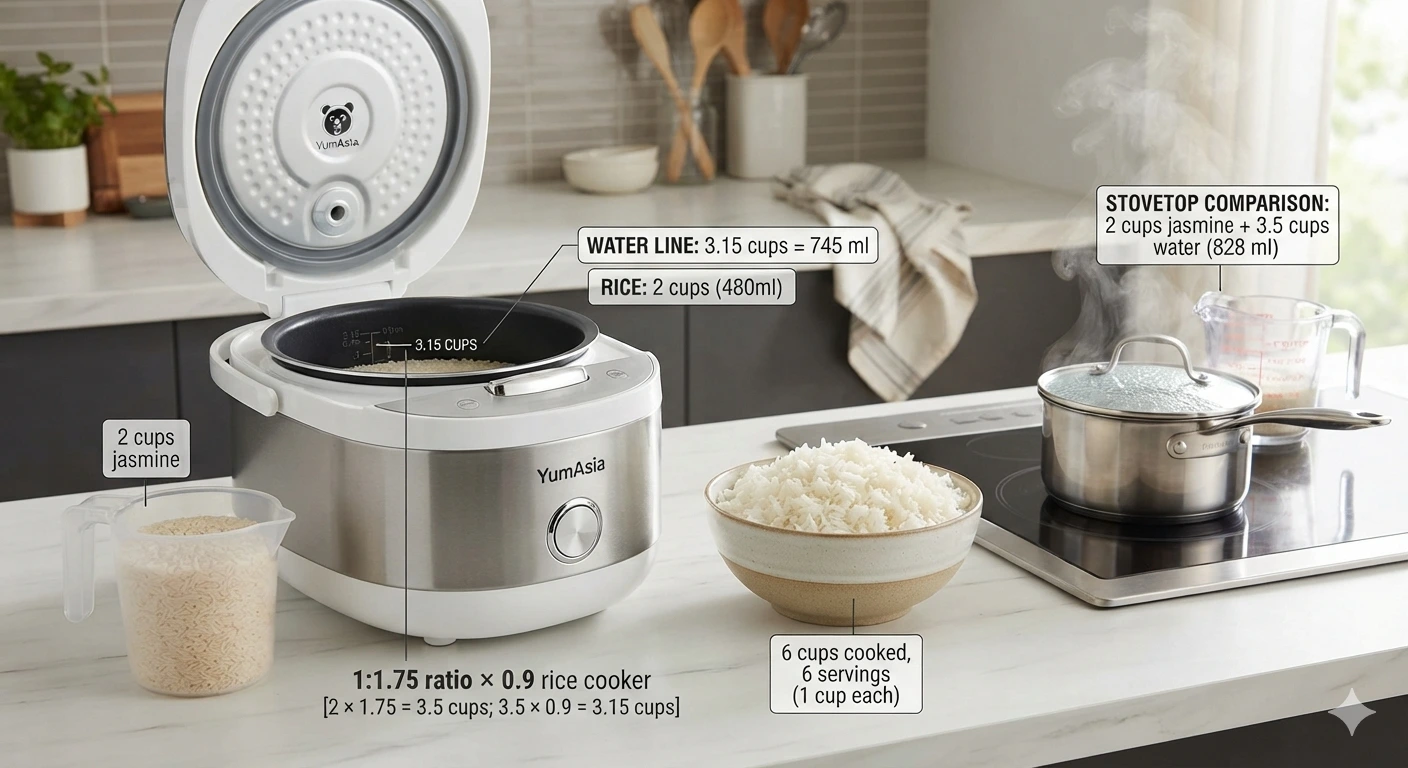
You’re cooking 2 cups of jasmine rice in a rice cooker.
Step 1 : Rice amount. 2 US cups of dry jasmine rice.
Step 2 : Published ratio. Jasmine is 1:1.75. 2 × 1.75 = 3.5 cups of water.
Step 3 : Method adjustment. Rice cooker uses 10% less water. 3.5 × 0.9 = 3.15 cups.
Step 4 : Convert to metric. 3.15 cups × 236.6 ml per cup = 745 ml.
Step 5 : Cooking time. Jasmine takes 15 to 20 minutes. The calculator uses the mid-range figure.
Step 6 : Cooked yield. 2 cups dry × 3 = 6 cups cooked. That’s about 1.42 litres.
Step 7 : Servings. 6 cups cooked ÷ 1 cup per serving = 6 servings.
So the number you’d measure is 745 ml of water for 2 cups of jasmine in a rice cooker. If you cooked the same rice on the stovetop with the absorption method, you’d use 828 ml because the pot isn’t sealed. Same rice, same amount, 83 ml difference from the method alone.
Now we’ve reached the part we’re all interested in: how do you actually cook perfect rice?
Cooking rice sounds simple, but getting it just right can sometimes be surprisingly difficult. Add too much water, and you may end up with soggy rice that needs to be drained. Use too little, and you could end up with burnt rice stuck to the bottom of the pot and a pot that takes some serious scrubbing to clean! 
So, how much water do you really need for 1 cup of rice?
If your answer is 2 cups of water, you’re sometimes right but not always. The ideal amount of water depends on the type of rice you’re cooking.
And if you’re like us, you don’t want to get it right only sometimes. You want to get it right every time!
That’s where our Rice to Water Ratio Calculator comes in handy. There are several ways to measure the right amount of water, including the popular finger method, but our calculator uses standard rice-to-water ratios based on the type of rice you’re cooking.
Here are the ratios used in our calculator:
| Rice Type | Rice-to-Water Ratio (by volume) |
|---|---|
| White Long Grain | 1:2 |
| White Medium Grain | 1:1.5 |
| White Short Grain | 1:1.25 |
| Jasmine | 1:1.75 |
| Black Japonica | 1:2 |
| Brown Long Grain | 1:1.75 |
| Brown Medium/Short Grain | 1:2 |
| Texmati | 1:1.75 |
| Wild Rice | 1:2 |
| Converted (Parboiled) | 1:2.25 |
| Basmati | 1:1.5 |
| Sushi (Calrose) | 1:1.33 |
Wondering how much water you need for brown rice? Or looking for the right jasmine rice-to-water ratio?
Simply check the table above or make things even easier and use our Rice to Water Ratio Calculator. 
The correct ratio depends on the rice variety and cooking method. White long grain uses 1 part rice to 2 parts water by volume. Basmati and white medium grain use 1:1.5. Jasmine and brown long grain use 1:1.75. Sushi rice uses 1:1.33. Brown short grain uses 1:2. Arborio uses 1:3. These are published ratios for the absorption method in a covered pot.
Volumes are the standard measure for home cooks, but weights are more accurate. One US cup of dry rice weighs about 185 grams. Weighing your rice on a kitchen scale and using a measuring cup for water is a common compromise that works well.
Brown rice has its bran layer intact, which slows water absorption and extends cooking time. A longer cook means more water evaporates through the lid, even on a covered pot. The published brown rice ratio of 1:1.75 to 1:2 accounts for both the slower absorption and the extra evaporation loss.
The evaporation-adjusted mode in the calculator makes this relationship explicit. It starts with the same 1:1 absorption figure for all rice, then adds water based on cooking time. Brown rice takes 40 to 50 minutes, so it accumulates more evaporation water than white rice at 18 to 20 minutes. That’s the whole reason the ratios differ.
The evaporation-adjusted mode is a scientific approach that separates two things: the water rice absorbs, and the water that escapes as steam. All rice varieties absorb roughly their own volume in water when cooked in a sealed environment. The extra water in published ratios exists only to replace what evaporates during cooking.
Formula: Total Water = Absorption Water + Evaporation Water
The calculator estimates evaporation at about 0.6 cups per 15 minutes for a covered pot. A rice cooker cuts that to 30% because the seal traps more steam. The pasta method, which is uncovered, doubles the rate. Cooking time comes from the rice variety’s reference figure.
The mode is useful when you want to understand why a ratio works, or when you’re cooking a variety that isn’t in the dropdown. Once you know the absorption and evaporation components, you can estimate a ratio for any rice by looking up its cooking time.
Jasmine rice uses a 1:1.75 ratio in a covered pot. For 1 cup of dry jasmine, that’s 1.75 cups of water. Jasmine is soft and floral, so it needs slightly more water than basmati but less than brown rice. A rice cooker cuts the water to about 1.58 cups per cup of dry rice.
The cooking time is 15 to 20 minutes on the stovetop. Let it rest covered for 10 minutes after the timer ends so the remaining moisture distributes evenly through the grains. Fluff with a fork, not a spoon, to keep the grains separate.
Basmati rice uses a 1:1.5 ratio. For 1 cup of dry basmati, use 1.5 cups of water. Basmati is a long-grain rice that cooks up light and separate, and the lower water ratio helps it stay that way. Rinsing the rice before cooking removes surface starch, which further prevents stickiness.
Soaking basmati for 20 to 30 minutes before cooking is a common practice in South Asian cooking. Soaked rice absorbs water faster and needs slightly less cooking water, sometimes as little as 1:1.25. The calculator uses the un-soaked ratio, so if you soak your rice, reduce the water by about 15%.
Yes, and it’s the most reliable way to get separate, fluffy grains. The pasta method uses a large pot of boiling water, roughly six cups of water per cup of rice, and drains the excess when the rice reaches the desired tenderness. It’s the standard technique for biryani and tahdig because it produces consistently separate grains.
The pasta method doesn’t use a measured ratio. The water volume is about volume and convenience, not absorption. The rice absorbs what it needs and you pour off the rest. The calculator reflects this by using a fixed 1:6 ratio for the pasta method, ignoring the rice variety’s published ratio.
Mushy rice usually means too much water or too long a cook. The grains burst and release starch, and the result is a sticky mass. If you used a rice cooker, check whether you used the rice cooker cup or a US cup. A rice cooker cup is only ¾ of a US cup, so if a recipe calls for 2 US cups and you measure with the rice cooker cup, you’ll get about 2.67 US cups of rice and the water measurement won’t match.
Crunchy rice means too little water or the pot came off the heat too early. On a stovetop, the first sign is a dry, cracked surface with a faint toasty smell. Add ¼ cup of hot water, cover, and cook another 5 minutes on low. Don’t stir; that’s what makes the bottom layer glue together.
Rinsing removes surface starch, which changes the texture of the finished rice more than the water ratio. Rinsed rice cooks up with more separate grains and less stickiness. The amount of water the rice absorbs barely changes with rinsing, but the starchy water clinging to unrinsed rice can make the final dish gummier.
If your recipe calls for rinsing and you skip it, use the same water amount from the calculator. The ratio doesn’t shift. What changes is the mouthfeel, and for varieties like basmati and jasmine, rinsing is worth the extra step.
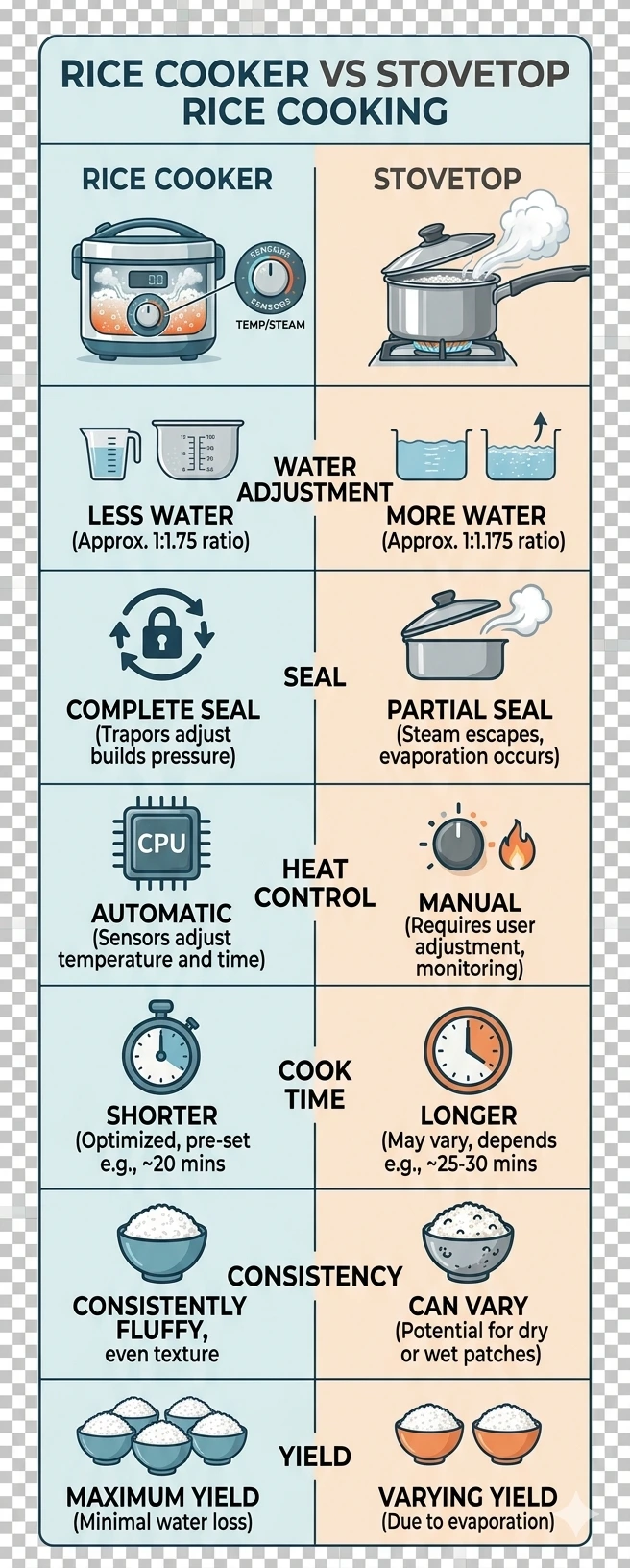
A rice cooker uses a sealed environment and a thermal sensor to stop cooking at the right moment. A stovetop pot is open to the air and relies on your eye and your timer. The difference shows up in water volume, consistency, and how hands-off the process is.
| Dimension | Rice Cooker | Stovetop Absorption |
|---|---|---|
| Water adjustment | −10% vs published ratio | Published ratio, no change |
| Seal | Sealed, traps steam | Vented or partially covered |
| Heat control | Thermal sensor cuts power | Manual, based on your stove |
| Cook time | 15–20 min (varies by model) | 15–50 min (varies by rice) |
| Result consistency | High, repeatable | Depends on stove and attention |
| Best for | Everyday cooking, busy households | Control over texture, small batches |
| Yield per cup | About 3 cups cooked | About 3 cups cooked |
The rice cooker wins on consistency. Once you’ve dialed in the water amount for your specific model, the result is nearly identical batch to batch. That’s why so many Asian households have a rice cooker sitting on the counter permanently.
The stovetop wins on flexibility. You can toast the rice before adding water, add aromatics like garlic or bay, or switch to the pasta method mid-recipe if the rice looks off. It’s also cheaper and takes up less counter space.
This calculator handles both. It applies a −10% water adjustment when you select the rice cooker method, which reflects the reduced evaporation from the sealed lid. It does not model a specific cooker’s heating profile, so if your cooker runs hot or cool, you may need to adjust the water slightly after a batch or two.
A home cook making rice for a family dinner needs a fast answer without a recipe. Enter 2 cups of white long grain, select the absorption method, and the calculator returns 4 cups of water and 18 to 20 minutes on the stovetop. That’s a standard ratio for a standard side dish. The servings tile shows 6 cups cooked, which covers four adults with a little leftover.
Sushi rice needs a specific texture: sticky enough to hold a roll, but not mushy. The calculator uses a 1:1.33 ratio and 18 to 20 minutes, which is the standard for Calrose and other short-grain sushi varieties. For 3 cups of dry rice, that’s 4 cups of water. The pasta method isn’t used here because the goal is maximum stickiness, not separation. Let the rice cool to room temperature before mixing in the seasoned vinegar.
Brown rice takes 40 to 45 minutes and a bit more water than white. A batch cook enters 4 cups of brown long grain and gets back 7 cups of water and a cook time of 40 to 45 minutes. The yield is 12 cups cooked, which is 12 servings or 6 meal-prep containers if you’re doing half-cup portions. Brown rice holds up well in the fridge for 4 to 5 days.