Plan exact quantities of fruit, vegetables, perishables, non-perishables, and canned foods for your household quarantine. Enter your household members and quarantine days to get a full shopping list.
| Item | Per person per day | Total needed | Notes |
|---|
| Item | Per person per week | Total needed | Storage |
|---|
| Item | Per person per week | Total needed | Shelf life |
|---|
| Item | Per person per week | Total needed | Notes |
|---|
| Metric | Value | Notes |
|---|
-
Select a citation style above. Click the citation text to select it all, then copy.

Founder & CEO, Toolraxy
Faiq Ur Rahman is a web designer, digital product developer, and founder of Toolraxy, a growing platform of web-based calculators and utility tools. He specializes in building structured, user-friendly tools focused on health, finance, productivity, and everyday problem-solving.
User Ratings:
ADVERTISEMENT
ADVERTISEMENT
It’s completely understandable to worry about having enough food during a global pandemic. When we’re used to being able to buy almost anything whenever we need it, an uncertain situation can make us want to stock up. Buying a little more than usual is fine, but there’s no need to panic-buy. Here are a few simple tips to help you shop wisely:
Make a shopping list: Before you go to the store, make a list of the things you actually need. This will help you stay focused and avoid buying unnecessary items.
Don’t buy everything just because it’s available: Seeing a product in stock doesn’t mean you need to fill your cart with it. Buy what you and your family are likely to use.
Don’t copy what everyone else is doing: If you see other shoppers buying large quantities of a particular product, don’t feel pressured to do the same. Think about what you really need.
Pay attention to fresh and perishable foods: Check the use-by dates before buying food and think about how quickly you can use it. There’s no point buying more fresh food than you can eat before it goes bad.
Choose nutritious foods that last longer: Foods such as wholemeal pasta, brown rice, UHT milk, grains, seeds, and legumes are good options because they can be stored for longer while still providing useful nutrients.
Try not to stock up on unhealthy snacks: It can be tempting to buy lots of sweets, chips, and other snacks when you’re spending more time at home. But if they’re sitting in your kitchen, you may end up eating them much faster than you expected!
Buy things you’ll actually use: Choose foods that you and your family normally enjoy. Don’t buy something simply because it has a long shelf life or happens to be available. And, of course, avoid anything you’re allergic to.
Take precautions while shopping: Follow the health and safety guidance in your area. When recommended, wear a mask and maintain a safe distance from others to help protect yourself and those around you.
The goal isn’t to fill your cupboards with everything you can find. A little planning and sensible shopping can help make sure you have what you need without wasting food or taking more than your fair share.
Choose metric or imperial units. Metric is the default.
Enter the number of women in the household.
Enter the number of men.
Add girls under 10, if any.
Add boys under 10, if any.
Set your quarantine length in days. Default is 14.
Use a duration preset if you want a quick 7, 14, 21, or 30-day plan.
Read the four category tables and the full summary for your shopping list.
No image: the steps map directly to the form fields above them, so a diagram would just repeat the inputs.
The calculator converts your household into “adult-equivalent portions,” then multiplies by days and per-item rates.
Formula: Adult Equivalent = (Women × 1.00) + (Men × 1.15) + (Girls × 0.75) + (Boys × 0.85)
Men eat slightly more than women, so they’re weighted at 1.15. Girls under 10 count as 0.75 of an adult portion, boys at 0.85. These aren’t guesses. They reflect typical calorie and food intake differences by age and sex.
Formula: Person-Days = Adult Equivalent × Quarantine Days
A household of two adults (one woman, one man) for 14 days is 2.15 adult equivalents × 14 = 30.1 person-days. That’s the number that drives all the food quantities.
Formula: Total Item Quantity = Person-Days × Per-Day Rate (or Adult Equivalent × Weeks × Per-Week Rate)
Fruit and vegetables use per-day rates. Apples run 0.20 kg per person per day; potatoes the same. Onions and carrots use 0.07 kg. The calculator sums these into a daily produce total of about 0.59 kg per person per day.
Perishables, dry goods, and canned items use per-week rates. Eggs are 8 per person per week, bread 1.5 loaves, milk 3.5 litres. Pasta, rice, and oats sit around 0.3 to 0.4 packs per person per week. Canned tuna is 0.5 cans per person per week.
Rounding for countable items (eggs, loaves, cans, jars) rounds up to the nearest whole unit. Weight-based items show one decimal place. The unit system toggle only changes how weights and volumes display; the underlying calculations don’t change.
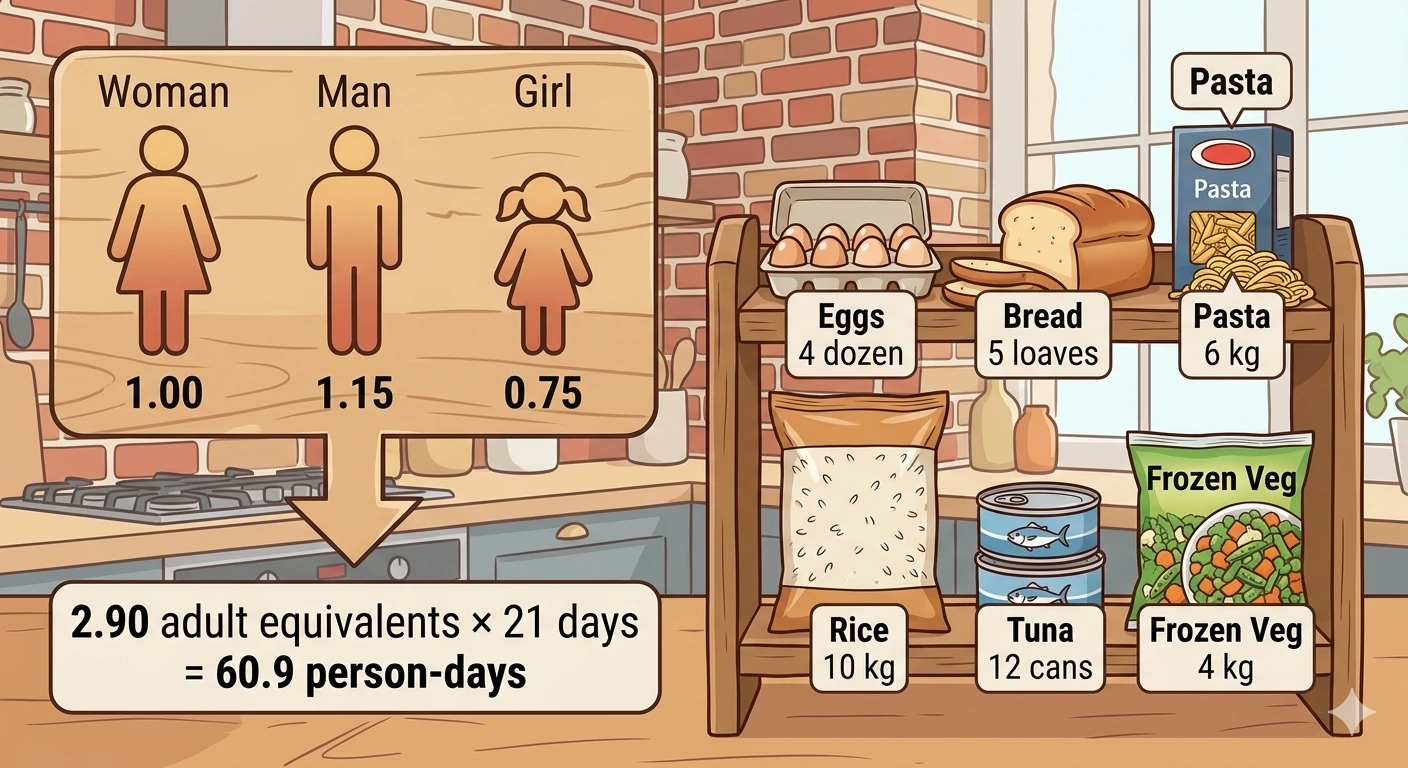
You’re planning for a household of three: one woman, one man, and one girl under 10. You want a 21-day supply.
Step 1 : Adult equivalents. (1 × 1.00) + (1 × 1.15) + (1 × 0.75) = 2.90.
Step 2 : Person-days. 2.90 × 21 = 60.9.
Step 3 : Fruit and vegetables. Daily produce rate is 0.59 kg per adult. 60.9 × 0.59 = 35.9 kg total. Apples alone: 60.9 × 0.20 = 12.2 kg. Potatoes: 12.2 kg. Onions and carrots: 4.3 kg each. Bell peppers: 3.0 kg.
Step 4 : Perishables. 21 days is 3 weeks. Eggs: 2.90 × 3 × 8 = 69.6, rounded to 70 eggs. Bread: 2.90 × 3 × 1.5 = 13.05, rounded to 14 loaves. Milk: 2.90 × 3 × 3.5 = 30.4 L. Minced meat: 2.90 × 3 × 1.5 = 13 trays.
Step 5 : Dry goods. Pasta and rice both at 0.4 packs per person per week: 2.90 × 3 × 0.4 = 3.5 packs each, rounded to 4. Honey at 0.1 jars per week: 2.90 × 3 × 0.1 = 0.87, rounded to 1 jar.
Step 6 : Canned and frozen. Frozen vegetables at 0.7 packs per week: 2.90 × 3 × 0.7 = 6.09, rounded to 7 packs. Tuna: 2.90 × 3 × 0.5 = 4.35, rounded to 5 cans. Tomatoes: 6.09, rounded to 7 cans.
The summary table shows 60.9 person-days and the four category totals. That’s the shopping list.

A single adult needs roughly 30 to 35 kg of food for 14 days, split across fruit and vegetables, perishables, dry goods, and canned or frozen items. A household of four adults doubles that to 120 to 130 kg. The calculator adjusts for age and gender, so a family with young children gets a realistic count rather than a flat per-person estimate.
Public health guidance points to 14 days as the baseline. A safer target is 14 days plus three to five extra days, in case isolation extends or a delivery falls through. For households with someone who has tested positive, 21 days is more realistic because the person isolating may need to stay home longer than the standard window.
Stock four categories: fruit and vegetables for the first week, perishables like eggs, bread, milk, and cheese for the first 7 to 10 days, dry goods like pasta, rice, oats, and lentils for the back half, and canned or frozen items for variety and protein. The calculator’s list covers all four with specific quantities.
A reasonable estimate for a single adult is $80 to $150 depending on the region and store. For a family of four, $300 to $500 is typical. Buying shelf-stable items in bulk and using store brands reduces the cost. The calculator doesn’t estimate cost because prices vary too much by location and brand.
You can, but delivery should supplement a base supply, not replace it. Delivery slots can be two to five days out during a surge, substitutions are common, and quantity limits sometimes apply. Stock the shelf-stable items yourself and use delivery for fresh top-ups. That way a failed delivery doesn’t leave you without food.
Honey, salt, and white rice stored in sealed containers last indefinitely. Canned goods last 2 to 5 years. Dry pasta and sealed oats last 1 to 3 years. Frozen vegetables keep 6 to 12 months. Fresh eggs last 3 to 5 weeks refrigerated, milk 1 week past the sell-by date, and hard cheese 4 to 6 weeks wrapped.
Dry goods go in a cool, dark, dry spot away from the stove and fridge. Perishables stay in the fridge at 40°F or below. Minced meat gets portioned into meal-sized bags and frozen the day you bring it home. Fresh produce should be eaten in the first four to five days, with apples and potatoes lasting the longest.
Yes, but separately. The calculator assumes a standard mixed diet with no allergies or dietary restrictions. Add gluten-free, diabetic, or low-sodium items to your own list. Prescription medications, infant formula, pet food, and hygiene supplies are outside the calculator’s scope and should be planned as separate lists.
This calculator provides general food quantity estimates for household planning. It does not account for individual dietary needs, medical conditions, allergies, or special populations like infants, pregnant women, or people on medically prescribed diets. Food safety guidance references the CDC and USDA, but specific local recommendations may differ. Verify quantities against your household’s actual consumption patterns before making a large purchase. Nothing here is medical advice.
ADVERTISEMENT
ADVERTISEMENT