Water Cooling Calculator: Cooling Time, Rate & Temperature Schedule

Water Cooling Calculator

Estimate how long hot water takes to cool to your target temperature. Uses Newton's law of cooling with container-specific coefficients for cups, mugs, pots, bottles, and coolers.

Unit system
Temperature & container
C
C
C
L
Newton's law of cooling states that the rate of heat loss is proportional to the temperature difference between the water and the surrounding air. Container material, insulation, and airflow all change the cooling coefficient. A vacuum flask keeps water hot for hours; a thin plastic cup loses heat in minutes.
Advanced options
min
Real-world factors. This calculator uses the standard Newton's law model, which is accurate when the temperature difference is moderate. At very high temperatures (near boiling), evaporation and radiation add extra cooling that Newton's law does not fully capture. Use the result as a practical estimate, and always check with a thermometer.
Cooling Result
Estimated Cooling Time
-
- temperature drop - cooling coefficient - container
💚-
Cooling time
-
Heat removed
-
Initial cooling rate
-
Half-life
-
Cooling timer
Ready to start
00:00 min:sec
Temperature schedule
Time elapsedWater temperatureDrop from startNotes
Container reference (cooling coefficients)
ContainerCoefficient kTypical cooling timeNotes
Thermal physics breakdown
MetricValueNotes
Full summary
MetricValueNotes
Powered by Toolraxy
Embed this calculator
Embed code
Live preview, identical to the main calculator EXACT MATCH
Cite this calculator
-

Select a citation style above. Click the citation text to select it all, then copy.

Creator & Maintainer

Image of Faiq Ur Rahman, CEO & Founder Toolraxy

Faiq Ur Rahman

Founder & CEO, Toolraxy

Faiq Ur Rahman is a web designer, digital product developer, and founder of Toolraxy, a growing platform of web-based calculators and utility tools. He specializes in building structured, user-friendly tools focused on health, finance, productivity, and everyday problem-solving.

Share:

Rate this Tool

User Ratings:

0
0 out of 5 stars (based on 0 reviews)
Excellent
Very good
Average
Poor
Terrible

ADVERTISEMENT

ADVERTISEMENT

Hot water doesn’t cool at a steady rate. It drops fast at first, then slows as it approaches room temperature. That curve is Newton’s law of cooling, and it’s the same math behind your coffee going cold, a pot of stock cooling on the counter, and a cooler full of ice melting in the sun. This calculator turns that curve into a usable time estimate. Enter your starting temperature, target temperature, and the container you’re using. The tool returns a cooling time you can set a timer to. It’s built for home cooks, food service workers, and anyone who needs to know when hot water hits a specific temperature.


How to Use the Water Cooling Calculator

  1. Pick your unit system. Metric uses Celsius and litres. Imperial uses Fahrenheit and cups. The tool converts temperatures and volume automatically when you switch.

  2. Enter the initial water temperature. The default is 100°C (212°F), which is boiling. Adjust it if your water started cooler.

  3. Set your target temperature. This is the temperature you’re waiting for. The default is 60°C (140°F), a common sipping temperature for tea and coffee.

  4. Enter the ambient temperature. The room or outdoor air temperature around the container. The default is 22°C (72°F).

  5. Choose your container type. Pick from ceramic mug, paper cup, glass, thin plastic, insulated travel mug, stainless bottle, thermos, small saucepan, large pot, glass pitcher, or cooler. Each has its own cooling coefficient.

  6. Enter the water volume. The amount of water matters. A full pot cools slower than a half-full mug. The default is 0.75 L (about 3 cups).

  7. Adjust airflow and lid settings. Still air, a breeze, or a fan all change the cooling rate. A lid on the container slows cooling by trapping heat. Select the state that matches your setup.

  8. Read the result and start the timer. The hero card shows estimated cooling time. Hit “Start timer” to run a countdown.

Worked Example

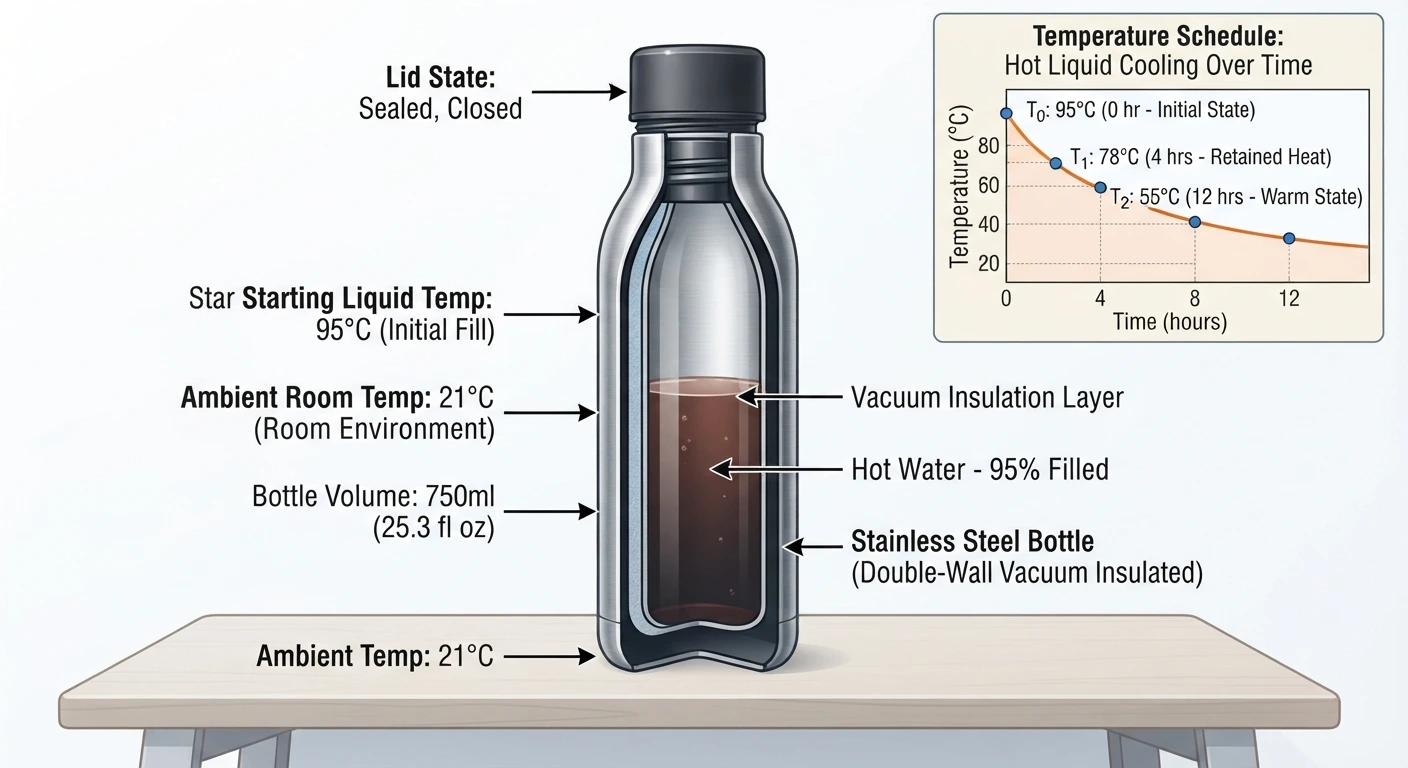
You’ve just boiled 0.75 L of water in a stainless steel bottle. You want it to cool from 100°C to 60°C, and the room is at 22°C. You’ve got a loose lid on it and there’s no fan running.

The container coefficient for a stainless steel bottle is k = 0.022/min. Still air keeps the airflow factor at 1.0. A loose lid applies a 0.85 factor. The volume adjustment for 0.75 L gives roughly 1.10. So the effective k is 0.022 × 1.0 × 0.85 × 1.10 = 0.0206/min.

The initial gap is 100 − 22 = 78°C. The target gap is 60 − 22 = 38°C. The cooling time formula gives: (1/0.0206) × ln(78/38) = 48.5 × 0.719 = 34.9 minutes. The calculator rounds that to 35 minutes.

The temperature schedule shows the water hits 80°C at about 8 minutes, 70°C at about 18 minutes, and 60°C at the 35-minute mark. Heat removed is 0.75 kg × 4.184 × 40 = 125.5 kJ. The initial cooling rate is 0.0206 × 78 = 1.61°C per minute.


diagram of a stainless steel bottle showing water volume, temperatures, and cooling time milestones.

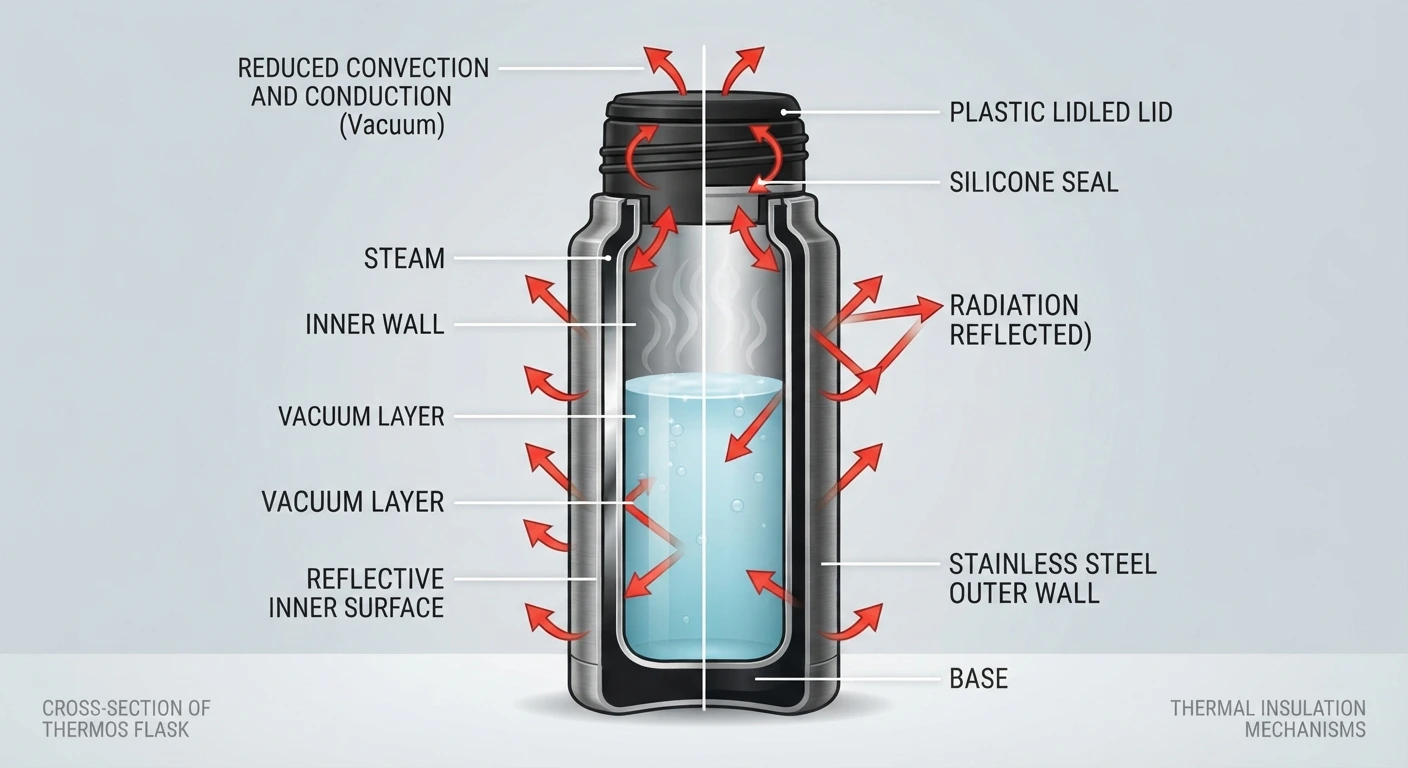
Why does a thermos keep water hot for so long?

A thermos keeps water hot for a long time because it slows down the transfer of heat between the hot water and the surrounding environment.

A typical thermos uses several features to reduce heat loss:

  • Double walls: There are two layers of material with a space between them.
  • Vacuum insulation: The air is removed from the space between the walls, greatly reducing heat transfer through conduction and convection.
  • Reflective surfaces: Some thermoses have reflective inner walls that reduce heat loss through thermal radiation.
  • Tight-fitting lid: The lid helps prevent warm air and steam from escaping, reducing heat loss through convection and evaporation.
  • Insulating materials: The cap and other parts are designed to limit heat transfer through the opening.

So, a thermos doesn’t actually “create” or maintain heat, it simply slows the rate at which the hot water loses its heat.


How a thermos keeps water hot using vacuum insulation


What People Use Water Cooling Calculation For

Cooling Tea or Coffee to Drinking Temperature

Home beverage drinkers use this calculation to know when their tea or coffee is cool enough to drink without burning their mouth. The situation: you’ve just poured boiling water over a tea bag in a ceramic mug and want to know when it hits 60°C. The inputs that matter most are the container type and volume. A 250 mL ceramic mug with k = 0.045 takes about 9 minutes to drop from 100°C to 60°C in a 22°C room. A reasonable output for a standard mug is 7–12 minutes.


Safe Cooling of Stock or Soup

Food service workers and home cooks use this calculation to verify that large volumes of hot liquid will cool fast enough to meet food safety guidelines. The situation: you’ve made 4 L of chicken stock and need it to drop from 100°C to 21°C within 2 hours. The inputs that matter are volume and container. A 4 L pot with k = 0.035 and a volume adjustment of about 0.7 gives an effective k of 0.0245. The cooling time from 100°C to 21°C in a 22°C room is about 2.5 hours. That’s over the FDA’s 2-hour window, so an ice bath or shallow pan would be needed.


Beverage Cooler Performance Testing

Anyone comparing coolers, thermoses, or insulated bottles uses this kind of calculation to see how long each one keeps water hot. The situation: you’re deciding between a vacuum flask and a stainless bottle for a hiking trip and want to know which one holds heat longer. The inputs that matter are the container coefficient and the target temperature. A vacuum flask with k = 0.006 keeps water above 60°C for over 3 hours. A single-wall stainless bottle with k = 0.022 drops below 60°C in about 35 minutes.

Frequently Asked Questions

How long does hot water take to cool to room temperature?

It depends on the container and volume. A mug of boiling water in a 22°C room cools to room temperature in about 45 to 60 minutes. A 4-litre pot can take 4 to 6 hours. The calculator gives you a specific estimate for your container and volume.


How long does it take for boiling water to cool to 60°C?

In a standard ceramic mug (250 mL), boiling water drops to 60°C in about 9 to 12 minutes. A stainless steel bottle takes 35 to 50 minutes. A vacuum flask can take 3 hours or more. Container material and volume drive the difference.


Does a lid make water cool faster or slower?

A lid slows cooling. It traps evaporating water vapor, which removes a major heat-loss pathway. A tight lid can reduce the cooling coefficient by 45% compared to an open container. If you want faster cooling, leave the lid off.


How does airflow affect water cooling?

Moving air speeds cooling by sweeping away the saturated vapor layer above the water surface. A fan directed at a mug can cut cooling time by about 30% compared to still air. Outdoor wind has a similar effect, roughly 30% faster than still air.


What is the cooling coefficient k?

k is the rate constant in Newton’s law of cooling, expressed per minute. It represents how quickly the water loses heat to its surroundings. A thermos has a very low k (about 0.006/min). A thin plastic cup has a high k (about 0.085/min).


How do you calculate the cooling time of water?

Use the formula t = (1/k) × ln((T_initial − T_ambient) ÷ (T_target − T_ambient)). You need the starting temperature, target temperature, ambient temperature, and the cooling coefficient k. The calculator does this automatically once you enter the inputs.


Does water volume affect cooling time?

Yes, significantly. A larger volume of water has more thermal mass and a lower surface-area-to-volume ratio, so it cools slower. A 4-litre pot takes roughly 4 to 6 times longer to cool than a 0.5-litre pot with the same container material.


What is the fastest way to cool hot water?

Pour it into a shallow metal pan, leave the lid off, and aim a fan at it. The metal conducts heat quickly, the shallow depth increases surface area, and the fan accelerates evaporation. This combination can cut cooling time by more than half compared to a covered pot in still air.


Can I use this calculator for food safety cooling?

You can estimate the cooling time, but the calculator models passive air cooling only. The FDA requires cooked food to cool from 135°F to 70°F within 2 hours. A large pot of stock will not hit that window through air cooling alone. You’d need an ice bath or shallow pans.


Disclaimer

This calculator provides estimates based on Newton’s law of cooling, which assumes a uniform water temperature and moderate temperature differences. Actual cooling times vary with container geometry, altitude, humidity, and water composition. The model does not fully account for evaporation and radiation at high temperatures. Always verify with a thermometer for food safety applications. For cooked food, follow FDA cooling guidelines: 135°F to 70°F within 2 hours, then to 41°F within 4 more hours.

ADVERTISEMENT

ADVERTISEMENT