Introduction
Building concrete stairs requires precise material estimates. Under‑order and you delay the project; over‑order and you waste money. The Concrete Stairs Calculator helps you quickly determine the volume of concrete needed for a straight staircase, plus the number of pre‑mixed bags and total cost. Input the tread depth (run), riser height, number of steps, stair width, and an optional landing. Adjust waste percentage, bag size, and price per bag. Switch between metric (cm, m³) and imperial (inches, ft³/yd³) units. The tool uses the standard formula for stair volume (total run × total rise / 2 × width) and adds landing volume if required. Whether you are a contractor, DIY homeowner, or student, this calculator gives you reliable estimates in seconds—no complex math required. Powered by Toolraxy, it runs entirely in your browser for private, instant results.
How to Use
Select currency and units – Choose your local currency and measurement system (metric or imperial).
Enter stair dimensions – Tread depth (run), riser height, number of steps, and stair width.
Add a landing (optional) – Check the box and enter landing length, width, and thickness.
Set waste percentage – Default 5% covers spillage and over‑excavation.
Choose bag size – Pick from 40, 60, 80, 90 lb bags, or enter a custom bag weight.
Enter concrete density – Standard 2400 kg/m³ (150 lb/ft³) is pre‑filled.
Set price per bag – Your local cost per bag.
Click “Calculate” – View stair volume, landing volume, total volume with waste, number of bags, and total cost.
How the Tool Works
The calculator follows three main steps: volume calculation, unit conversion, and bag/cost estimation.
Volume Formulas
Stair volume (m³)
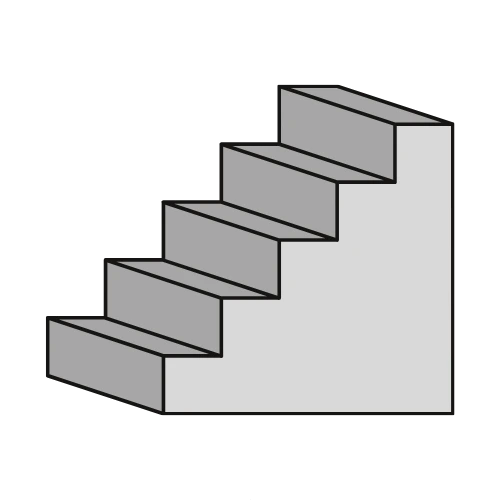
Total run = tread depth (m) × number of steps
Total rise = riser height (m) × number of steps
Stair volume = (total run × total rise / 2) × stair width (m)
Landing volume (m³)
Landing volume = landing length (m) × landing width (m) × landing thickness (m)
Total volume with waste
Total volume = (stair volume + landing volume) × (1 + waste% / 100)
Unit Handling
Metric: Inputs in cm → divide by 100 to get meters. Volume displayed in m³.
Imperial: Inputs in inches → divide by 12 to get feet. Volume converted to m³ internally, then displayed as ft³ or yd³ (1 m³ = 35.3147 ft³; 27 ft³ = 1 yd³).
Bag Quantity (Always Rounded Up)
Total cubic feet = total volume (m³) × 35.3147
Bag yield in cubic feet based on bag weight:
Bags needed = ceil(total cubic feet ÷ bag yield in ft³)
Cost Calculation
Total cost = bags needed × price per bag
Note: The density field is present but not used in calculations. It remains for reference only. Bag yields are derived from standard industry values (lb → ft³) independent of density.
Validation & Edge Cases
If number of steps ≤ 0, stair volume = 0.
If any dimension is empty or invalid, it is treated as 0.
Waste percentage can be 0–30% (no limit enforced beyond UI).
Bag yields for standard sizes are fixed; custom bag weight uses a linear approximation (0.0075 ft³ per lb).
Results update on every input change; “Calculate” button recalculates as well.
Worked Example
Problem: You need to pour a concrete staircase with 10 steps, each tread depth 30 cm, riser height 18 cm, stair width 120 cm, no landing. Waste factor 5%. You will use 60 lb bags costing $8.50 each. How many bags and total cost?
Step‑by‑step (metric):
Convert cm to m: tread = 0.30 m, riser = 0.18 m, width = 1.20 m.
Total run = 0.30 × 10 = 3.00 m
Total rise = 0.18 × 10 = 1.80 m
Stair volume = (3.00 × 1.80 / 2) × 1.20 = (5.4 / 2) × 1.20 = 2.7 × 1.20 = 3.24 m³
Add waste 5%: total with waste = 3.24 × 1.05 = 3.402 m³
Convert to cubic feet: 3.402 × 35.3147 = 120.15 ft³
60 lb bag yield = 0.45 ft³
Bags needed = ceil(120.15 ÷ 0.45) = ceil(267) = 267 bags
Total cost = 267 × 8.50=∗∗8.50=∗∗2,269.50**
Takeaway: Order 267 bags. The calculator confirms this instantly and also shows stair volume (3.240 m³), total with waste (3.402 m³), and cost in your chosen currency.
Benefits of Using This Tool
Saves time – Instant stair volume without manual geometry.
Reduces manual errors – No risk of forgetting the “divide by 2” or unit conversion mistakes.
Instant results – Updates as you type or change settings.
Free to use – No subscription or payment required.
Private – All calculations run in your browser; no data sent to any server.
Accessible on any device – Responsive design works on desktop, tablet, and mobile.
Supports both metric and imperial – Switch units without re‑entering values.
Includes optional landing – One tool for stairs and landings together.
FAQs
How accurate is this concrete stairs calculator?
The calculator is mathematically exact based on your inputs. Accuracy depends on precise measurements of tread depth, riser height, and width. Use a tape measure or laser distance tool for best results.
Can I calculate concrete for L‑shaped or spiral stairs with this tool?
No. This tool is designed only for straight stairs with a constant tread and riser. L‑shaped, U‑shaped, or spiral stairs require different geometry and are not supported.
What is the difference between tread depth and run?
Tread depth (also called run) is the horizontal distance from the front of one step to the front of the next. Total run is tread depth multiplied by the number of steps.
Does this calculator include the concrete for the landing edge or nosing?
No. The landing volume is calculated as a simple slab (length × width × thickness). It does not include any overhangs, nosing profiles, or edge beams. Add extra waste to compensate.
How do I convert bag yield from pounds to cubic feet manually?
Standard conversion: divide the bag weight in pounds by 150 (density in lb/ft³) then multiply by 0.85–0.95 for compaction and air. The tool uses fixed yields: 40 lb → 0.3 ft³, 60 lb → 0.45 ft³, 80 lb → 0.6 ft³, 90 lb → 0.675 ft³.
Why does the density field exist if it’s not used?
The density field is a reference for advanced users who want to verify bag yield assumptions. It does not affect calculations. Future updates may incorporate density, but currently bag yields are pre‑defined.
Can I use this calculator for concrete steps without a riser (e.g., floating treads)?
No. The calculator assumes a closed riser design (each step has a vertical riser). For open‑riser stairs, the volume is lower. You would need to adjust by using a smaller riser height or reduce the number of steps manually.
Is this tool suitable for professional construction bidding?
It provides a reliable estimate for material takeoffs, but always add contingency (e.g., 10–15% instead of 5%) and consult local codes. For final bids, confirm bag yields with your concrete supplier.
What happens if I enter zero or negative steps?
The calculator shows zero volume for stairs and “—” for bags and cost. Positive numbers are required for meaningful results.
How does the waste factor apply to the landing separately?
The waste percentage applies to the total volume (stairs + landing) after adding both components. It does not differentiate between stair and landing waste.
Can I share my calculation with my contractor?
Yes. Use the “Copy” button to copy a summary to your clipboard, or the “Share” button to send via messaging or email. The summary includes all key results and the tool link.
Does this tool account for reinforcement steel (rebar) or formwork?
No. Only concrete volume, bags, and cost are estimated. Rebar, formwork, labor, and finishing are separate expenses.