What Is Beef Ham and How Is It Made?
Beef ham is a cured beef product made from the leg or thigh muscle. The meat is typically wet-brined or dry-cured with salt, nitrites, and sometimes sugar, then smoked or left unsmoked. The result is a firm, pink-hued joint that slices cleanly and tastes like a cross between roast beef and traditional pork ham. The cure is what gives it the color and the extended shelf life.
Curing does more than preserve. It firms up the muscle fibers, which is why beef ham slices without crumbling the way a plain roast does. That texture is why it’s popular for deli sandwiches and cold cuts.
How to Use the Beef Ham Cooking Time Calculator
Choose imperial or metric.
Enter the joint weight. The default is 3 lb, which is a typical small roast.
Pick your product type: raw, pre-cooked, or thin sliced.
Select a joint shape. Bone-in joints cook slower than boneless.
Choose a cooking method.
Set the oven temperature if you’re roasting. Other methods ignore this field.
Add a glaze if you want one. Glazing adds browning time to the roast.
Decide whether to rest the joint. Then calculate.
How the Beef Ham Cooking Time Formula Works
The calculator multiplies your joint weight by a rate that depends on method and product type, then layers on shape, glaze, and rest adjustments.
Formula: Base Time = Weight (lb) × Rate (min/lb)
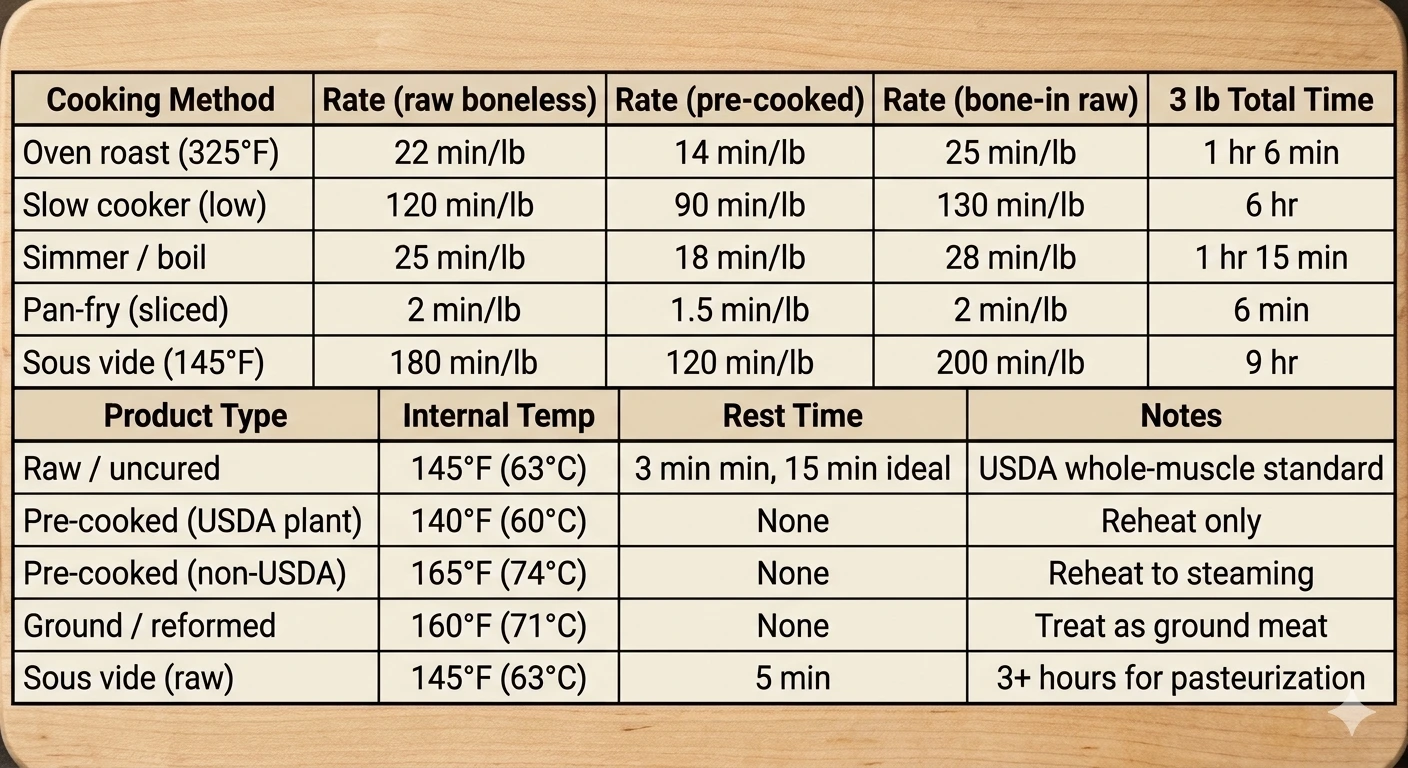
Rates come from five method profiles. Oven roasting a raw boneless joint uses 22 min/lb. Pre-cooked drops to 14. Bone-in raw rises to 25. Slow cooking runs 120 min/lb for raw joints. Simmering uses 25 min/lb. Sous vide runs 180 min/lb. Pan-frying, which only works for thin sliced product, uses 2 min/lb.
Formula: Total Cook Time = (Weight × Rate × Shape Factor) + Glaze Time
A flat or rectangular joint roasted in the oven gets multiplied by 0.9 because the thinner profile heats faster. Other shapes use a 1.0 factor. Glazing adds 15 minutes across the board, which covers brushing on the glaze and letting it caramelize under the broiler or in the oven’s dry heat.
Formula: Target Internal Temp = 145°F (raw), 140°F (pre-cooked)
Raw beef ham must reach 145°F with a 3-minute rest. Pre-cooked beef ham from a USDA-inspected plant only needs reheating to 140°F. Pre-cooked ham from other sources must hit 165°F. Rest time is 15 minutes for raw joints and 10 minutes for pre-cooked. The calculator tracks rest separately because it’s not active cooking time, so the timer doesn’t include it.
Example of a 3.5-pound raw bone-in beef ham at 325°F
You’re roasting a 3.5-pound raw bone-in beef ham at 325°F. No glaze. You plan to rest it.
Step 1 : Base rate. Raw bone-in oven rate is 25 min/lb.
Step 2 : Base time. 3.5 × 25 = 87.5 min.
Step 3 : Shape factor. Bone-in uses 1.0, so no change. A flat joint would have multiplied by 0.9.
Step 4 : Glaze. None, so no adjustment.
Step 5 : Total. 87.5 min, or 1 hr 28 min (rounded).
Step 6 : Target temp. 145°F (63°C) for raw beef ham.
Step 7 : Rest. 15 minutes tented with foil.
So roughly 1 hour 28 minutes in the oven, then 15 minutes on the counter. The internal temperature will coast up another 5 to 10 degrees during the rest. If you dropped to a 3-pound boneless joint, you’d be at 66 minutes, a full 22 minutes faster.

Frequently Asked Questions
How long do you cook beef ham per pound?
A raw boneless beef ham roasted at 325°F takes about 22 minutes per pound. Pre-cooked joints take 14 minutes per pound. Bone-in raw joints take 25. Slow cooking runs 120 minutes per pound. The calculator gives the exact number for your weight, method, and product type.
What temperature should beef ham reach?
Raw beef ham must reach 145°F (63°C) with a 3-minute rest. Pre-cooked beef ham from a USDA-inspected plant only needs reheating to 140°F (60°C). Pre-cooked ham from other sources should reach 165°F (74°C). Always use a meat thermometer.
Is beef ham the same as corned beef?
No. Beef ham is cured beef from the leg or thigh, brined and often smoked. Corned beef is cured beef brisket, usually simmered rather than roasted. Both are cured beef but the cuts, textures, and cooking methods differ.
Can you overcook beef ham?
Yes, especially pre-cooked joints. Going past 165°F dries out the meat and makes it crumbly. Raw beef ham is more forgiving, but the sweet spot is 145°F for juiciness. The calculator warns on simmer times over 2 hours for pre-cooked joints.
How long does beef ham last in the fridge?
Cooked beef ham lasts 3 to 5 days refrigerated in an airtight container. Pre-cooked store-bought beef ham keeps for 7 to 10 days unopened and 3 to 5 days after opening. Frozen slices keep for 2 to 3 months.
Do you need to glaze beef ham?
Glazing is optional but adds flavor and a caramelized crust. Honey, maple, brown sugar, and mustard glazes all work. Apply the glaze in the last 20 to 30 minutes of roasting so it browns without burning. The calculator adds 15 minutes to the cook time when you select a glaze.
Can you cook beef ham in a slow cooker?
Yes, and it’s one of the easier methods. Slow cooking runs 120 minutes per pound for raw joints, so a 4-pound joint needs about 8 hours on low. Add liquid to cover the bottom third of the joint and baste every hour or so.
Why does bone-in beef ham take longer to cook?
Bone conducts heat more slowly than muscle, so a bone-in joint takes about 14% longer than a boneless one of the same weight. That’s why the calculator uses 25 min/lb for bone-in versus 22 for boneless. The bone also adds flavor from marrow and connective tissue.
Food Safety Disclaimer
This calculator provides cooking time estimates for planning purposes. Actual times vary with oven calibration, pan material, joint shape, and starting temperature. Always use a meat thermometer to confirm doneness. The USDA minimum internal temperature for whole muscle beef is 145°F (63°C) with a 3-minute rest. Undercooked meat carries a risk of foodborne illness, which is a higher concern for young children, older adults, pregnant women, and anyone with a weakened immune system. Follow safe food handling practices and refrigerate leftovers within two hours.