

convert between CRL and gestational age, and get estimated due date and conception date.
| Milestone | Date | Notes |
|---|
| CRL (mm) | Gestational age | Embryo size comparison | Typical milestones |
|---|
ADVERTISEMENT
















User Ratings:
ADVERTISEMENT
ADVERTISEMENT
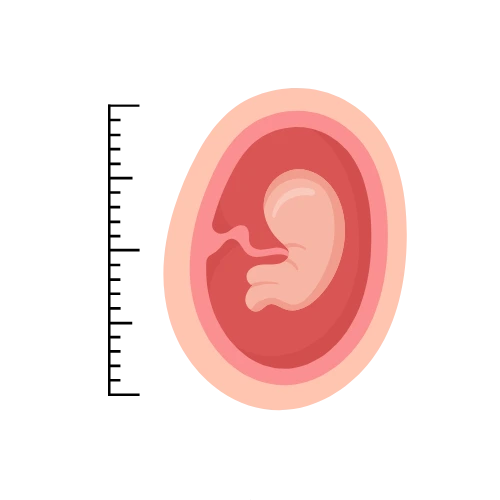
Crown-rump length is the number your sonographer jots down at a first-trimester scan. It’s the longest measurable axis of the embryo, from the top of the head to the bottom of the buttocks. That single millimeter value is what most clinics use to set your due date, because CRL dating beats LMP dating for accuracy in the window between roughly 7 and 13 weeks.
The tricky part is that CRL and gestational age don’t move in a straight line. Growth follows a square-root curve, which is why a 10 mm jump at the small end means more than a 10 mm jump at the large end. The Robinson equation handles that curve.
How to Use the CRL Calculator
Type the crown-rump length in millimeters into the first field. Anything from 5 to 84 mm is in the reliable range.
Watch the gestational age fields fill in automatically with weeks and days.
Reverse the process if you’d rather start with GA. Type weeks, type days, and the CRL updates itself.
Set the ultrasound date so the tool can anchor the calendar milestones to the right day.
Read the hero panel. Your estimated due date sits at the top in large type.
Scan the four tiles for CRL, gestational age, conception date, and trimester.
Check the reference table below to see where your measurement falls against typical milestones.
Tap a quick example button (CRL 20 mm, CRL 45 mm, GA 12w 0d) to see how the fields behave.
Formula: Gestational age (days) = 8.052 × √(CRL in mm) + 23.73
That’s the Robinson & Fleming equation from 1975, still the reference standard for first-trimester ultrasound dating. It takes the square root of the CRL measurement, scales it by 8.052, and adds a 23.73-day offset.
To go the other direction:
Formula: CRL (mm) = ((GA days − 23.73) ÷ 8.052)²
Both directions use the same constants. The tool uses a square-root curve because embryos don’t grow a fixed number of millimeters per day. Early on, one day of development adds a fraction of a millimeter. By 12 weeks, a single day can add nearly a full millimeter. The square root absorbs that acceleration.
Two-way sync is handled by tracking which field you last edited. If you touched the CRL field, the tool recalculates gestational age from it. If you touched the weeks or days fields, it works backward to CRL. Gestational days are clamped between 0 and 6, and CRL values below 5 mm or above 84 mm trigger a warning banner rather than blocking the calculation. The math still runs, but the output gets flagged as less reliable.
Say your scan report shows a CRL of 52 mm, and the ultrasound was done on April 14, 2026. You want to know the gestational age, due date, and conception estimate.
Plug 52 into the CRL formula: GA = 8.052 × √52 + 23.73
√52 ≈ 7.211. Multiply by 8.052 = 58.07. Add 23.73 = 81.8 days.
Rounded to the nearest day: 82 days, which is 11 weeks 5 days.
Back-calculate LMP: April 14 minus 82 days = January 22, 2026.
Due date: January 22 plus 280 days = October 29, 2026.
Conception estimate: October 29 minus 266 days = February 5, 2026.
The tool would show 11w 5d in the gestational age tiles, October 29, 2026 in the hero panel, and February 5, 2026 as the estimated conception date. The reference row for 50 mm would highlight (closest to 52), and you’d see the entry for a plum-sized embryo at 11w 4d.
If your LMP-based estimate said 12 weeks exactly, the CRL estimate (11w 5d) differs by 2 days. That’s inside the 7-day redating threshold, so most clinics would keep the original LMP-based due date.
It’s the length of the embryo from the top of the head to the bottom of the buttocks, measured by ultrasound in the first trimester. CRL is the standard measurement used to date a pregnancy between 7 and 13 weeks.
Use the Robinson equation: GA (days) = 8.052 × √(CRL in mm) + 23.73. A CRL of 25 mm works out to about 64 days, or 9 weeks 1 day.
At 7 weeks, a normal CRL sits between 9 and 14 mm. Measurements a millimeter or two outside that range are common and usually just reflect normal variation in ovulation timing.
Yes. CRL dating is accurate to within ±3 to 5 days, while LMP dating carries a ±1 to 2 week margin. That’s why most clinics switch to the CRL-based due date when the two disagree by more than the redating threshold.
After about 13 weeks 6 days, which corresponds to a CRL of roughly 84 mm. Past that point, second-trimester measurements like biparietal diameter and femur length take over.
A 45 mm CRL corresponds to about 11 weeks 1 day of gestational age. That’s near the end of the first trimester, and it’s usually the point when the nuchal translucency scan can be performed.
The measurement can be off by 3 to 5 days even in expert hands. Positioning, image quality, and how the embryo is lying all affect the number. The formula itself is validated across large populations, so the error is mostly in the measurement, not the math.
A CRL smaller than expected for the LMP-based age usually means ovulation happened later than assumed, or the scan was done earlier than the LMP suggested. In some cases it can prompt a follow-up scan to check for growth restriction.
No. CRL measures the embryo. Gestational sac diameter measures the fluid-filled sac around it. They’re different measurements with different reference charts and different accuracy profiles.
Yes, but interpret the results cautiously. CRL dating is less reliable in twin pregnancies because the embryos may grow at slightly different rates. Your provider will use the larger CRL for dating and monitor both.
It’s GA (days) = 8.052 × √(CRL in mm) + 23.73, published by Robinson and Fleming in 1975. It remains the most widely validated CRL dating equation and is used by clinics worldwide.
Standard practice is to take three measurements in a mid-sagittal plane with the embryo in a neutral position, then average them. A single measurement is fine for most clinical purposes, but averaging reduces the error band.
This CRL calculator is for educational purposes only. It applies the Robinson & Fleming formula to the measurement you enter and estimates a due date from there. Real pregnancy dating involves clinical judgment, multiple measurements, and sometimes repeat scans. Always rely on your healthcare provider’s dating for decisions about screening windows, delivery planning, or any other clinical matter. If your CRL and LMP estimates disagree, ask your provider which due date they’re using.
ADVERTISEMENT
ADVERTISEMENT