National Insurance isn’t one tax. It’s two running side by side: the employee’s contribution, which comes straight out of your pay, and the employer’s contribution, which sits on top of your salary as a separate cost to the business. Most payslips show only the employee side. That’s the number that hits your net pay. But if you’re hiring, budgeting for a new role, or comparing a job offer against self-employed contracting, the employer side is the one that actually determines what you cost. This calculator handles both. Enter the salary, choose the right NI category, and you’ll see the full picture including how the Employment Allowance eats into the employer bill, and how categories like M or H zero out the employer rate for younger workers.
How to Use the UK National Insurance Calculator
Leave the currency on GBP unless you’re modelling a different currency for comparison.
Type the gross annual salary into the first field.
Choose the tax year, 2025/26 or 2026/27.
Select the NI category letter that matches the employee. Category A covers most people.
Set the pay frequency if you want the summary table to reflect it.
Toggle Employment Allowance on if the employer qualifies for it.
Enter the number of employees the allowance needs to cover.
Read the result. The hero figure is the employee NI for the year.
How the UK National Insurance Formula Works
Two calculations run in parallel. One for the employee, one for the employer. Same salary, different thresholds, different rates.
Formula: Employee NI = 8% × (Earnings between £12,570 and £50,270) + 2% × (Earnings above £50,270)
Formula: Employer NI = 15% × (Earnings above £5,000) − Employment Allowance used
The employee side uses two bands. Anything between the Primary Threshold (£12,570) and the Upper Earnings Limit (£50,270) gets charged at 8%. Anything above £50,270 gets charged at 2%. Earnings below the Primary Threshold pay nothing.
The employer side is flatter. One rate, one threshold. Everything above £5,000 gets charged at 15%, with no upper cap.
 Same salary, two thresholds, two rates. The employer side has no upper cap.
The Employment Allowance then reduces the employer bill. You can claim up to £10,500 against the total employer NI across the business. If employer NI is less than £10,500, the allowance wipes it out entirely. If it’s more, you pay the difference.
NI categories change the rates and thresholds. Category C pays 0% because the employee is past State Pension age. Categories M, H, and Z drop the employer rate to 0% up to a higher threshold. Category B pays 1.85% instead of 8%. The calculator handles all eight categories.
Worked Example
Marcus earns £52,000 a year. He’s on Category A, under State Pension age, and his employer doesn’t claim the Employment Allowance because they’re a public sector body.
Step 1 – Employee NI main band: £50,270 − £12,570 = £37,700. Charged at 8% = £3,016.00.
Step 2 – Employee NI upper band: £52,000 − £50,270 = £1,730. Charged at 2% = £34.60.
Step 3 – Employee NI total: £3,016.00 + £34.60 = £3,050.60.
Step 4 – Employer NI: £52,000 − £5,000 = £47,000. Charged at 15% = £7,050.00.
Step 5 – Total NI cost: £3,050.60 + £7,050.00 = £10,100.60.
Marcus’s employee NI works out to 5.87% of his salary, and the employer adds another 13.56% on top. If his employer claimed the full Employment Allowance, the £7,050 employer bill would drop to zero, since the allowance caps at £10,500 and his employer NI is under that. Total NI would fall to £3,050.60.
Frequently Asked Questions
How much National Insurance on £45,000?
On £45,000 with Category A, you pay £2,594.40 in employee NI. That’s 8% on £32,430, the gap between the Primary Threshold and your salary. Your employer pays 15% on £40,000, which is £6,000 before any Employment Allowance.
Do under 21s pay National Insurance?
Yes, on their own earnings above £12,570. The difference is on the employer side. Category M means the employer pays 0% up to the Upper Secondary Threshold of £50,270, instead of the usual 15% from £5,000. That’s a genuine saving for businesses hiring young workers.
What is the Upper Earnings Limit?
The Upper Earnings Limit is £50,270 for 2025/26. Above that figure, employee NI drops from 8% to 2%. It’s the same figure as the higher-rate income tax threshold, which is why the two taxes step up together at the same salary level.
Can I claim Employment Allowance as a sole director?
Usually no. If you’re the only employee of your own limited company and you’re paid above the Secondary Threshold, HMRC blocks the claim. There are exceptions — if you have other employees on payroll, or if your company does charitable work, you may still qualify.
How is National Insurance calculated for weekly pay?
HMRC applies the thresholds per pay period, not annually. A weekly-paid employee has a weekly Primary Threshold of about £241.85 instead of the annual £12,570. The calculator gives annual figures, which match what a steady weekly pattern produces over a full year.
What happens if I’m on the wrong NI category?
You’ll either overpay or underpay. Overpaid NI is refundable, usually through a new tax code or a direct HMRC claim. Underpaid NI is more painful, HMRC treats it as arrears and may apply penalties. Check your payslip if anything looks off after a life event like turning 21 or reaching State Pension age.
Does National Insurance count towards my State Pension?
Yes, Class 1 contributions from employment count towards your State Pension. You need 35 qualifying years for the full new State Pension. Years with low earnings may still count if you were above the Lower Earnings Limit (£6,500 for 2025/26), even if no NI was actually deducted.
Is National Insurance the same as income tax?
No. They’re separate taxes with separate thresholds, rates, and rules. Income tax funds general public spending. NI funds specific social insurance programmes, mainly the State Pension and the NHS. Both come out of your pay, but they’re calculated independently.
What is the difference between Class 1 and Class 4 NI?
Class 1 is for employees, it comes out of payroll. Class 4 is for self-employed people, calculated on annual profits. Class 4 rates are 6% on profits between £12,570 and £50,270, then 2% above. Self-employed people also pay Class 2, which is a small flat weekly charge.
Can I opt out of National Insurance?
No, not if you’re employed and earning above the Primary Threshold. NI isn’t optional the way pension contributions are. You can reduce the amount through salary sacrifice, and you stop paying once you reach State Pension age, but there’s no formal opt-out while you’re working and below that age.
Disclaimer
This calculator uses HMRC’s published 2025/26 rates and thresholds. Real payroll calculations happen per pay period, so a variable-hours worker can see a slightly different annual total than a steady-salary estimate. The tool also assumes England, Wales, or Northern Ireland rules for the underlying framework, NI is UK-wide, but payroll software may apply different pay-period divisors. Check the result against your P60 or an accountant’s figures before making decisions. Nothing here is tax advice.



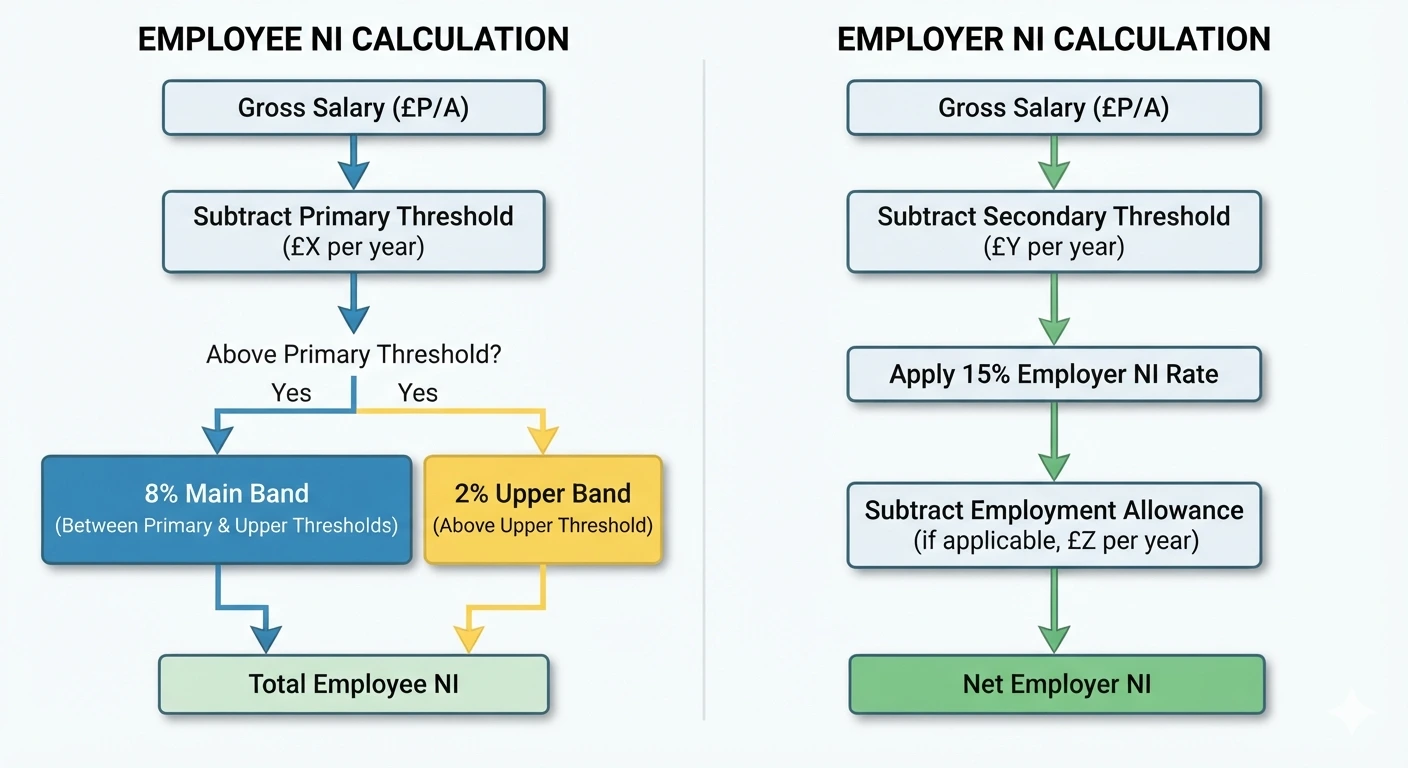 Same salary, two thresholds, two rates. The employer side has no upper cap.