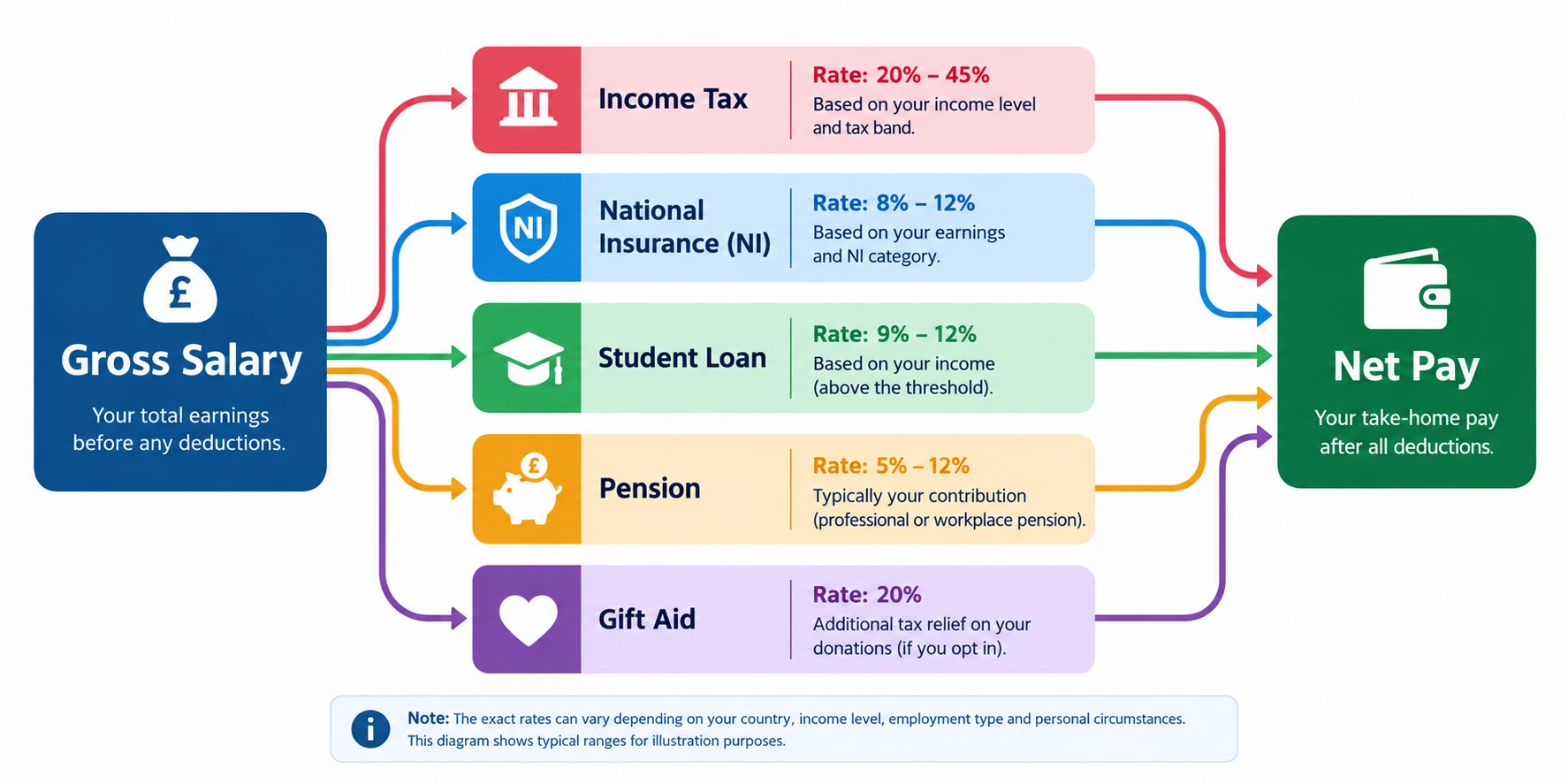
Your gross salary isn’t what you spend. Between income tax, National Insurance, student loan repayments, and pension contributions, a £45,000 offer can shrink to something closer to £34,000 by the time it hits your account. This calculator shows you that gap. It covers England, Wales, Northern Ireland, and Scotland, handles salary sacrifice, relief at source, and net pay pension methods, and accounts for student loan Plans 1, 2, 4, 5, and postgraduate. Whether you’re comparing job offers, checking a payslip, or running a budget, you’ll get the exact figures HMRC would use. Plug in your numbers and see what you actually keep.
How to Use the UK Take Home Pay Calculator
Pick your currency from the dropdown, GBP is set by default.
Type your annual gross salary into the salary field.
Select the tax year (2025/26 or 2026/27).
Choose your tax region: England/Wales/NI or Scotland.
Enter your pension contribution percentage, then select the contribution method.
Choose your student loan plan, or leave it as “No student loan.”
Add Gift Aid donations or Blind Person’s Allowance if either applies.
Hit Calculate or just watch the results update as you type.
How the UK Take Home Pay Formula Works
The calculator doesn’t use one single formula. It chains five separate deductions in a fixed order, because each one changes the base for the next.
Formula: Net Pay = Gross Salary − Income Tax − National Insurance − Student Loan − Pension Cost
Income tax starts with your personal allowance (£12,570 for most people). Subtract that from your taxable gross. The remainder gets sliced into bands 20%, 40%, 45% in England and Wales, or six different bands in Scotland. If your income crosses £100,000, the personal allowance tapers by £1 for every £2 above that line. At £125,140, it’s gone entirely.
National Insurance works on a different base. For 2025/26, you pay 8% on earnings between £12,570 and £50,270, then 2% on anything above that. Salary sacrifice pension contributions reduce both the tax base and the NI base. Relief at source and net pay arrangements only reduce the tax base.
Student loan repayments come off gross pay after pension (if salary sacrifice) but before tax. Plan 1 starts at £26,065, Plan 2 at £28,470, Plan 4 at £32,745, Plan 5 at £25,000, and postgraduate loans at £21,000. Most plans charge 9% of income above the threshold; postgraduate is 6%.

Worked Example
Priya earns £52,000 a year. She works in Manchester, contributes 5% to her pension through salary sacrifice, and has a Plan 2 student loan. She doesn’t claim Gift Aid or Blind Person’s Allowance.
Step 1 – Pension: £52,000 × 5% = £2,600. Her salary sacrifice reduces taxable gross to £49,400.
Step 2 – Personal allowance: £49,400 is below £100,000, so she keeps the full £12,570.
Step 3 – Income tax: Taxable income is £49,400 − £12,570 = £36,830. That all falls in the basic rate band (up to £37,700). Tax = £36,830 × 20% = £7,366.
Step 4 – National Insurance: NIable pay is £49,400. She pays 8% on £49,400 − £12,570 = £36,830, which comes to £2,946.40. No 2% charge because she’s under £50,270.
Step 5 – Student loan: Plan 2 threshold is £28,470. Repayment = (£49,400 − £28,470) × 9% = £1,883.70.
Step 6 – Net pay: £52,000 − £7,366 − £2,946.40 − £1,883.70 − £2,600 = £37,203.90.
Her effective tax rate is 23.5%. Monthly take-home: £3,100.33.
Frequently Asked Questions
How much take home pay on £45,000 UK?
On £45,000 with no pension and no student loan, you’d take home about £34,500 a year, or £2,875 a month. That’s after £5,486 in income tax and £2,514 in National Insurance. The exact figure depends on your pension contributions and student loan plan.
What is the UK personal allowance for 2025/26?
The personal allowance is £12,570 for 2025/26. You pay no income tax on that amount. It starts tapering once your income crosses £100,000 and disappears entirely at £125,140.
How much National Insurance do I pay on £50,000?
On £50,000, you pay 8% National Insurance on £37,430, the amount between £12,570 and £50,000. That works out to £2,994.40 for the year. There’s no 2% charge because you’re just under the £50,270 upper earnings limit.
What’s the difference between salary sacrifice and relief at source?
Salary sacrifice cuts your gross salary before tax and NI are worked out. Relief at source deducts from net pay and the pension provider claims 20% back from HMRC. Salary sacrifice saves you more because it reduces both tax and NI.
How do I calculate my take home pay manually?
Start with gross salary. Subtract pension (if salary sacrifice). Subtract the personal allowance. Apply the tax bands to what’s left. Work out NI separately on gross minus pension. Add student loan if applicable. Take everything off gross salary. The result is your net pay.
What is the 60% tax trap?
Between £100,000 and £125,140, you lose £1 of personal allowance for every £2 earned above £100,000. That adds 20% to your marginal rate on top of the 40% higher rate, creating a 60% effective rate on that slice of income.
Do Scottish taxpayers pay different income tax?
Yes. Scotland has six income tax bands: 19%, 20%, 21%, 42%, 45%, and 48%. The personal allowance is the same, but the band thresholds differ from England, Wales, and Northern Ireland.
How much is student loan repayment on £30,000?
On Plan 2, £30,000 is £1,530 above the £28,470 threshold. At 9%, that’s £137.70 for the year, or about £11.48 a month. Plan 1, 4, and 5 have different thresholds.
Can I use this calculator for a job offer comparison?
Absolutely. Run your current salary through it, then run the new offer. Compare the net figures, not the gross. A £3,000 raise can shrink to £1,700 after tax and NI, and a pension change can swing it further.
Does Gift Aid reduce my tax bill?
Gift Aid extends your basic-rate band by the grossed-up donation amount. A £100 donation becomes £125 for tax purposes, keeping £125 more of your income at 20% instead of 40%. The saving is 20% of the grossed-up amount.
What’s the employer NI cost on my salary?
Employer NI is 15% on earnings above £5,000. On a £45,000 salary, that’s £6,000. It doesn’t come out of your pay, but it’s useful to know when negotiating, it’s part of what you cost your employer.
How accurate is this UK take home pay calculator?
It uses HMRC’s 2025/26 rates and thresholds for income tax, National Insurance, student loans, and pension methods. It’s accurate for standard PAYE employees. Complex situations, multiple jobs, benefits in kind, self-employment need a full tax return.
Disclaimer
This calculator provides estimates based on HMRC’s published rates for 2025/26. It’s for guidance only and doesn’t constitute financial or tax advice. Your actual take-home pay may differ if you have benefits in kind, multiple income sources, or circumstances HMRC treats differently. Always check your payslip or speak to a qualified accountant for decisions that affect your finances.
Sources
Income Tax rates and Personal Allowances (2025/26), GOV.UK
https://www.gov.uk/income-tax-rates
Rates and thresholds for employers 2025 to 2026, GOV.UK
Rates and allowances: National Insurance contributions, GOV.UK
Income Contingent Student Loan repayment plans & interest rates (England), GOV.UK
Changes to salary sacrifice for pensions from April 2029, GOV.UK
Tax relief on donations to charity (Gift Aid), GOV.UK
https://www.gov.uk/donating-to-charity/gift-aid
Blind Person’s Allowance, GOV.UK
https://www.gov.uk/blind-persons-allowance
Direct taxes: Rates and allowances for 2025/26, House of Commons Library
Tax on UK pensions and pension contributions, MoneyHelper
Student loan repayment changes from 2027, Which?