What Is Paper Thickness?
Paper thickness, also called caliper, is the measured distance between the two surfaces of a single sheet of paper, expressed in microns (µm), mils (thousandths of an inch), or millimeters. It is a physical measurement distinct from paper weight, which describes mass per unit area and is expressed in GSM or pounds per ream.
The two properties are related but not interchangeable. A 100 gsm sheet can be thin and dense or thick and bulky, depending on the fiber composition and how the paper was pressed during manufacturing. The ratio between thickness and weight is called bulk. Low-bulk paper is dense and smooth. High-bulk paper is thick and airy for its weight. Book publishers care about bulk because it determines how thick a finished book will be for a given page count. Printers care about caliper because it determines how a sheet feeds through a press and how it folds. The Technical Association of the Pulp and Paper Industry publishes the standard test methods (TAPPI T411) that North American mills use to measure caliper.
How Do You Measure Paper Thickness?
You measure paper thickness by stacking many sheets and dividing the total height by the sheet count, or by using a micrometer for a direct single-sheet reading. The stack method is more accurate for thin papers because it averages out the natural variation between individual sheets.
Pick your measurement method: stack, direct caliper, GSM, or basis weight.
In stack mode, enter the total height of your stack and the number of sheets. Choose your stack height unit (mm, cm, inches, mils, or microns).
In caliper mode, enter a known micrometer reading and pick the unit (microns, mm, mils, inches, or points).
In GSM mode, enter the paper’s grammage and either use a preset bulk value or enter your own.
In basis weight mode, enter the weight in pounds, select the grade (bond, text, cover, index, bristol, or newsprint), and set the bulk ratio.
Read the hero figure for thickness per sheet, shown in either microns or millimeters depending on magnitude.
Check the four tiles for thickness in microns, millimeters, mils, and the estimated paper weight in GSM.
Scroll to the reference table to see which common paper type your result matches.
Paper Thickness Formula: Stack, Caliper, GSM, and Basis Weight
The paper thickness formula depends on which measurement method you’re using. Stack mode divides total height by sheet count. Caliper mode converts a direct reading to microns. GSM mode multiplies grammage by bulk. Basis weight mode converts pounds to GSM first, then applies the same bulk multiplication.
Formula: Stack thickness (µm) = (Stack height in µm) ÷ Number of sheets
Formula: Caliper thickness (µm) = Caliper reading × Unit conversion factor
Formula: GSM thickness (µm) = GSM × Bulk ratio
Formula: Basis weight thickness (µm) = (Basis weight in lb × Grade factor) × Bulk ratio
The unit conversion factors are fixed. One millimeter equals 1,000 microns. One mil (thou) equals 25.4 microns. One inch equals 25,400 microns. One typographic point equals 352.7778 microns.
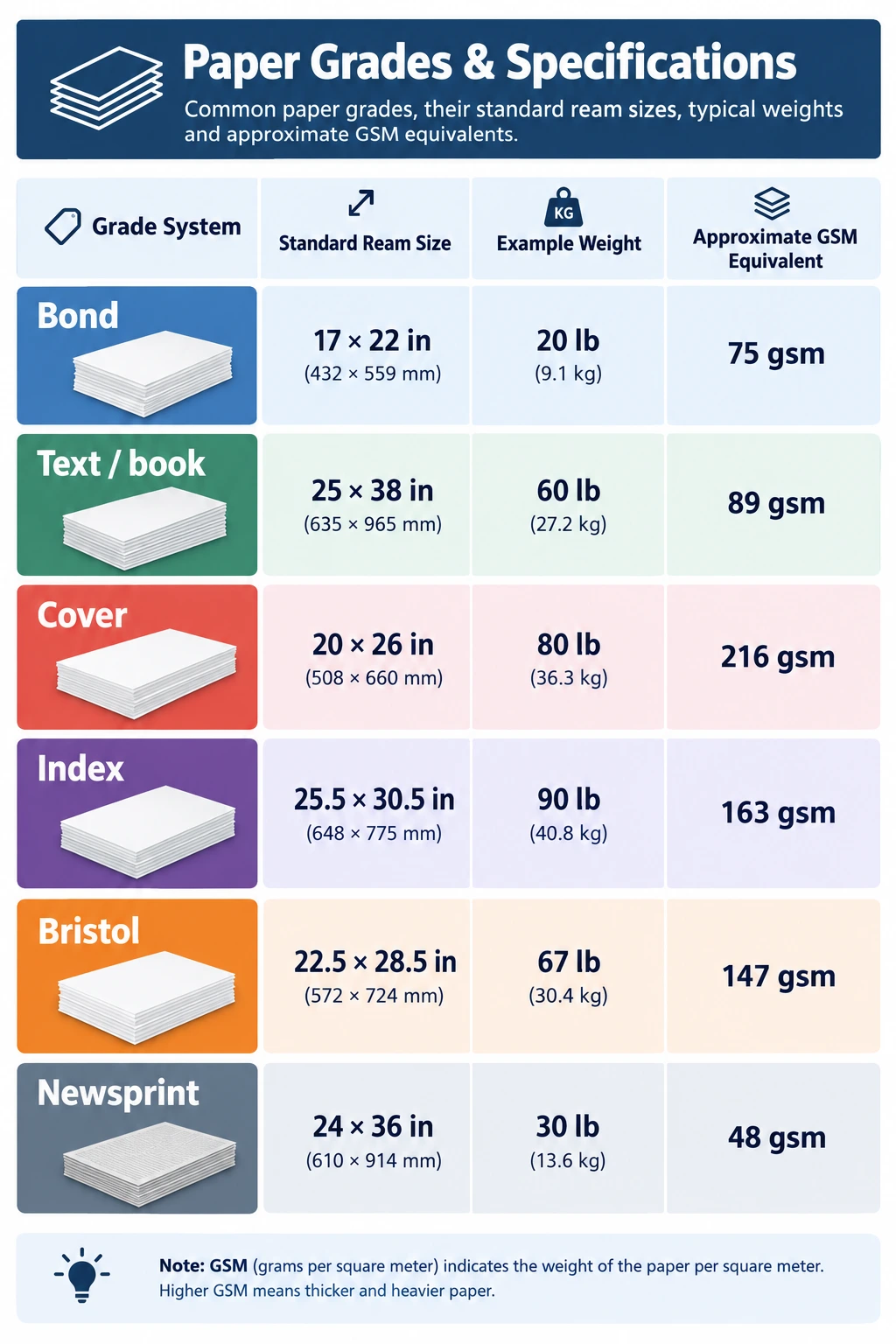
The grade factors for basis weight conversion are: bond 3.76, text 1.48, cover 2.70, index 1.81, bristol 2.20, newsprint 1.63. Each factor represents the GSM equivalent of one pound of that grade, based on the grade’s standard ream size.
Example of Measuring a Stack of 250 Sheets at 21.5 mm
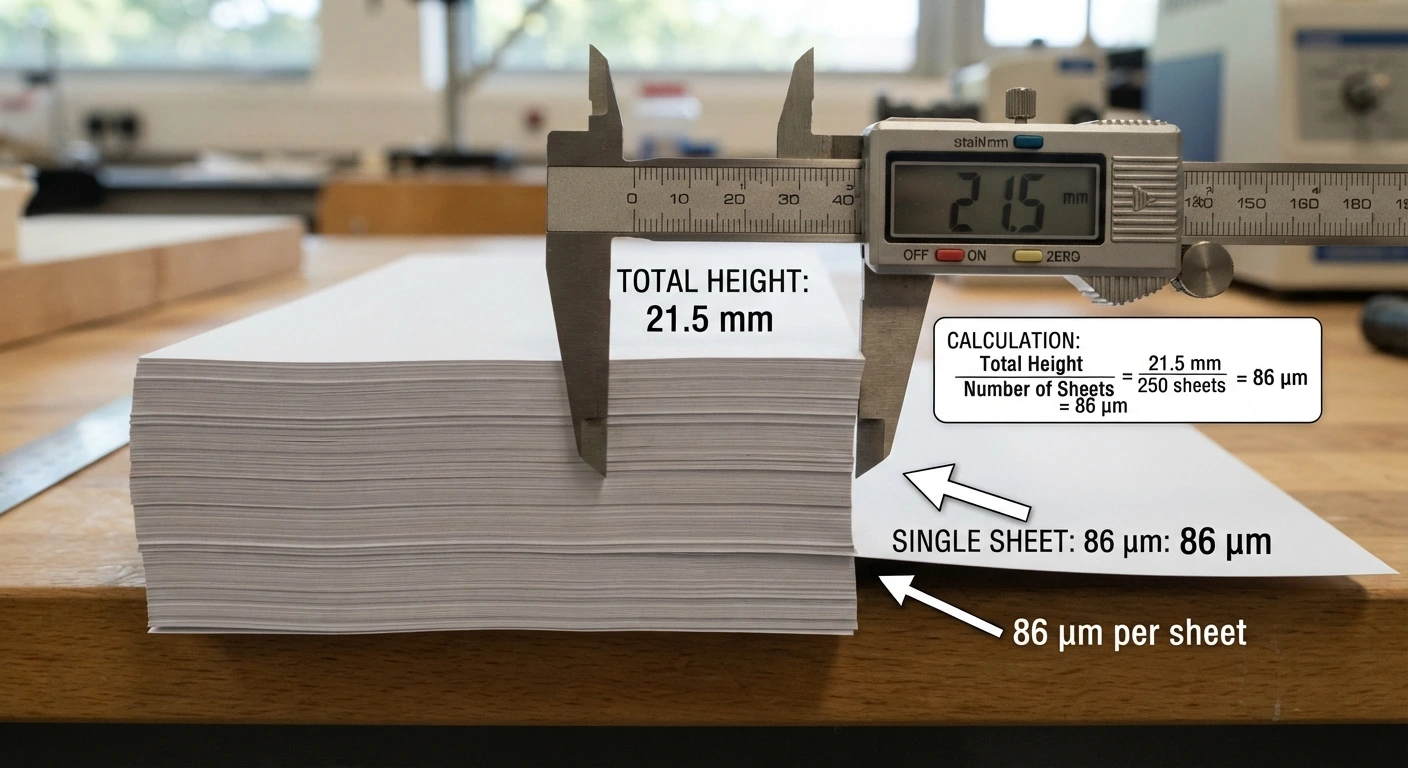
A print shop receives a ream of paper labeled “80 lb text.” The label tells them the weight, not the thickness. They measure a stack of 250 sheets with a ruler and get 21.5 mm total height.
Step 1: Convert the stack height to microns. 21.5 mm × 1,000 = 21,500 µm.
Step 2: Divide by sheet count. 21,500 µm ÷ 250 sheets = 86 µm per sheet.
Step 3: Convert to mils. 86 µm ÷ 25.4 = 3.39 mil.
Step 4: Estimate the paper weight. With a typical bulk of 1.4 for text paper, 86 µm ÷ 1.4 = 61.4 gsm.
Step 5: Cross-check against the reference table. The calculator shows that 86 µm sits between 60 lb text (120 µm) and newspaper (80 µm), so the label “80 lb text” is inconsistent with the measurement. Either the stack wasn’t compressed consistently, the sheets aren’t the labeled weight, or the ruler reading is off.
That cross-check is the practical value. The calculator doesn’t just convert the measurement; it tells you whether the result matches a known paper type. A mismatch usually means an input error, a mislabeled ream, or a measurement that needs repeating.

Paper Thickness by Stock Type
This table shows typical caliper ranges for common paper stocks. Values are drawn from manufacturer specification sheets and industry references. Individual products within a grade vary by mill.
The spread within each grade reflects mill differences, fiber composition, and manufacturing tolerances. A 20 lb bond from one mill might measure 98 µm; the same nominal grade from another might measure 106 µm. Both are within specification. The reference table in the calculator shows which type your result matches based on a ±10% band, not a single number.
Why Paper Is Sold by Weight, Not Thickness
The paper industry sells by weight because weight is stable and thickness is not. A sheet’s thickness changes with humidity, with the calendering pressure applied at the mill, and with the measurement method. Its weight does not. A ream that weighs 20 pounds when it leaves the mill still weighs 20 pounds in a warehouse at 60% humidity. Its thickness may have changed by 4% in the interim.
Weight is also easier to measure at production speed. A paper machine produces a continuous web at 3,000 feet per minute. Weighing a section of that web is straightforward. Measuring caliper inline requires a non-contact sensor, and the reading depends on the sensor’s calibration and the web’s moisture content. Most mills measure caliper on a sampling basis, not continuously.
The historical convention of “basis weight” the weight of 500 sheets at a specific sheet size emerged from the North American paper trade in the 19th century. Different grades used different standard sheet sizes, and the basis weight convention is a legacy of that trade practice. Bond paper used 17×22 inch sheets. Text paper used 25×38. Cover used 20×26. A “20 lb” bond is a different physical paper from a “20 lb” cover, even though both reams weigh 20 pounds, because the sheet sizes differ.
The American Forest and Paper Association codified these conventions in the 20th century, and they persist in North American printing despite the metric system being the global standard. A print buyer in the US still orders “80 lb text” where a European counterpart would order “120 gsm.”
How Paper Thickness Affects Print, Fold, and Feel
Thickness is not just a number on a spec sheet. It drives how paper performs through every step of printing, folding, binding, and distribution. A sheet that’s 10 µm too thick can jam a digital press. A cover that’s 20 µm too thin can feel flimsy in the customer’s hand.
In offset printing, the sheet’s caliper determines the pressure settings on the press. The ink transfer depends on the nip pressure between the blanket cylinder and the impression cylinder. If the sheet is thicker than expected, the pressure increases and the ink dot gain changes. The print looks darker and the halftones close up. If the sheet is thinner, the impression is light and the print looks washed out.
In digital printing (laser and inkjet), the caliper affects the paper path. Digital presses have a specified range of acceptable thicknesses, typically 60–350 µm for laser printers. Sheets outside that range either jam or produce poor image quality. Toner adhesion depends on the heat transfer through the sheet, which depends on the sheet’s thermal mass, which depends on the thickness.
In folding, the caliper determines the minimum fold radius before the coating cracks. Heavier sheets need a larger fold radius or a score line to prevent cracking along the fold. A 200 µm sheet folds cleanly without scoring. A 350 µm sheet needs a score to fold without cracking the coating.
In binding, the caliper determines the spine width for perfect-bound books. The printer measures the total thickness of the text block (page count × caliper ÷ 2) and adds a small allowance for the cover and glue. If the caliper is off by 5%, the spine is off by 5%, and the cover doesn’t fit.
In the customer’s hand, caliper determines the perceived quality. A business card at 300 µm feels substantial. The same design at 250 µm feels cheap. The difference is 50 µm about the thickness of a human hair. But the perceptual gap is significant because it’s the difference between “premium” and “standard.”
The Technical Association of the Pulp and Paper Industry publishes test methods for the properties that interact with caliper, including T494 for tensile strength and T403 for bursting strength. These standards inform how mills evaluate whether a sheet will perform in downstream applications.
Frequently Asked Questions
How thick is a sheet of paper in microns?
Standard office paper (20 lb bond, 75 gsm) is 90–110 µm thick. Thin papers like onionskin run 25–35 µm. Heavy cardstock runs 250–350 µm.
How do you convert GSM to thickness?
Multiply GSM by the bulk ratio. A 100 gsm sheet with bulk 1.4 is 140 µm thick. Bulk varies by grade: cover stock is dense (1.2), text and book papers are fluffier (1.4–1.8).
What is 100 lb text in GSM?
100 lb text converts to approximately 148 gsm using the text grade factor of 1.48. The caliper is typically 185–215 µm depending on bulk.
How do you measure paper thickness without a micrometer?
Stack 100 or more sheets, measure the total height in millimeters, and divide by the sheet count. Multiply the result by 1,000 to get microns. This is the most accurate home method.
What is the difference between caliper and thickness?
Nothing. Caliper is the paper industry term for thickness. Both refer to the measured distance between the two surfaces of a single sheet.
What is a mil in paper thickness?
A mil is one thousandth of an inch, equal to 25.4 microns. Office paper at 100 µm measures 3.94 mil. Business cards at 320 µm measure 12.6 mil.
How thick is cardstock?
Cardstock typically starts at 200 µm (8 mil) and runs up to 350 µm (14 mil). 65 lb cover averages 230 µm, 80 lb cover averages 280 µm, and 100 lb cover averages 350 µm.
What is bulk in paper?
Bulk is the ratio of thickness to weight. A sheet with high bulk is thicker for its weight. Book papers run 1.4–1.8 bulk. Cover stocks are denser at 1.2–1.3.
How many sheets of paper are in an inch?
At 100 µm per sheet, 254 sheets fit in one inch. The number varies with thickness: onionskin at 30 µm gives 847 sheets per inch, while 100 lb cover at 350 µm gives 73 sheets per inch.
Why does my paper measure differently than the spec sheet?
Two reasons. First, caliper varies by mill and product run within a grade. Second, measurement conditions (clamping pressure, humidity, temperature) affect the reading by 2–5%.
What is the ISO standard for paper thickness?
ISO 534:2011 specifies the measurement of thickness and apparent bulk density of paper and board, using a clamping pressure of 100 kPa. TAPPI T411 is the North American equivalent with a 50 kPa pressure.
Can I use this calculator for paperboard?
Yes, in caliper mode. Paperboard thickness runs 350 µm to over 1,000 µm. The calculator handles the conversion to mils and millimeters for any value in that range.
Disclaimer
This calculator estimates paper thickness from user inputs using industry-standard conversion factors. Actual thickness varies by mill, product run, moisture content, and measurement conditions. For specification-critical work, verify against the manufacturer’s published caliper data measured under the applicable standard (TAPPI T411 or ISO 534). The calculator is a planning tool, not a substitute for direct measurement.
Sources
The Technical Association of the Pulp and Paper Industry publishes TAPPI T411, the standard test method for thickness (caliper) of paper, paperboard, and combined board used by North American mills.
The International Organization for Standardization publishes ISO 534:2011, the international standard for measuring paper and board thickness, apparent sheet density, and apparent bulk density.
ASTM International publishes ASTM D645, the standard test method for thickness of paper and paperboard products, which provides a parallel measurement protocol used in quality control.
The National Institute of Standards and Technology publishes conversion factors in NIST Handbook 44, which is the reference for the micron-to-mil and micron-to-inch conversions used throughout the calculator.
The American Forest and Paper Association publishes grade definitions and standard ream sizes for bond, text, cover, index, bristol, and newsprint papers, which are the basis for the basis-weight conversion factors.
The Technical Association of the Pulp and Paper Industry also publishes TAPPI T494, the standard for tensile breaking strength, whose testing procedures inform the industry’s understanding of how fiber composition affects paper structure and caliper.