Estimate how much crushed stone you need for a driveway, walkway, patio, or drainage project. Enter your area dimensions, pick a stone type and depth, and the calculator returns the total weight in tons or tonnes, the volume in cubic yards or cubic metres, and an optional cost estimate based on your supplier’s price per ton.
The tool handles rectangular, circular, triangular, and trapezoidal areas. You don’t need to convert shapes into separate rectangles by hand.
How to Use the Crushed Stone Calculator
Pick your unit system: Imperial (feet, inches, tons, sq ft) or Metric (metres, millimetres, tonnes, sq m).
Choose the shape of your project area. Rectangle, circle, triangle, and trapezoid are all supported.
Enter the dimensions the shape requires. A rectangle asks for length and width. A circle asks for diameter.
Select the linear unit for your dimensions: feet, metres, or yards.
Set the stone layer depth and pick the depth unit: inches, millimetres, centimetres, or feet.
Choose a waste and compaction allowance between 0% and 50%. Ten to fifteen percent is standard for driveways.
Select your stone type. The calculator loads the correct compacted density automatically.
Enter a price per ton if you want a material cost estimate. Leave it at zero to skip the cost output.
Review the results: total tonnage, volume in cubic yards or cubic metres, truckload estimates, and a dimension summary.
Hit Calculate at any time to refresh. The tool also recalculates as you type.
How the Crushed Stone Calculator Formula Works
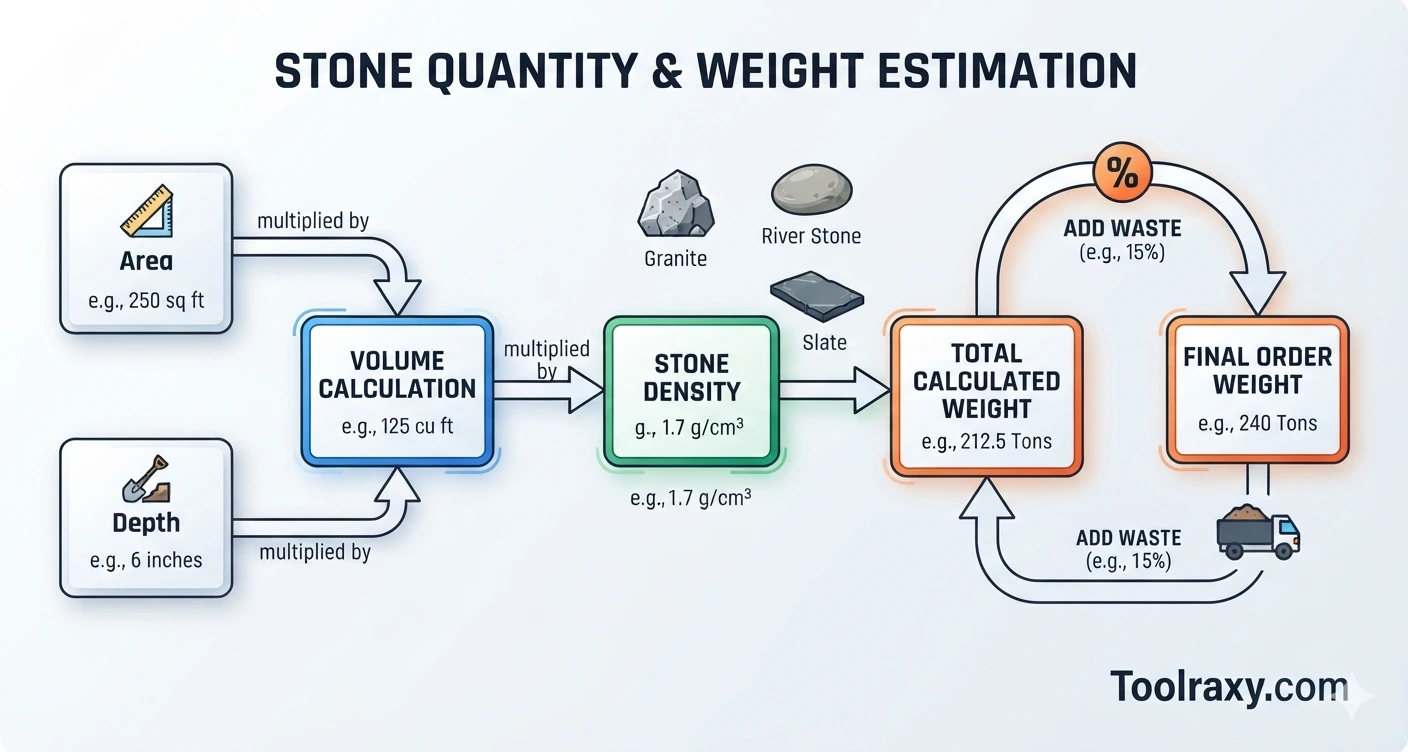
The calculator turns your area and depth into a compacted volume, then multiplies by the stone’s density to get weight.
Formula: Weight = Area × Depth × Density × (1 + Waste%)
Each piece works like this:
Area = calculated from the shape you select. Rectangle: length × width. Circle: π × (diameter ÷ 2)². Triangle: 0.5 × base × height. Trapezoid: 0.5 × (top base + bottom base) × height.
Compacted volume = Area × Depth. This is the volume after the stone is rolled and packed.
Weight = Compacted volume × Density. Density is specific to the stone type.
Order weight = Weight × (1 + Waste%). This is the number you take to your supplier.

Worked Example
Let’s price a crushed stone base for a driveway. The driveway is a rectangle: 36 feet long by 11 feet wide. The base layer is 4 inches deep. The stone is crushed limestone at 162 lb/ft³. Waste allowance: 12%. Stone price: $32 per US ton.
Step 1: Area. 36 ft × 11 ft = 396 sq ft.
Step 2: Depth in feet. 4 in ÷ 12 = 0.333 ft.
Step 3: Compacted volume. 396 × 0.333 = 132 cubic feet.
Step 4: Volume in cubic yards. 132 ÷ 27 = 4.89 yd³.
Step 5: Weight without waste. 4.89 yd³ × 1.62 tons/yd³ = 7.92 US tons. (Limestone at 162 lb/ft³ works out to about 1.62 tons per cubic yard.)
Step 6: Order weight with waste. 7.92 × 1.12 = 8.87 US tons.
Step 7: Material cost. 8.87 × $32 = $283.84.
The calculator rounds to two decimal places. Your supplier will likely round up to the nearest half-ton or whole ton. For this job, order 9 tons.
Frequently Asked Questions
How many tons of crushed stone do I need for a driveway?
Multiply area by depth to get volume, then multiply by density. A 400 sq ft driveway base at 4 inches deep with crushed limestone needs about 8 US tons. Add 10–15% waste and order 9 tons.
How do I calculate how much crushed stone I need?
Measure the area in square feet, convert the depth to feet, and multiply them. That gives you cubic feet. Divide by 27 for cubic yards. Multiply cubic yards by the stone’s tons-per-yard density to get the weight in tons.
How many square feet does a ton of crushed stone cover?
At 2 inches deep, one US ton of crushed limestone covers about 100 sq ft. At 4 inches, it covers about 50 sq ft. The coverage drops as the depth increases. The calculator shows the area and depth relationship in the dimension summary table.
What is the difference between #57 and #411 stone?
#57 has particles between 1/2 and 1 inch with no dust. It drains well and is used for French drains and driveway top layers. #411 contains #57 stone plus stone dust. The dust fills the voids, making it compact harder. #411 is better for driveway bases.
How deep should crushed stone be for a driveway?
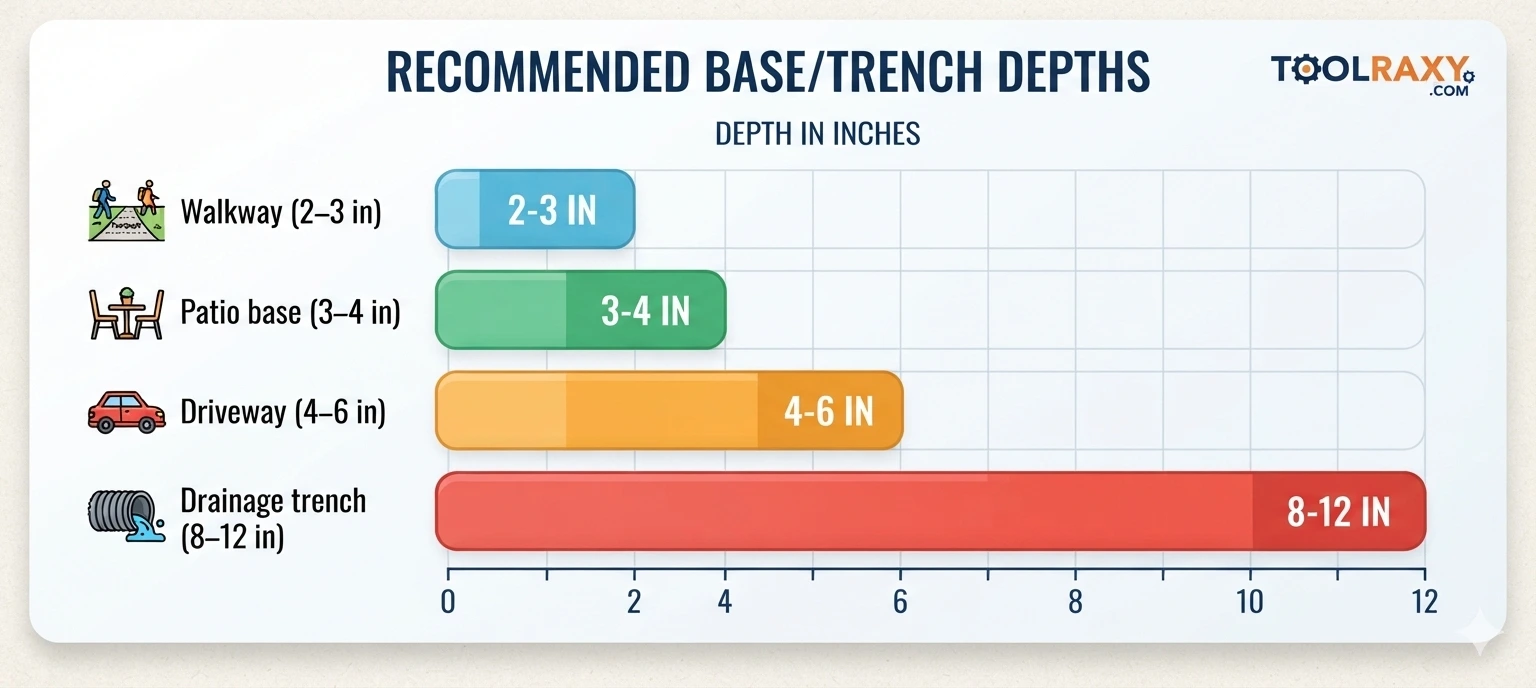
Four to six inches of compacted crushed stone is standard for a residential driveway. Use 4 inches for cars and light trucks. Go to 6 inches for heavy vehicles, soft subgrade, or freeze-thaw climates.
How much does a ton of crushed stone cost?
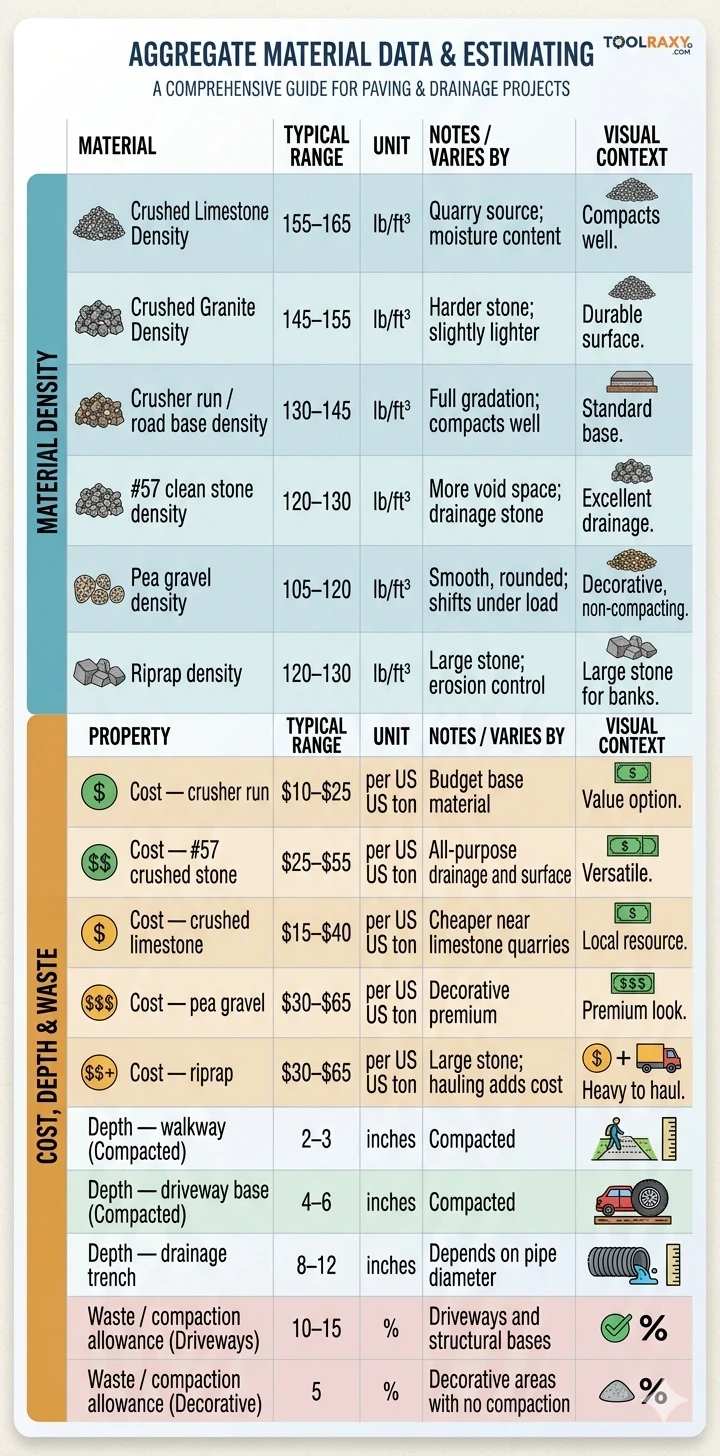
Crusher run costs $10–$25 per US ton. #57 crushed stone runs $25–$55 per ton. Crushed limestone is $15–$40 per ton. Pea gravel is $30–$65 per ton. Regional quarry supply and haul distance swing these ranges significantly.
Can I use pea gravel for a driveway base?
No. Pea gravel is smooth and rounded, so it shifts under vehicle weight instead of locking together. A pea gravel base will rut and migrate. Use crushed stone with angular faces for any driveway that carries cars or trucks.
How much does a cubic yard of crushed stone weigh?
A cubic yard of crushed stone weighs between 1.2 and 1.6 US tons depending on the stone type. Limestone is the heaviest at about 1.6 tons. Pea gravel is lighter at about 1.2 tons. The calculator uses the density of the stone type you select.
Do I need to add waste to my crushed stone order?
Yes. Add 10–15% for driveway bases and structural layers. The waste covers spillage, uneven subgrade, and the volume lost when loose stone compacts. For decorative areas that won’t be compacted, 5% is enough.
How many cubic yards are in a ton of crushed stone?
It depends on the stone. For crushed limestone at 1.6 tons per cubic yard, one ton is about 0.63 cubic yards. For pea gravel at 1.2 tons per cubic yard, one ton is about 0.83 cubic yards. The calculator converts between weight and volume automatically.
What stone is best for a French drain?
#57 clean stone is the standard for French drains. It has enough void space for water to flow freely. Crusher run and #411 contain dust that can clog the drain over time. Use clean stone, not compactable base material.
How do I convert cubic feet to tons of crushed stone?
Divide cubic feet by 27 to get cubic yards. Multiply cubic yards by the stone’s density in tons per cubic yard. Crushed limestone is about 1.6 tons per cubic yard. #57 clean stone is about 1.25 tons per cubic yard.