

Founder & CEO, Toolraxy
Estimate concrete volume, material costs, reinforcement, finish, base preparation, removal of an old driveway, labor, and total project cost for your concrete driveway. Enter your slab dimensions, pick a concrete price, choose reinforcement and finish options, and the calculator returns a line-by-line cost breakdown plus the total project cost.
You’ll see your driveway area in square feet or square metres, the concrete volume in cubic yards or cubic metres, and the cost per square foot. Every number updates as you type.
How to Use the Concrete Driveway Cost Calculator
Choose your unit system: Imperial (feet, inches, cubic yards, sq ft) or Metric (metres, millimetres, cubic metres, sq m).
Enter the driveway length and width in feet or metres.
Set the slab thickness. Residential driveways typically use 4 inches (100 mm).
Pick a waste allowance between 0% and 30%. Five to ten percent covers spillage and uneven subgrade.
Select your concrete mix strength and enter the delivered price per cubic yard or cubic metre.
Choose a reinforcement type if needed. The calculator adds the cost per square foot automatically.
Pick a finish, then set the price per square foot. Broom finish is standard and costs nothing extra.
Toggle edge forms, sealer, and control joints. Each option adds its cost to the breakdown.
Choose a base material and depth if you’re pouring over new subgrade.
If you’re removing an old driveway, turn that on and enter the removal cost per square foot.
Enter your labor rate per square foot, any permit fees, and a contingency percentage.
Hit Calculate. The tool returns the total project cost, the cost per square foot, and a full component table.
The calculator turns your driveway dimensions into a concrete volume, adds a waste factor, then multiplies every cost component by the area or the volume.
Formula: Total Project Cost = (Concrete Cost + Reinforcement Cost + Finish Cost + Edge Form Cost + Sealer Cost + Joints Cost + Base Cost + Removal Cost + Labor Cost) × (1 + Contingency%) + Permits
Each component breaks down like this:
Concrete volume = Length × Width × Thickness (converted to cubic yards or cubic metres)
Concrete cost = Volume × (1 + Waste%) × Price per unit volume
Reinforcement cost = Area × Price per sq ft (only if a type other than None is selected)
Finish cost = Area × Finish price per sq ft
Edge form cost = Perimeter × Rate per linear foot (or metre)
Base cost = Area × Base price per sq ft (only when a base material is selected)
Removal cost = Area × Removal price per sq ft (only when removal is toggled on)
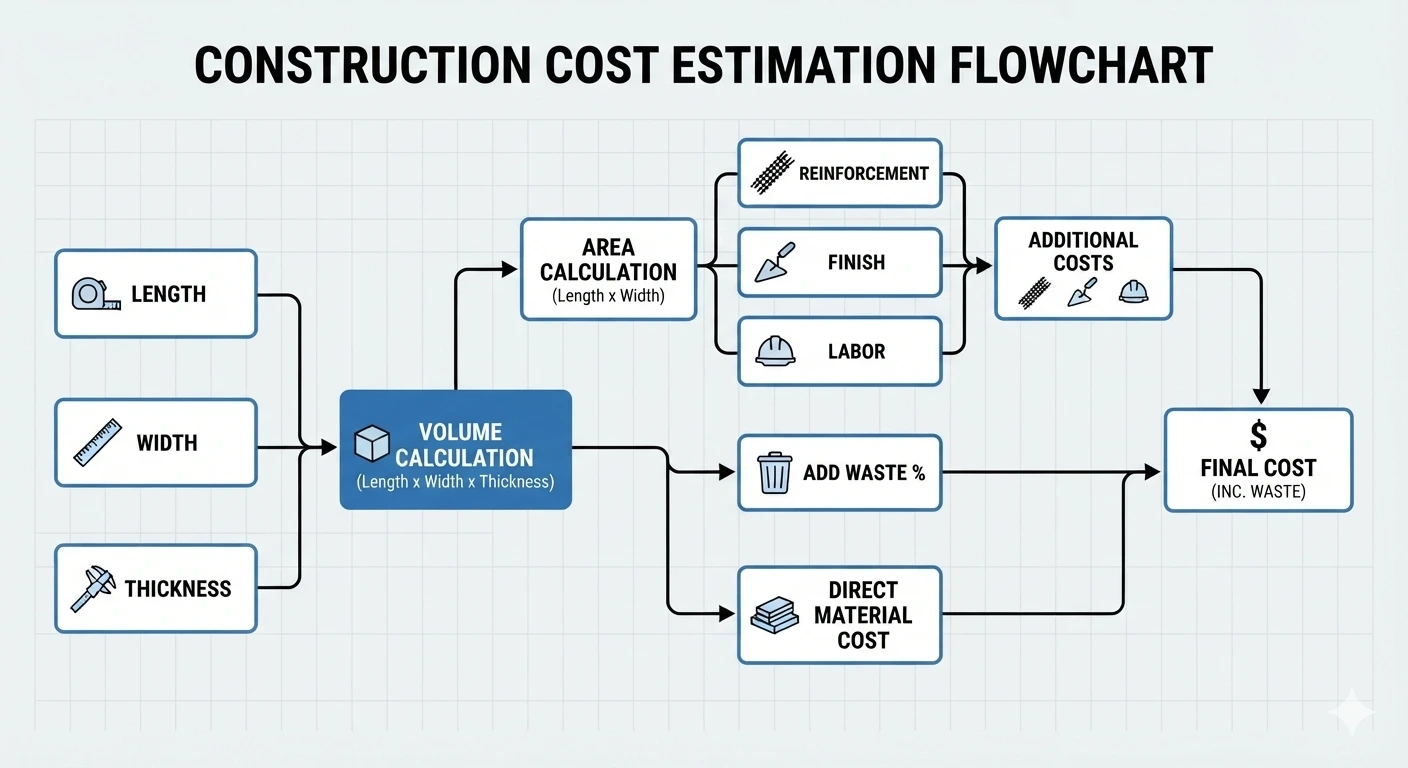
The waste factor applies only to the concrete volume, not to the finish, reinforcement, or labor. Edge forms price by perimeter, not area, so they scale differently from the other components.
The calculator clamps inputs to the minimums and maximums defined in the form. If a field is left empty, it defaults to zero. The one exception is the concrete volume waste factor: the tool treats a blank waste field as 0%, which means no overage.
Concrete driveways cost more upfront but last longer and need less maintenance. Asphalt installs for roughly $3–$7 per square foot, while concrete runs $6–$12. Over a 30-year horizon, concrete often wins on total cost because it doesn’t need sealcoating every two to three years.
| Dimension | Concrete Driveway | Asphalt Driveway |
|---|---|---|
| Typical installed cost | $6–$12/sq ft | $3–$7/sq ft |
| Lifespan | 30–50 years | 15–20 years |
| Maintenance | Seal every 3–5 years; occasional crack filling | Seal every 2–3 years; patching as needed |
| Installation time | 1–2 weeks (including cure) | 2–4 days |
| Hot-weather performance | Stable; resists rutting | Softens; can rut under heavy loads |
| Cold-weather performance | Resists freeze-thaw with air-entrained mix | Becomes brittle; cracks in deep freeze |
| Repair method | Patch with concrete; color match is hard | Patch with asphalt; color match is easy |
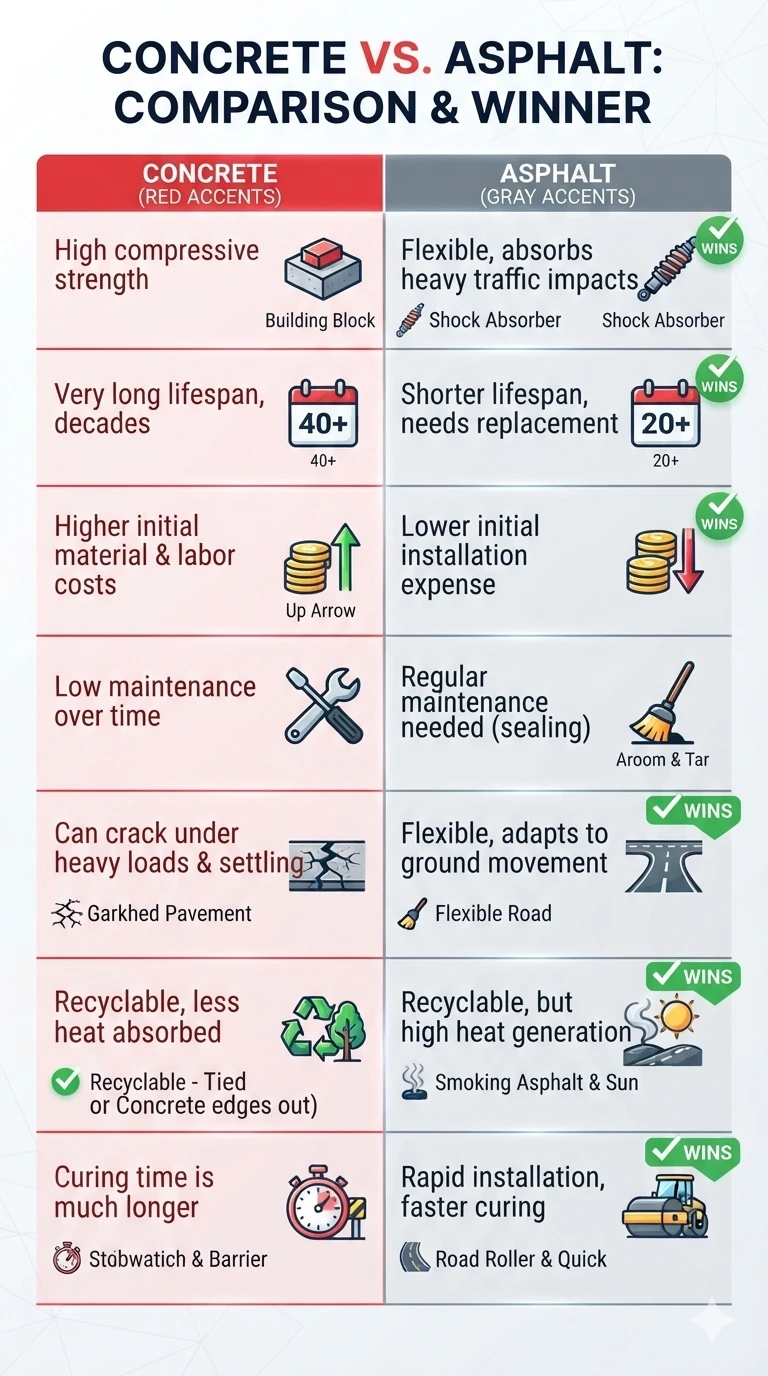
Concrete wins on longevity and hot-weather stability. If you live in a climate with 100°F summers and you park heavy vehicles, concrete holds its shape better. Asphalt softens and ruts under the same conditions.
Asphalt wins on upfront cost and repairability. If your budget is tight or you plan to sell the house in five years, asphalt gets you a functional driveway for half the money. Patching is also simpler: a bag of cold patch and a tamper handles most small repairs.
Concrete is the better choice for steep driveways. Asphalt can slump on grades above 10%. Concrete holds its profile. For flat or gently sloped driveways, both work.
One thing this calculator doesn’t do: price asphalt. The tool is built for concrete volume and concrete cost components. If you’re comparing the two, use the concrete output here and get an asphalt quote separately.
A general contractor pricing a new build uses the calculator to line-item the driveway before the foundation is poured. The inputs that matter most are length, width, thickness, and base depth. The concrete price comes from a ready-mix quote, not a national average.
A reasonable output for a 500 sq ft driveway at 4 inches thick, standard mesh, broom finish, and 4 inches of gravel base lands between $3,500 and $5,500 depending on labor rates. The contractor uses that number in the bid package and adjusts the waste factor if the site is tight.
A homeowner replacing a cracked 20-year-old slab starts by measuring the old driveway. Removal cost goes in the removal field. The new slab dimensions may match the old footprint, or they may change.
If the old driveway is 600 sq ft and the new one is 550 sq ft, the removal cost should use 600 sq ft. The calculator applies the removal rate to the new driveway area, so you’d either run a separate removal calculation or adjust the area input temporarily to match the old footprint.
Three contractors hand you three quotes. One says $8,200. Another says $6,900. The third says $11,500. The calculator lets you reverse-engineer what each bid implies about unit costs.
Enter the dimensions, then adjust the labor rate and finish price until the total matches the bid. You’ll see whether the low bid skimps on base prep or reinforcement. The high bid might include a premium finish you didn’t ask for. This turns three numbers into a line-by-line comparison.
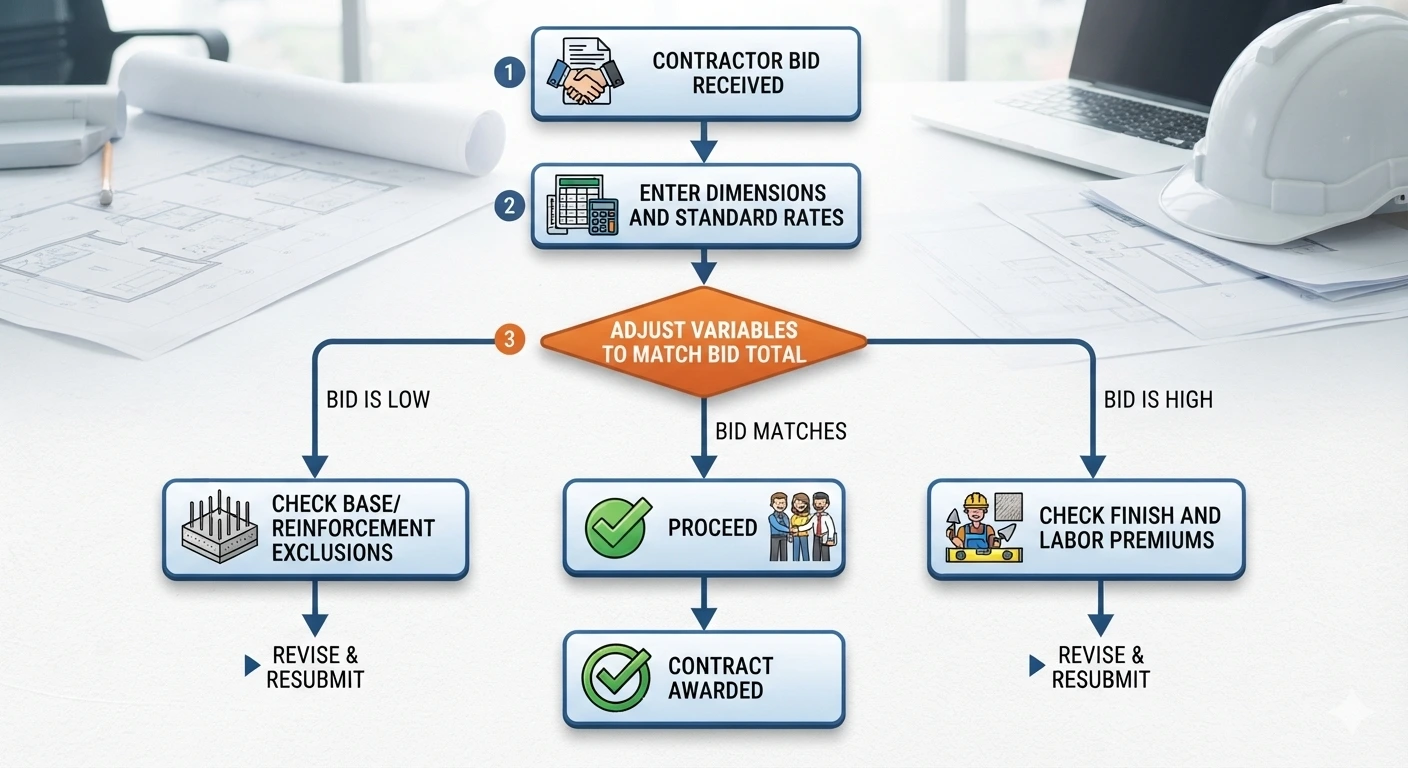 Matching a bid total to the calculator output reveals which cost lines the contractor is weighting.
A DIYer pouring their own driveway uses the calculator for material takeoff, not for labor. Set the labor rate to $0. Enter the concrete price from the local ready-mix plant. The output shows concrete volume, reinforcement cost, and base material cost.
The calculator’s volume output is the number to hand to the dispatcher. Order 5–10% more than the calculated volume. For a 0.73 yd³ slab, order 0.8 yd³. Ready-mix plants sell in quarter-yard increments in many markets, so you’d round up to 1.0 yd³. The extra concrete becomes a thickened edge or a small pad.