
Compare Pauling electronegativity values of two elements and predict bond type
Powered by Pauling's electronegativity scale · Chemistry Tools

Founder & CEO, Toolraxy
Faiq Ur Rahman is a web designer, digital product developer, and founder of Toolraxy, a growing platform of web-based calculators and utility tools. He specializes in building structured, user-friendly tools focused on health, finance, productivity, and everyday problem-solving.
User Ratings:
ADVERTISEMENT
ADVERTISEMENT
Electronegativity is a measure of an atom’s ability to attract electrons in a chemical bond. It’s a fundamental concept in chemistry that explains why some bonds are ionic, some are polar covalent, and some are nonpolar covalent. Electronegativity matters because it determines the distribution of electrons in molecules, which affects molecular polarity, bond strength, chemical reactivity, and physical properties like boiling point and solubility. Understanding electronegativity is essential for predicting how atoms will interact, designing new molecules, and understanding the behavior of materials.
Select the first element from the dropdown menu, choose from a comprehensive list of elements with their symbols and names.
Select the second element from the second dropdown menu, the order doesn’t matter for the electronegativity difference.
Click Calculate or simply wait for automatic updates, the electronegativity difference appears instantly.
Review the bond type classification: ionic, polar covalent, or nonpolar covalent.
Check the individual electronegativity values and a detailed interpretation of the result.
Use the example buttons to quickly test common pairs like Na–Cl, H–O, or C–H.
The calculator applies the Pauling electronegativity scale, which assigns a dimensionless number to each element representing its ability to attract electrons in a chemical bond. The scale ranges from about 0.7 (cesium) to 4.0 (fluorine).
Formula: ΔEN = |χ₁ − χ₂|
Where χ₁ and χ₂ are the Pauling electronegativity values of the two elements. The absolute difference is then used to classify the bond type.
Bond Type Classification:
Formula: Ionic Bond — ΔEN ≥ 1.7
Formula: Polar Covalent Bond — 0.4 ≤ ΔEN < 1.7
Formula: Nonpolar Covalent Bond — ΔEN < 0.4
The difference in electronegativity tells you how electrons are distributed in the bond. A large difference means electrons are transferred from one atom to another (ionic). A small difference means electrons are shared more or less equally (nonpolar covalent). A moderate difference means electrons are shared unequally (polar covalent).
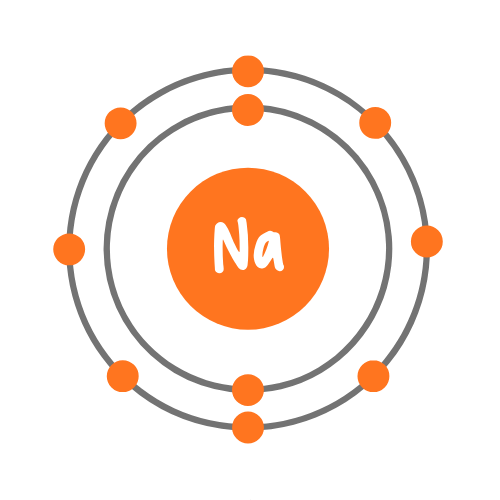
Let’s calculate the electronegativity difference between sodium (Na) and chlorine (Cl) and determine the bond type.
Step 1: Find the Pauling electronegativity values
Sodium (Na): χ = 0.93
Chlorine (Cl): χ = 3.16
Step 2: Calculate the electronegativity difference
ΔEN = |3.16 − 0.93| = 2.23
Step 3: Determine the bond type
Since ΔEN = 2.23 ≥ 1.7, the bond is classified as ionic.
Interpretation: The large electronegativity difference between sodium and chlorine means that chlorine pulls electrons away from sodium, forming Na⁺ and Cl⁻ ions. This is the classic example of an ionic bond, the electron transfer creates a strong electrostatic attraction between the oppositely charged ions.
Compares electronegativity values of any two elements from a comprehensive periodic table.
Automatically classifies the bond type: ionic, polar covalent, or nonpolar covalent.
Shows the exact electronegativity difference (ΔEN) and individual values.
Includes example buttons for common element pairs to help you learn.
Provides a detailed interpretation of what the bond type means.
Updates results instantly as you change selections.
Runs entirely client-side with no server communication, keeping your data private.
Free to use on any device with responsive design.
Electronegativity is the measure of an atom’s ability to attract electrons in a chemical bond. It was defined by Linus Pauling and is expressed on a dimensionless scale where fluorine has the highest value (3.98).
The Pauling scale is the most common electronegativity scale, developed by Linus Pauling. It ranges from about 0.7 (cesium) to 4.0 (fluorine). The scale is based on bond energies and is widely used to predict bond types.
The electronegativity difference (ΔEN) is the absolute difference between the electronegativity values of two atoms. It determines the type of bond that forms: ionic (ΔEN ≥ 1.7), polar covalent (0.4–1.7), or nonpolar covalent (< 0.4).
An ionic bond forms when the electronegativity difference is large (≥ 1.7), causing one atom to transfer electrons to the other. This creates ions with opposite charges that attract each other. NaCl is a classic example.
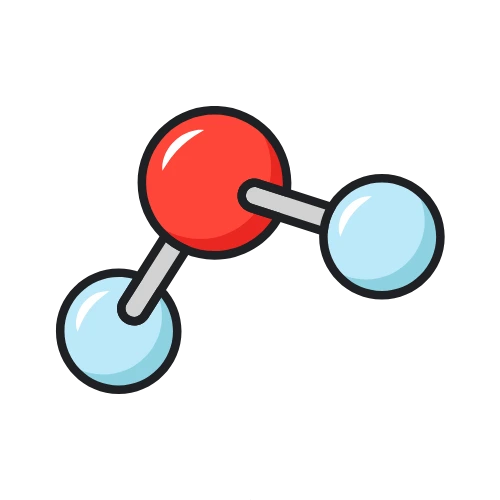
A polar covalent bond forms when the electronegativity difference is moderate (0.4–1.7), causing electrons to be shared unequally. This creates a dipole moment, a partial positive and partial negative charge. Water (H₂O) is a classic example.
A nonpolar covalent bond forms when the electronegativity difference is small (< 0.4), causing electrons to be shared equally. There is no dipole moment. F₂ or C–H bonds are classic examples.
Hydrogen has a Pauling electronegativity of 2.20. This makes it slightly less electronegative than carbon (2.55) and significantly less electronegative than oxygen (3.44) or fluorine (3.98).
Fluorine is the most electronegative element with a Pauling value of 3.98. It attracts electrons more strongly than any other element, which is why it forms strong ionic bonds with metals and polar bonds with other nonmetals.
ADVERTISEMENT
ADVERTISEMENT