

Estimate the asphalt tonnage, volume, and cost needed for driveways, parking lots, and roadways. Supports rectangular, circular, triangular, and trapezoidal areas with metric and imperial units.
| Dimension | Value | Metric equivalent | Imperial equivalent |
|---|
| Unit | Compacted volume | With waste | Notes |
|---|
| Unit | Compacted weight | With waste | Notes |
|---|
| Truck capacity | Tons / tonnes per load | Loads required | Notes |
|---|
| Metric | Value | Notes |
|---|
| Metric | Value | Notes |
|---|
—
Select a citation style above. Click the citation text to select it all, then copy.
ADVERTISEMENT

Founder & CEO, Toolraxy
Faiq Ur Rahman is a web designer, digital product developer, and founder of Toolraxy, a growing platform of web-based calculators and utility tools. He specializes in building structured, user-friendly tools focused on health, finance, productivity, and everyday problem-solving.
User Ratings:
ADVERTISEMENT
ADVERTISEMENT
The Asphalt Calculator turns paving dimensions into an order-ready tonnage. Pick your shape, enter length and width (or diameter, or base and height), set the compacted thickness, and choose a mix type. It returns surface area, compacted volume, weight in tonnes or US tons, truckload counts, and material cost. Metric and imperial units both work. Built for driveways, parking lots, and road resurfacing, where a short order delays the job and a long one wastes money.
Paving crews measure a site in feet and inches. Suppliers sell asphalt by the ton. That mismatch is where overordering happens, and it’s the reason this calculator exists. Enter the shape of your area and its dimensions, add the thickness you want once the roller has finished, and the tool handles the unit conversion. Choose a mix type, set a waste allowance, and you’ll get tonnage, volume, truckload counts, and a material cost estimate. The default 5% waste covers spillage, compaction loss, and uneven subgrade. HMA, warm mix, porous asphalt, and recycled millings each carry their own density, so the weight changes with the mix. Driveway jobs, parking lot expansions, and small road patches all use the same math.
Choose your area shape from the first dropdown. Rectangle covers squares. Circle takes a diameter, triangle takes a base and height, and trapezoid takes two bases plus a height.
Set the linear unit to metres, feet, or yards. The dimension fields update to match.
Enter the length and width, or the equivalent fields for whichever shape you picked.
Type the compacted thickness and select its unit. Two inches is the common default for residential driveways.
Adjust the waste allowance if you want more or less than the standard 5%.
Pick your mix type, then optionally add a price per ton and choose a currency. Results update as you type.
Asphalt tonnage equals surface area times compacted thickness times density, plus a waste allowance. That one line sits behind every result on this page. The tool works in metres and kilograms internally, then converts the answer to whichever unit system you’re using.
Formula: Weight = Area × Thickness × Density × (1 + Waste%)
Area itself depends on the shape you chose:
Rectangle area = Length × Width
Circle area = π × (Diameter ÷ 2)²
Triangle area = 0.5 × Base × Height
Trapezoid area = 0.5 × (Top base + Bottom base) × Height

Thickness gets converted to metres so it matches the density unit (kg/m³). Inches, millimetres, centimetres, and feet all funnel through that conversion. Densities come from the mix preset: HMA at 2,322 kg/m³, WMA at 2,240, porous asphalt at 2,000, and recycled millings at 1,920. Selecting “Custom density” unlocks the field so you can type whatever your supplier quotes.
A few edge cases matter. Zero or negative dimensions trigger a warning instead of a number. Waste is capped at 50%. And the cost block stays hidden until you enter a price above zero, so you’re not looking at a row of zeros.
Say you’re paving a two-car driveway that’s 24 feet long and 12 feet wide. You want 2 inches of compacted HMA. Waste allowance stays at the default 5%. Your supplier charges $120 per US ton.
Step 1: Area. 24 × 12 = 288 ft². That’s 26.76 m².
Step 2: Thickness. 2 inches = 0.0508 m.
Step 3: Volume. 26.76 × 0.0508 = 1.359 m³.
Step 4: Waste. 1.359 × 1.05 = 1.427 m³.
Step 5: Weight. 1.427 × 2,322 = 3,314 kg. In US tons, that’s 3,314 ÷ 907.18 = 3.65 tons.
Step 6: Cost. 3.65 × $120 = about $438.
Order 4 tons. Suppliers usually round up to the nearest half-ton, and running short mid-pour costs more than a small surplus.

Proper asphalt thickness is critical for pavement performance and longevity. Our calculator provides industry-standard thickness options based on application type and expected loads.
Residential Driveways (2-3 inches) – Light-duty applications for passenger vehicles require 2-3 inches of compacted asphalt over a properly prepared base. The calculator recommends 3 inches as standard for most residential driveways, providing approximately 15-20 years of service with proper maintenance. Thinner applications (2 inches) may be suitable for infrequently used secondary driveways or walkways.
Parking Lots (4-6 inches) – Commercial and multi-family parking areas require 4-6 inches of asphalt to withstand repeated vehicle traffic and occasional heavy loads. Our calculator provides separate options for light commercial (4 inches) and standard commercial (6 inches) parking lots, with appropriate material adjustments for each thickness.
Roads and Streets (6-8 inches) – Public roads and heavily trafficked streets require 6-8 inches of asphalt for structural integrity. Residential streets typically use 6 inches, while collector roads and commercial streets require 8 inches. The calculator accounts for these differences with specific thickness options and corresponding material requirements.
Industrial Applications (8+ inches) – Truck terminals, loading docks, and industrial facilities may require 8+ inches of asphalt or specialized pavements. Our calculator’s 8-inch option provides baseline calculations for these heavy-duty applications, with recommendations for engineering consultation for specialized requirements.
Asphalt is cheaper up front and easier to patch. Concrete lasts longer and takes more punishment before failing. The right choice depends on budget, climate, and how long you plan to stay in the property.
| Dimension | Asphalt | Concrete |
|---|---|---|
| Installed cost | $5–$12 per ft² | $6–$15 per ft² |
| Lifespan | 15–25 years | 25–40 years |
| Maintenance | Seal every 2–5 years | Minimal, occasional crack repair |
| Repair | Patch blend, hard to see | Patch visible, harder to match |
| Climate | Softens in extreme heat | Handles heat better, cracks in freeze-thaw |
| Time to use | 24–48 hours | 5–7 days cure |
| Resale effect | Neutral to positive | Positive |
Asphalt wins on budget. A 600 ft² driveway runs $3,000–$7,200 installed versus $3,600–$9,000 for concrete. That lower entry point matters for long rural driveways where the total area pushes concrete out of reach.
Concrete wins on longevity. A well-built concrete driveway can go 30 years with minimal attention. Asphalt needs resealing every few years and typically gets a full overlay around year 15–20. Over a 30-year horizon, the lifetime costs converge more than the upfront numbers suggest.
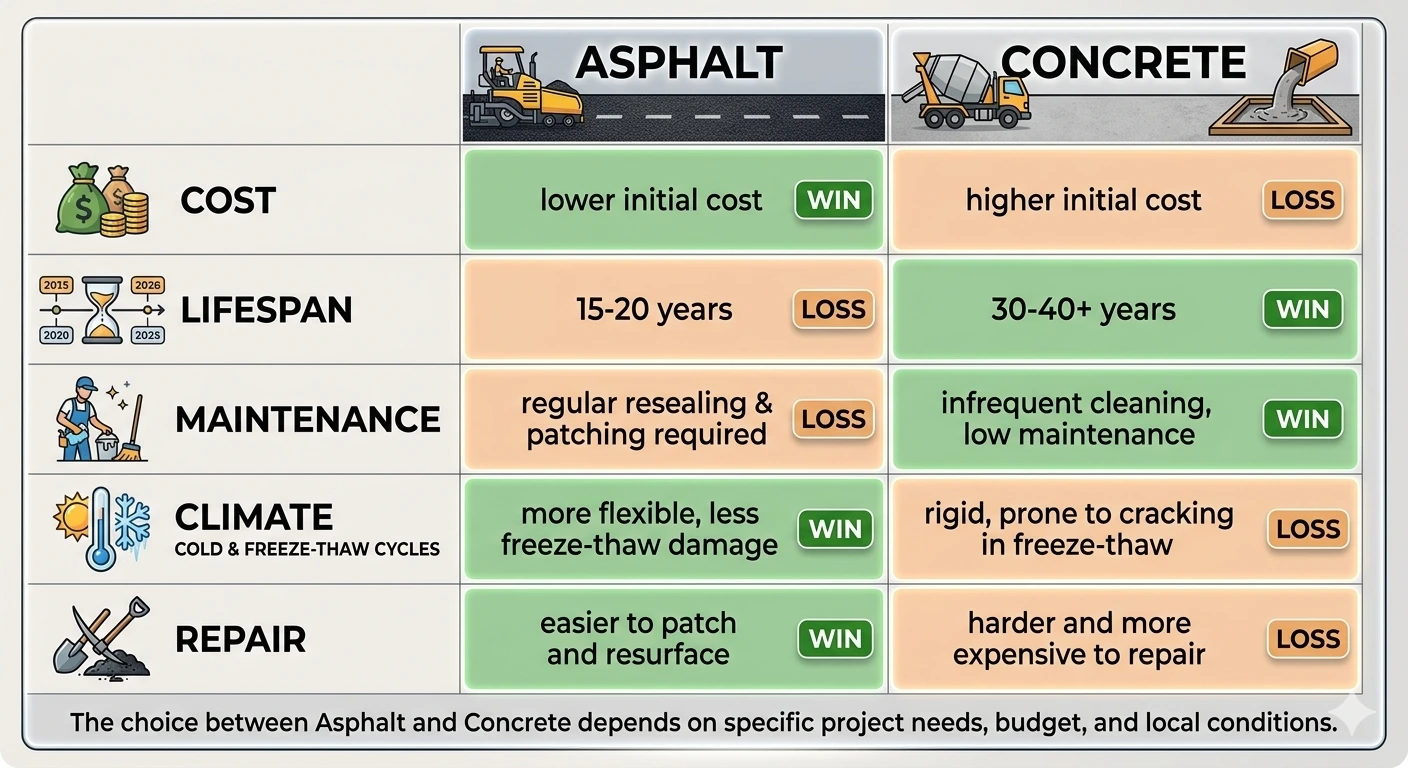
This calculator handles asphalt quantities only. If you’re comparing materials, use the tonnage output to price the asphalt option, then get a separate concrete quote in cubic yards.

Residential Driveways – A standard 20×10 foot driveway with 3-inch thickness requires approximately 2.5-3 tons of asphalt. Most residential driveways range from 400-800 square feet, requiring 4-8 tons of material. Our calculator includes a driveway preset with standard dimensions and thickness for quick estimation, with adjustments available for specific project requirements.
Parking Lots – Commercial parking lots vary significantly in size, but a standard 50×100 foot lot with 4-inch thickness requires approximately 83-93 tons of asphalt. The calculator provides parking lot presets with common dimensions and appropriate thickness options, along with recommendations for subbase preparation and drainage considerations.
Road Paving – Residential street paving (100×24 feet for two lanes) with 6-inch thickness requires approximately 67-74 tons of asphalt per 100-foot section. The calculator includes road construction templates with standard widths for residential, collector, and arterial roads, adjusting thickness based on traffic classification.
Walkways and Paths – Asphalt walkways typically use 2-inch thickness over a compacted base. A 3×50 foot pathway requires approximately 0.6-0.7 tons of material. The calculator provides walkway presets with standard dimensions and reduced thickness options appropriate for pedestrian traffic.
Playground and Court Surfaces – Basketball courts, playgrounds, and recreational surfaces typically use 4-inch thickness for durability. A standard 50×30 foot basketball court requires approximately 25-28 tons of asphalt. The calculator includes recreational surface templates with appropriate thickness and density recommendations for sports applications.
Patio and Outdoor Living Spaces – Asphalt patios provide durable, low-maintenance outdoor surfaces. A 15×20 foot patio with 3-inch thickness requires approximately 4.2-4.7 tons of material. The calculator includes patio presets with recommendations for proper slope (minimum 2% for drainage) and edge detailing.
At 2 inches compacted with HMA and 5% waste, 1,000 ft² needs about 12.7 US tons. That’s roughly 11.5 metric tonnes. Bump to 3 inches and you’re at 19 US tons.
A US ton of HMA covers about 80 ft² at 2 inches compacted. At 3 inches, coverage drops to roughly 53 ft². The metric version: one tonne covers about 8.6 m² at 50 mm.
A US short ton is 2,000 pounds (907 kg). A metric tonne is 1,000 kg, or about 2,205 pounds. The metric tonne is roughly 10% heavier. Always confirm which one your supplier quotes.
Two inches of compacted HMA over a proper gravel base is standard for residential driveways carrying cars and light trucks. If you regularly park heavy vehicles, go to 3 inches. The base matters as much as the surface, 4 to 6 inches of compacted gravel underneath.
HMA in North America typically runs $80 to $150 per US ton. UK pricing sits around £70 to £120 per tonne. Indian rates land between ₹4,000 and ₹8,000 per tonne. Your local plant, order size, and mix type all move the number.
Yes. Enter the lot dimensions, set thickness to 2.5 or 3 inches for car traffic, and pick your mix. The truckload table is especially useful at parking-lot scale, you’ll often need three or more loads.
Standard HMA compacted density is about 2,322 kg/m³, or 145 lb/ft³. Warm mix is slightly lighter at roughly 2,240 kg/m³. Porous asphalt and recycled millings drop to 2,000 and 1,920 kg/m³ respectively.
Because density values apply to the material after rolling. If you enter loose depth, the tonnage will come out too high. Loose asphalt is 20–25% thicker than its compacted state.
A standard dump truck carries about 20 metric tonnes, or roughly 22 US short tons. Larger articulated trucks handle 25 tonnes. The calculator’s truck table shows loads required for each capacity.
Yes, unless your area is perfectly square and your base is perfectly flat. A 5% allowance covers spillage, compaction loss, and small subgrade irregularities. Go to 7–10% for irregular shapes or rough base conditions.
Material cost estimates from this tool cover asphalt only. Labour, equipment rental, base preparation, permits, and disposal of old pavement aren’t included. Asphalt prices change with oil markets and regional supply, so always confirm the rate with your supplier before committing to a budget. Treat the tonnage figures as a planning estimate, not a substitute for a site visit from a qualified paving contractor.
Asphalt Institute MS-2 Asphalt Mix Design Methods (7th Edition) – Asphalt Institute
Iowa DOT 1B-4: Densities for Use in Estimating Quantities – Iowa Department of Transportation
NYSDOT Regional Design Instruction – New York State Department of Transportation
Density, Adhesion and Stiffness of Warm Mix Asphalts – ScienceDirect (Elsevier)
Asphalt Millings: Physical and Mechanical Properties – NYC Department of Environmental Protection
FHWA Reclaimed Asphalt Pavement – Federal Highway Administration (US DOT)
Iowa State University Extension: Asphalt Driveways (August 2001) – Iowa State University
Rhode Island Residential Paving Standards – Rhode Island Contractors’ Registration Board
Louisiana DOTD QA Manual for Asphalt Pavements (2018) – Louisiana Department of Transportation
Pennsylvania Asphalt Pavement Association: Constructing Quality Asphalt Pavements – PA Asphalt
Asphalt Calculator – Tons, Thickness, Density and Waste – CalcEngineer
ADVERTISEMENT
ADVERTISEMENT