
Measure your wingspan-to-height ratio. Find out if you have a positive, neutral, or negative ape index, and see how you compare to elite athletes in climbing, swimming, basketball, and combat sports.
| Ape index | Category | Meaning |
|---|
| Sport | Average ape index | Your status | Why it matters |
|---|
| Athlete | Sport | Height | Wingspan | Ape index | Your ratio vs athlete |
|---|
| Metric | Value | Notes |
|---|
-
Select a citation style above. Click the citation text to select it all, then copy.
ADVERTISEMENT

Founder & CEO, Toolraxy
Faiq Ur Rahman is a web designer, digital product developer, and founder of Toolraxy, a growing platform of web-based calculators and utility tools. He specializes in building structured, user-friendly tools focused on health, finance, productivity, and everyday problem-solving.
User Ratings:
ADVERTISEMENT
ADVERTISEMENT
Your ape index tells you how your arm span stacks up against your height. That single ratio shapes reach in climbing, stroke length in swimming, and how much ground you cover in the paint. This calculator takes two measurements and returns your ratio, your absolute difference in centimetres or inches, and where you land against elite athletes across six sports.
Most people sit close to 1.0. Some sit well above it. The number itself won’t make you a better athlete, but it explains why certain body types gravitate toward certain sports, and why coaches at the elite level pay attention to wingspan at draft combines.
If you’ve ever wondered whether your arms are “long for your height,” this tool answers that in seconds. It’s built for climbers, swimmers, fighters, basketball players, and anyone curious about their own proportions.
You need two measurements: your standing height and your arm span from fingertip to fingertip. Take each measurement two or three times and use the average. Small errors in either input shift the ratio more than you’d expect at short heights.
Choose your unit system. Metric gives you centimetres. Imperial gives you inches. The calculator converts between them automatically when you switch.
Enter your standing height. Stand barefoot against a wall with your back flat. Mark the top of your head and measure from the floor to that mark.
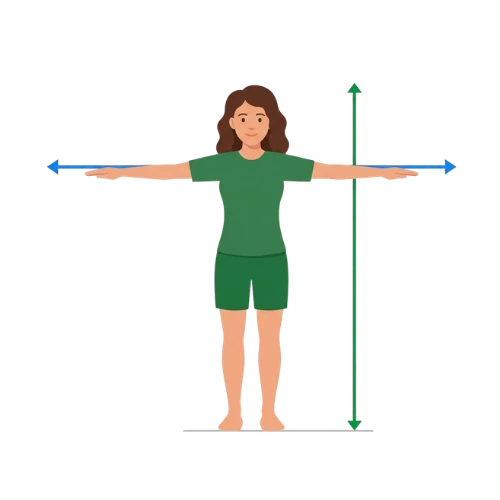
Enter your arm span. Stand straight, extend both arms horizontally at shoulder height, and measure from the tip of one middle finger to the other.
Or pick a preset. Average male, average female, and NBA player presets load typical measurements so you can see how the outputs behave.
Read your ape index. The large number is your ratio (arm span ÷ height). The tiles below show your absolute difference, wingspan as a percentage of height, and reach radius.
Check the interpretation table. Your row is highlighted so you can see which category you fall into.
Compare by sport. The sport table tells you whether your ratio sits above, within, or below the typical range for six sports.
The ape index is arm span divided by height. That’s it. One division, two inputs, a single ratio. The result is dimensionless, so it works the same whether you measure in centimetres or inches.
Formula: Ape Index (ratio) = Arm Span ÷ Height
The calculator also reports three derived values: the absolute difference (Arm Span − Height), wingspan as a percentage of height ((Arm Span ÷ Height) × 100), and reach radius (Arm Span ÷ 2). The absolute difference is signed: positive means your span exceeds your height, negative means it falls short.
A 178 cm climber measures her arm span at 184 cm. She wants to know whether that’s a meaningful reach advantage or just noise.
Step 1: Divide arm span by height. 184 ÷ 178 = 1.034.
Step 2: Subtract height from arm span. 184 − 178 = +6 cm.
Step 3: Calculate wingspan as a percentage. (184 ÷ 178) × 100 = 103.4%.
Step 4: Calculate reach radius. 184 ÷ 2 = 92 cm.
The calculator classifies a ratio of 1.034 as “Above average” (the threshold is 1.02). Against the climbing range of 1.00–1.03, she sits just above the top of the band. The sport table marks her as “Above average” for climbing, meaning she has more reach than the typical elite climber at her height.
At 178 cm, a +6 cm difference puts her arm span in roughly the 80th–90th percentile for adult women. The result doesn’t mean she’ll climb harder grades. It means reach-dependent moves will feel different for her than for someone with a 1.00 index at the same height.

Get the measurement right and the calculation takes care of itself. These are the practical habits that separate a reliable reading from a guess.
Measure in the morning. You’re tallest after a night’s sleep. Evening measurements can be 1–2 cm shorter.
Use a wall, not a friend’s estimate. Stand barefoot with your heels, glutes, upper back, and head touching the wall. Mark the top of your head with a pencil flat against the wall.
Get help for the arm span. Ask someone to hold the tape at one fingertip while you extend the other arm. Doing it alone usually adds 2–3 cm of error.
Keep arms at shoulder height. Not above. Not below. Horizontal. A 10-degree upward tilt can add 3–5 cm to your span.
Measure twice, average the numbers. Write both down. If they differ by more than 1 cm, measure a third time and drop the outlier.
Don’t round to the nearest inch. A 0.5 cm difference can shift your ratio across a category boundary (for example, from 1.019 to 1.021, crossing from “Neutral” to “Above average”).
Check your unit system before entering. The most common input error is entering height in centimetres and span in inches. The calculator won’t warn you; it will just return a wrong ratio.
There’s no universal “good” value. For general health and proportion, anything between 0.98 and 1.02 is typical. For sports where reach matters, higher is usually better: climbers average around 1.02–1.03, swimmers 1.02–1.05, and NBA players 1.05–1.06.
It depends on the sport. In climbing, swimming, basketball, and combat sports, a higher ratio generally corresponds to a reach advantage. In deadlifting and bench pressing, longer arms can be a disadvantage because the bar travels further. The ratio itself is neutral; context determines whether it helps.
Most adults sit between 0.98 and 1.02. Adult men average slightly positive (around 1.01–1.03, or +5.3 cm). Adult women average near zero to slightly positive (around 0.99–1.01, or +1.2 cm). The overall population average is close to 1.0.
Divide your arm span by your height. If your arm span is 180 cm and your height is 175 cm, your ratio is 1.029. Subtract height from span to get the difference: +5 cm. Measure both values in the same unit.
A negative difference (or a ratio below 1.0) means your arm span is shorter than your height. This is common and not a problem. Some elite climbers, including Lynn Hill and Brooke Raboutou, have negative indices.
Yes. Arm span and height are both highly heritable. You can’t train your way to longer arms. Some climbers believe training can improve the ratio, but the evidence is thin; most of the change comes from measurement error or postural shifts.
Not meaningfully. Your arm bones don’t lengthen after puberty. You can improve your measured span by fixing measurement errors (arms at the right height, tape straight) and by stretching your shoulders to reduce rounding, but the underlying skeletal ratio is fixed.
Published measurements vary. One common figure is 198 cm span at 193 cm height, giving a ratio of 1.025. This calculator uses 201 cm span at 193 cm height (ratio 1.041) in its athlete comparison table. The discrepancy comes from different published sources.
The calculator lists Jones at 193 cm height with a 215 cm span, giving a ratio of 1.114. In inches, that’s roughly an 8.5-inch reach advantage. He’s one of the highest-profile examples of a large positive index in combat sports.
Yes, but not in isolation. NBA players average a ratio of about 1.06, well above the general population. Wingspan helps with rebounding, blocking, and shooting over defenders. But skill, height, and athleticism matter more than any single ratio.
Stand straight with your back against a wall. Extend both arms horizontally at shoulder height. Measure from the tip of one middle finger to the tip of the other. Keep the tape straight and level. Measure twice.
The league average is approximately 1.06, based on DraftExpress measurement data. That’s roughly a 4.4–4.8 inch (11–12 cm) span excess over height. A 1.1 ratio is more common in the NBA than a 1.0 ratio.
This calculator provides an anthropometric ratio for educational and informational purposes. It is not a medical device and does not diagnose, treat, or screen for any condition, including Marfan syndrome or other connective tissue disorders. An ape index above 1.05 is one feature clinicians may consider alongside other findings; it is not diagnostic on its own. Consult a qualified healthcare provider for any health concerns.
Wikipedia contributors. “Ape index.” Wikipedia. https://en.wikipedia.org/wiki/Ape_index
Frontiers in Sports and Active Living. “Morphology of male World Cup and elite speed climbers.” 2025. https://www.frontiersin.org/journals/sports-and-active-living/articles/10.3389/fspor.2025.1679627/full
Epstein, David. The Sports Gene. 2014. (NBA average ratio of 1.06, general population 1.01.)
RealGM. “Kawhi Leonard Has Largest Wingspan Ratio Of Any All-Star In Past 15 Years.” 2016. https://basketball.realgm.com/wiretap/240773/
Slate. “A Hello to Arms: Forget height. Basketball players’ wingspans are absurd and amazing.” 2014. https://slate.com/culture/2014/05/nba-wingspans-forget-height-basketball-players-wingspans-are-absurd-and-amazing.html
Kirk, Chris. “Best Body Type For MMA.” Sweet Science of Fighting. 2022. https://sweetscienceoffighting.com/guides/best-body-type-for-mma
Yahoo Sports / Triathlete. “Do You Know Your Ape Index?” 2022. https://sports.yahoo.com/know-ape-index-184747144.html
SAGE Journals. “Anthropometrics Related to the Performance of a Sample of Male Swimmers.” 2014.
NEJM. “Diagnostic Worksheet for Marfan syndrome by Ghent Criteria.”
ScienceDirect. “Marfan Syndrome, an overview.”
FPnotebook. “Arm Span.” 2025. (Adult male +5.3 cm, adult female +1.2 cm.)
NIH / PMC. “Arm span/height ratio reference values in children and adolescents.”
ADVERTISEMENT
ADVERTISEMENT