
Calculate area for rectangle, triangle, or circle – with currency support
Powered by Toolraxy

Founder & CEO, Toolraxy
Faiq Ur Rahman is a web designer, digital product developer, and founder of Toolraxy, a growing platform of web-based calculators and utility tools. He specializes in building structured, user-friendly tools focused on health, finance, productivity, and everyday problem-solving.
User Ratings:
ADVERTISEMENT
ADVERTISEMENT
A Square Footage Calculator determines the area of any space in square feet, the standard measurement for real estate, flooring, painting, landscaping, and construction projects in the US and Canada. One square foot equals a square measuring 12 inches on each side.
Whether you’re estimating flooring for a rectangular room, calculating paint coverage for triangular walls, or determining sod quantity for a circular garden bed, knowing accurate square footage prevents costly overordering or mid-project shortages. This square footage calculator handles three common shapes—rectangles, triangles, and circles—with length, width, base, height, or radius inputs in feet, inches, yards, meters, or centimeters. Results display in square feet, square yards, square meters, and acres. Add an optional price per square foot with 22 currency options for instant cost estimates. Powered by Toolraxy, all calculations run locally in your browser.
Select shape – Choose rectangle, triangle, or circle
Enter rectangle dimensions – Length and width (if rectangle selected)
Enter triangle dimensions – Base and height (if triangle selected)
Enter circle dimension – Radius (if circle selected)
Choose units – Feet, inches, yards, meters, or centimeters for each measurement
Add price (optional) – Enter cost per square foot for total estimate
Select currency – Pick from 22 global currencies
View results – Square feet, square yards, square meters, acres, and total cost update automatically
Copy or share – Save results for project documentation
The square footage calculator applies standard geometric area formulas based on the selected shape.
Rectangle:
Area (sq ft) = Length (ft) × Width (ft)
Triangle:
Area (sq ft) = ½ × Base (ft) × Height (ft)
Circle:
Area (sq ft) = π × Radius (ft)²
(π = 3.14159265359)
Feet (ft) → Multiply by 1
Inches (in) → Divide by 12
Yards (yd) → Multiply by 3
Meters (m) → Multiply by 3.28084
Centimeters (cm) → Divide by 30.48
Square yards = Square feet ÷ 9
Square meters = Square feet × 0.092903
Acres = Square feet ÷ 43,560
Any dimension of zero or below shows “—” for all results
Negative numbers are treated as zero
Price of zero hides the cost row entirely
Square feet and square yards round to 2 decimal places
Square meters round to 2 decimal places
Acres round to 6 decimal places
Very small areas (0.01 sq ft)
Very large areas (acres for land measurement)
Mixed units across dimensions
Circle area using π (accurate to machine precision)
Shape switching preserves input values for each shape type
Real-world scenario: You’re installing hardwood flooring in an L-shaped living room. Break it into two rectangles: main area 20 ft × 15 ft, and dining extension 10 ft × 8 ft.
Shape: Rectangle
Length: 20 feet
Width: 15 feet
Price per square foot: $8.50
Step 1: Calculate main rectangle area
20 × 15 = 300 square feet
Step 2: Calculate dining extension (same shape, second calculation)
10 × 8 = 80 square feet
Step 3: Total area
300 + 80 = 380 square feet
Step 4: Convert to other units
Square yards: 380 ÷ 9 = 42.22 sq yd
Square meters: 380 × 0.092903 = 35.30 sq m
Acres: 380 ÷ 43,560 = 0.0087 acres
Step 5: Calculate total cost
380 × $8.50 = $3,230.00
The L-shaped room contains 380 square feet of flooring area. At $8.50 per square foot installed, the flooring material costs $3,230 (excluding underlayment, trim, and labor). This square footage calculator confirms you need approximately 42.2 square yards of flooring—helpful when ordering from suppliers who price by the yard.
Takeaway: For L-shaped or irregular rooms, break the space into rectangles, calculate each separately, then add totals. This calculator handles one shape at a time, so document intermediate results.
Square footage measures the total area of a space in square feet—the standard real estate and construction unit in North America. One square foot equals 144 square inches or a 12-inch by 12-inch square. Understanding square footage matters for nearly every building and renovation project.
Real estate listings display square footage as a primary value indicator. Flooring, tile, carpet, and hardwood are sold by the square foot. Paint and primer coverage is rated in square feet per gallon. Landscaping materials like sod, mulch, and gravel are often priced per square foot or square yard. Contractors quote jobs based on square footage. Without accurate area calculations, you risk overbuying materials (wasting money) or underbuying (delaying your project). Professional appraisers, contractors, and DIY homeowners all rely on precise square footage measurements.
Manual calculation depends on your shape:
Rectangle or square: Multiply length by width. A 12-foot by 10-foot room = 120 square feet.
Triangle: Multiply base by height, then divide by 2. A triangle with 10-foot base and 8-foot height = (10 × 8) ÷ 2 = 40 square feet.
Circle: Multiply π (3.1416) by radius squared. A circle with 5-foot radius = 3.1416 × 25 = 78.54 square feet.
For irregular shapes, break the space into rectangles, triangles, and circle segments, calculate each area separately, then add them together. Always convert all measurements to the same unit (feet recommended) before multiplying.
There is no universal “good” square footage—it depends entirely on property type and location. Median US home sizes vary significantly by region. A 1,000-square-foot apartment might be spacious in New York City but tiny in suburban Texas. For commercial spaces, retail needs vary by business type.
What matters is comparing square footage to your specific needs. For flooring projects, calculate exactly to avoid waste. For painting, add 10–15% for multiple coats and touch-ups. For real estate, understand that different markets value square footage differently. This square footage calculator helps you establish accurate measurements; interpreting whether that measurement is “good” depends on your project goals and local standards.
Several variables influence your square footage results:
Measurement precision: 1/8 inch measurement errors multiply across large areas. A 1-inch error on a 50-foot wall changes square footage by over 4 square feet.
Shape complexity: L-shaped, U-shaped, or irregular rooms require breaking into multiple shapes, increasing potential error from each measurement.
Unit consistency: Mixing feet and inches without conversion is the most common mistake. Always convert everything to feet or everything to inches before calculating.
Included spaces: Real estate square footage definitions vary. Some include garages, basements, or unfinished attics; others don’t. Clarify what you’re measuring.
Wall thickness: For interior usable space, measure from interior wall surfaces. For total building area, measure from exterior walls.
Sloped ceilings: Spaces with sloped ceilings (attics, A-frames) use different rules—typically only areas with ceiling height above 5 feet count toward square footage.
Too high: Check your unit selections. Length in feet but width in inches creates results 12× too high. Also verify you didn’t measure exterior walls when you need interior dimensions. For circles, confirm you used radius (half the diameter), not diameter.
Too low: Ensure you converted inches to feet correctly (divide inches by 12). For triangles, did you forget the multiply by 0.5? Half of base × height is the formula; skipping the 0.5 gives results 2× too high, not too low. For circles, verify you squared the radius (multiplied radius by itself).
Other causes: Decimal point errors (10.5 vs 105), incorrect tape measure readings, or forgetting to measure closets and alcoves.
Use a square footage calculator in these situations:
Before buying flooring – Carpet, hardwood, tile, vinyl, laminate—all priced by square foot.
For painting projects – Estimate paint quantity (check coverage per gallon on the can).
Real estate comparisons – Compare home or apartment sizes objectively.
Landscaping planning – Sod, mulch, gravel, artificial turf, and pavers.
HVAC sizing – Heating and cooling systems are sized by square footage.
Construction estimating – Drywall, insulation, subflooring, and roofing materials.
Furniture planning – Ensure furniture fits room dimensions before purchase.
Don’t use square footage for three-dimensional materials (mulch depth, concrete volume—use cubic yards) or linear materials (baseboards, crown molding—use linear feet).
Measuring in inches without converting – A 120-inch by 120-inch room is 100 square feet (120÷12=10; 10×10=100), not 14,400 square feet.
Forgetting to convert both dimensions – Converting length but not width yields nonsense results.
Using diameter instead of radius for circles – A 10-foot diameter circle has 5-foot radius. Area = 3.1416 × 25 = 78.54 sq ft, not 3.1416 × 100 = 314.16 sq ft.
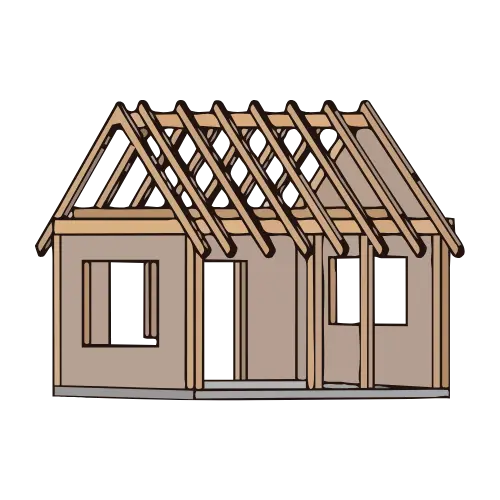
Measuring sloped walls incorrectly – For triangular walls (cathedral ceilings), measure base and vertical height, not slope distance.
Ignoring waste factor – Flooring and painting need 10–15% extra for cuts, mistakes, and future repairs. Add this after calculating raw square footage.
Measuring from blueprints incorrectly – Blueprint measurements are often to wall centers. For usable space, measure interior wall to interior wall.
You’re painting a two-story house with the following surfaces:
Main rectangle: 40 ft long × 20 ft high (first two stories) = 800 sq ft
Gable triangle (above second story): 40 ft base × 10 ft height ÷ 2 = 200 sq ft
Subtract windows and doors: approximately 150 sq ft
Total paintable area: 800 + 200 – 150 = 850 square feet
Paint requirement calculation:
Paint covers 350 square feet per gallon (first coat)
Need two coats = 1,700 square feet total coverage
Gallons needed: 1,700 ÷ 350 = 4.86 gallons → purchase 5 gallons
Cost estimate:
Paint at $45 per gallon = $225
Primer at $30 per gallon (optional, 1 gallon) = $30
Total material: $255 before supplies and labor
This square footage calculator determines the 850 sq ft area, then you manually apply the paint coverage formula. Without accurate square footage, you might buy 3 gallons (insufficient) or 8 gallons (wasting $135).
Saves time – No manual unit conversions or geometric formula recall
Reduces manual errors – Eliminates formula mistakes and unit confusion
Instant results – Updates as you type or change shapes
Free to use – No account, no email, no hidden fees
Private – Client-side calculations only; no data sent to any server
Accessible on any device – Works on smartphones, tablets, and computers
Three shapes – Rectangles, triangles, and circles all in one tool
Multiple units – Feet, inches, yards, meters, and centimeters
Four output units – Square feet, square yards, square meters, acres
22 currencies – For cost estimates in USD, EUR, GBP, JPY, and more
The calculator is mathematically exact to standard geometric formulas. Accuracy depends entirely on your measurements—use a quality tape measure and measure twice.
Yes. For rectangles: length × width. For triangles: (base × height) ÷ 2. For circles: π × radius². Always convert all measurements to the same unit before multiplying.
One square yard equals 9 square feet (a 3 ft × 3 ft square). Flooring and landscaping materials are sometimes sold by the square yard, especially carpet and sod.
Yes. Select meters or centimeters for any dimension. Results always include square meters alongside square feet for easy metric reference.
The calculator saves inputs separately for each shape. Rectangle dimensions don’t apply to circles, and vice versa. Switch back to a previous shape to see your earlier values.
Break the room into rectangles, calculate each using this tool, then add the square footage totals manually. For complex spaces, sketch the layout and divide into simple shapes.
The cost row hides when price per square foot is zero. Enter a price above 0 to see total cost displayed.
Yes for measurement assistance. However, professional appraisers use specific ANSI standards for measuring homes (interior vs exterior walls, included spaces). This tool calculates geometry—you must follow appropriate measurement standards for your jurisdiction.
Click the Share button to copy results and tool link to your clipboard. On mobile devices, native share menus appear for easy texting or emailing.
Measuring in inches but forgetting to convert to feet. A 120-inch length is 10 feet, but 120 × 120 = 14,400 (incorrect) while 10 × 10 = 100 (correct). This tool handles conversion automatically.
Yes. Select the circle shape, enter the radius (half the diameter), and choose your unit. The calculator returns square feet, square yards, square meters, and acres.
For flooring: add 10–15%. For painting: add 10–15% for multiple coats and touch-ups. For landscaping: add 5–10% for irregular edges. For tile: add 15–20% due to cuts and pattern matching.
ADVERTISEMENT
ADVERTISEMENT