

Bruce Protocol Stress Test Calculator: HR Max, VO2 Max & MET Max

Bruce Protocol Stress Test Calculator

Estimate heart rate max, VO2 max, and MET max from age, sex, and exercise time using the Bruce treadmill protocol.

Stress test information
yrs
min
sec
Sex and age determine the VO2 max regression and fitness classification. Exercise time is the total time completed on the Bruce treadmill protocol.
Metabolic results
MET max
-
- sex - age - time
-
Heart rate maximum
-
VO2 max
-
MET max
-
Fitness category
-
Calculation breakdown
QuantityValueFormulaNotes
Bruce protocol stages
StageSpeed (mph)Grade (%)Time (min)METs
What your MET level means
METsEquivalent activityYour status
VO2 max norms for your age and sex
CategoryVO2 max (mL/kg/min)METsDescription
Full summary
MetricValueNotes
Powered by Toolraxy
Embed this calculator
Embed code
Live preview, identical to the main calculator EXACT MATCH
Cite this calculator
-

Select a citation style above. Click the citation text to select it all, then copy.

Creator & Maintainer

Image of Faiq Ur Rahman, CEO & Founder Toolraxy

Faiq Ur Rahman

Founder & CEO, Toolraxy

Faiq Ur Rahman is a web designer, digital product developer, and founder of Toolraxy, a growing platform of web-based calculators and utility tools. He specializes in building structured, user-friendly tools focused on health, finance, productivity, and everyday problem-solving.

Share:

Rate this Tool

User Ratings:

0
0 out of 5 stars (based on 0 reviews)
Excellent
Very good
Average
Poor
Terrible

ADVERTISEMENT

ADVERTISEMENT

What is The Bruce Protocol Stress Test?

The Bruce protocol is the treadmill test cardiologists have used for decades to measure exercise capacity. You walk and run through seven three-minute stages, each faster and steeper than the last, until you can’t continue. Your total time on the treadmill converts to a VO2 max estimate, a MET max, and a fitness category.

This calculator takes your sex, age, and exercise time, then runs the Bruce regression equations. The output tells you where your aerobic capacity sits against age- and sex-matched norms. It’s not a clinical diagnosis, but it’s the same math a stress lab uses.

If you’ve done a Bruce protocol test and have the time written on a discharge sheet, plug it in. The calculator shows what those numbers mean, stage by stage.


A Man Running on a treadmill

How to Use the Bruce Protocol Calculator

Three inputs drive the result: sex, age, and total exercise time. Sex selects the correct regression equation. Age determines the heart rate maximum estimate and the fitness norm band. Exercise time is the number of minutes and seconds you completed on the treadmill.

  1. Select your sex. The calculator uses different VO2 max regression equations for males and females.

  2. Enter your age. Age sets heart rate max using the Fox formula (220 − age) and picks the correct VO2 norm row.

  3. Enter your exercise time in minutes and seconds. This is the total time completed on the Bruce protocol, not the stage number.

  4. Read your MET max. The hero number is your estimated maximal MET level. One MET equals 3.5 mL of oxygen per kilogram per minute.

  5. Check the tiles. Heart rate max, VO2 max, MET max, and fitness category are displayed together.

  6. Scan the stage table. Your exercise time highlights the stage you reached. The table shows speed, grade, and MET level for each of the seven stages.

  7. Compare to MET equivalents. The MET table shows which everyday activities match your maximal capacity.

  8. Check the VO2 norms. Your VO2 max is classified against age- and sex-specific ranges from the Cooper Institute.

Bruce Protocol Formula

The calculator uses two published regression equations to convert exercise time into VO2 max. One for males, one for females. Both were derived from treadmill tests and validated against direct oxygen consumption measurements.

Formula (male): VO2 max = 14.76 − (1.379 × T) + (0.451 × T²) − (0.012 × T³)

Formula (female): VO2 max = 4.38 × T − 3.9

Formula: MET max = VO2 max ÷ 3.5

Formula: Heart Rate Max = 220 − Age

T is total exercise time in minutes (including fractions of a minute). The male equation is a cubic polynomial that produces a curved relationship between time and VO2 max. The female equation is linear.

Example Calculation

A 45-year-old woman completes 8 minutes and 12 seconds on the Bruce protocol. She wants to know her VO2 max and where she sits against her age group.

Step 1: Convert time to decimal minutes. 8 minutes 12 seconds = 8.2 minutes.

Step 2: Apply the female regression equation. VO2 max = 4.38 × 8.2 − 3.9 = 32.0 mL/kg/min.

Step 3: Calculate MET max. 32.0 ÷ 3.5 = 9.1 METs.

Step 4: Estimate heart rate max. 220 − 45 = 175 bpm.

Step 5: Classify against norms. For a 45-year-old female, 32.0 mL/kg/min falls in the “Fair” category (the range for 40–49 females is roughly 33.0–36.3 for Fair, so she’s just below that threshold).

The result puts her maximal capacity just below the middle of her age group. A MET max of 9.1 means she can sustain activities at roughly nine times resting metabolic rate, equivalent to jogging at a moderate pace. Completing an extra 45 seconds on the test would push her VO2 max to 34.2 mL/kg/min, moving her into the “Good” category.
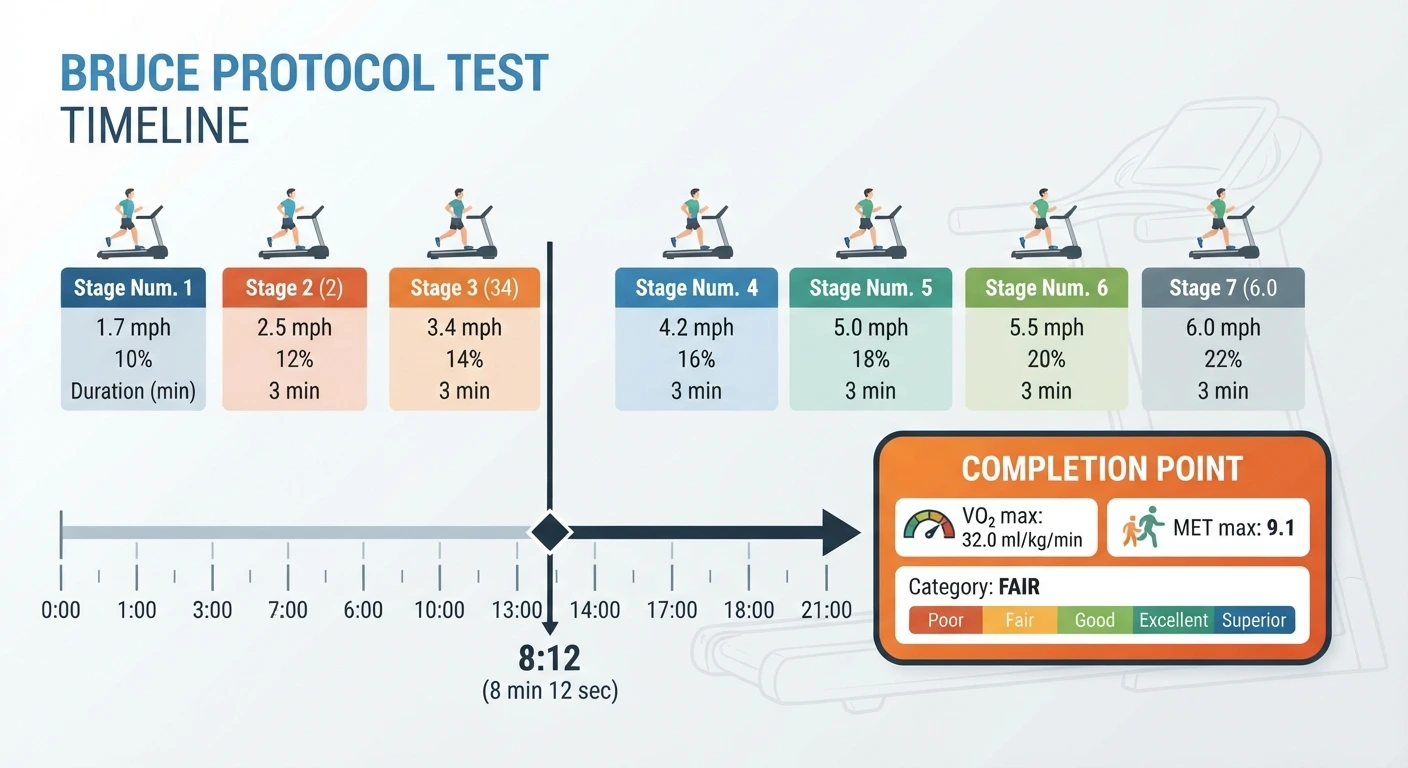
Bruce protocol timeline showing completion at 8 minutes 12 seconds with VO2 max and MET outputs

What Factors Affect Bruce Protocol Results?

The Bruce protocol measures maximal exercise capacity, but many factors shape that number beyond cardiovascular fitness.

  • Age. VO2 max declines by roughly 10% per decade after age 30 in sedentary adults. The regression equations don’t account for age, but the fitness norms do.

  • Sex. Females have lower average VO2 max than males at every age due to differences in haemoglobin concentration, body composition, and heart size. The calculator uses sex-specific equations.

  • Body weight. The VO2 max equation produces an absolute value in mL/kg/min. Heavier individuals with the same exercise time may have lower relative VO2 max because they’re moving more mass.

  • Fitness training. Endurance training raises VO2 max by 15–25% in previously untrained individuals. A trained runner will reach higher stages than an untrained person of the same age.

  • Motivation. The Bruce protocol is symptom-limited. If you stop early because of leg fatigue or breathlessness that isn’t cardiovascular, the VO2 estimate will be lower than your true capacity.

  • Medications. Beta-blockers lower heart rate and reduce exercise capacity. The calculator’s heart rate max estimate (220 − age) will overestimate actual max HR in patients on these drugs.

  • Test protocol. A modified Bruce test produces lower exercise times for the same workload because of the extra warm-up stages. The calculator assumes standard Bruce.

Frequently Asked Questions

What is a good Bruce protocol score?

Completing 9 minutes or more on the standard Bruce protocol is generally considered good. That corresponds to roughly 10 METs, which is associated with a low risk of death in clinical studies. Elite athletes often complete 12–15 minutes.


How do I calculate VO2 max from Bruce protocol time?

For males, use: VO2 max = 14.76 − (1.379 × T) + (0.451 × T²) − (0.012 × T³). For females, use: VO2 max = 4.38 × T − 3.9. T is total exercise time in minutes. The calculator does this automatically.


What is a MET max?

MET max is your maximal metabolic equivalent, the highest rate of oxygen consumption you can sustain during exercise. One MET equals 3.5 mL of oxygen per kilogram per minute. A MET max of 10 means you consume oxygen at ten times your resting rate at peak effort.


What is a normal VO2 max for my age?

VO2 max norms depend on age and sex. For a 30-year-old male, the “Good” range is roughly 44.0–48.3 mL/kg/min. For a 30-year-old female, the “Good” range is about 37.8–42.4. The calculator classifies your result against these bands.


Is 10 METs good on a stress test?

Yes. Completing 10 METs on the Bruce protocol is associated with a low risk of death from cardiovascular causes. It’s a threshold that many cardiologists use to reassure patients. It corresponds to roughly 9 minutes on the standard protocol.


What is the Bruce protocol formula?

The Bruce protocol formula converts exercise time to VO2 max. The male equation is a cubic polynomial. The female equation is linear. The formulas were derived from treadmill tests with direct oxygen consumption measurements.


How long is the Bruce protocol?

The standard Bruce protocol has seven stages, each lasting three minutes. Maximum duration is 21 minutes if you complete all stages. Most clinical tests end between 6 and 12 minutes.


What is a MET equivalent?

A MET equivalent is an everyday activity that matches a given MET level. For example, 10 METs is equivalent to running at 6 mph. The calculator’s MET table maps your MET max to common activities.


What is the modified Bruce protocol?

The modified Bruce protocol adds two warm-up stages at lower grades before the standard stages begin. It’s used for elderly patients, cardiac patients, and sedentary individuals who can’t tolerate the standard 10% starting grade.


What does VO2 max measure?

VO2 max measures the maximum rate at which your body can consume oxygen during exercise. It’s expressed in mL of oxygen per kilogram of body weight per minute. Higher VO2 max means better aerobic fitness.


What is a poor VO2 max?

A “Poor” VO2 max is below the 20th percentile for your age and sex. For a 30-year-old male, that’s below about 40.5 mL/kg/min. For a 30-year-old female, below about 34.4. The calculator classifies your result automatically.


Can I improve my Bruce protocol score?

Yes. Endurance training raises VO2 max by 15–25% in untrained individuals over 8–12 weeks. Training also improves the economy of movement, which means you can reach higher stages before reaching maximal effort.

Disclaimer

This calculator provides an estimate of VO2 max and MET max from Bruce protocol exercise time using published regression equations. It is for educational and informational purposes only. It is not a medical device, does not interpret stress test results, and does not diagnose, treat, or screen for cardiovascular disease. A supervised stress test includes ECG monitoring, blood pressure measurement, and symptom assessment that this calculator cannot replicate. Consult a qualified healthcare provider for any cardiovascular concerns.

Sources

Bruce, R.A., Kusumi, F., Hosmer, D. “Fundamentals of clinical cardiology: maximal oxygen intake and nomographic assessment of functional aerobic impairment in cardiovascular disease.” American Heart Journal, 1973. (Original Bruce protocol publication.)

Pollock, M.L., Bohannon, R.L., Cooper, K.H. et al. “A comparative analysis of four protocols for maximal treadmill stress testing.” American Heart Journal, 1976. (Female regression equation: 4.38T − 3.9.)

Foster, C., Jackson, A.S., Pollock, M.L. et al. “Generalized equations for predicting functional capacity from treadmill performance.” American Heart Journal, 1984. (Male regression equation validation.)

Cooper Institute. Physical Fitness Assessments and Norms for Adults and Law Enforcement. 2013. (VO2 max norms by age and sex.)

Gulati, M., Black, H.R., Shaw, L.J. et al. “The prognostic value of a nomogram for exercise capacity in women.” New England Journal of Medicine, 2005. (Female MET capacity norms.)

Morris, C.K., Myers, J., Froelicher, V.F. et al. “Nomogram based on metabolic equivalents and age for assessing aerobic exercise capacity in men.” Journal of the American College of Cardiology, 1993. (Male MET nomogram: METs = 18.0 − 0.15 × Age.)

American College of Sports Medicine. ACSM’s Guidelines for Exercise Testing and Prescription, 11th edition. (Metabolic equations and Bruce protocol standards.)

Myers, J., Prakash, M., Froelicher, V. et al. “Exercise capacity and mortality among men referred for exercise testing.” New England Journal of Medicine, 2002. (MET capacity and mortality relationship.)

ADVERTISEMENT

ADVERTISEMENT