
Find the mass percentage of each element in a chemical compound
Powered by standard atomic weights · Chemistry Tools

Founder & CEO, Toolraxy
Faiq Ur Rahman is a web designer, digital product developer, and founder of Toolraxy, a growing platform of web-based calculators and utility tools. He specializes in building structured, user-friendly tools focused on health, finance, productivity, and everyday problem-solving.
User Ratings:
ADVERTISEMENT
ADVERTISEMENT
When you’re analyzing a chemical compound, knowing the formula isn’t always enough, you also need to understand how much of each element contributes to the total mass. Percent composition tells you the mass percentage of each element in a compound, which is essential for everything from verifying the purity of a substance to determining empirical formulas and understanding chemical reactions. Whether you’re a chemistry student learning about stoichiometry, a researcher analyzing a sample, or a professional working in quality control, calculating percent composition is a fundamental skill.
This percent composition calculator lets you build any chemical formula by selecting elements from the periodic table and setting their quantities. The tool computes the molecular weight and the mass percentage of each element, showing you a detailed breakdown of how the mass is distributed. Choose from common examples like water, sodium chloride, or glucose, or build your own custom compound. All processing runs locally in your browser, keeping your data private while you explore the composition of chemical compounds.
Select an element from the dropdown menu in each row, choose from a comprehensive list of elements with their symbols and names.
Enter the number of atoms of that element in the compound using the quantity input field.
Add more elements as needed using the “Add Element” button build any compound by adding rows.
Click one of the example buttons to quickly load common compounds like H₂O, NaCl, or C₆H₁₂O₆.
Review the molecular weight, formula display, and the detailed percent composition breakdown table.
Use the Copy button to save results or Share to send them to others.
The calculator applies the standard method for calculating percent composition, which determines the mass percentage of each element in a compound. The total molar mass is calculated first, then each element’s contribution is divided by the total.
Formula: Percent Composition = (Mass of Element ÷ Total Molar Mass) × 100%
For a compound with elements E₁, E₂, …, Eₙ and quantities q₁, q₂, …, qₙ:
Formula: Mass of Elementᵢ = Atomic Massᵢ × Quantityᵢ
Formula: Total Molar Mass = Σ (Mass of Elementᵢ)
Formula: Percentᵢ = (Mass of Elementᵢ ÷ Total Molar Mass) × 100%
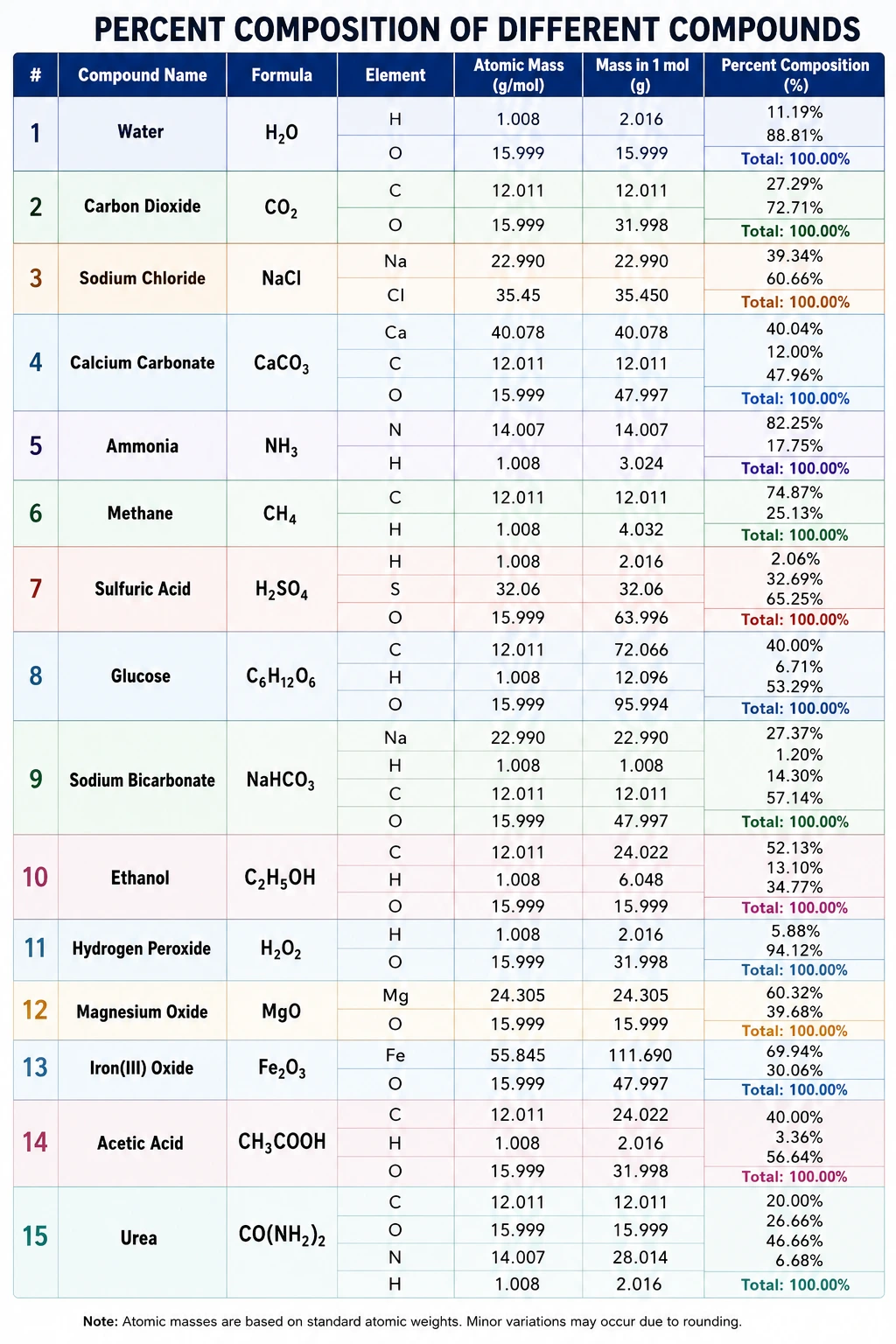
For example, in water (H₂O): Total molar mass = 18.015 g/mol. Oxygen’s contribution = 15.999 g/mol. Percent oxygen = (15.999 ÷ 18.015) × 100 = 88.81%. Hydrogen’s contribution = 2.016 g/mol. Percent hydrogen = (2.016 ÷ 18.015) × 100 = 11.19%.
The calculator uses standard atomic weights from IUPAC, providing accurate percent composition values for any compound you build.
Let’s calculate the percent composition of glucose, one of the most important carbohydrates in biology.
Step 1: Identify the elements and their quantities
Carbon (C): 6 atoms
Hydrogen (H): 12 atoms
Oxygen (O): 6 atoms
Step 2: Look up the atomic masses
Carbon: 12.011 g/mol
Hydrogen: 1.008 g/mol
Oxygen: 15.999 g/mol
Step 3: Calculate the mass contribution of each element
Carbon: 12.011 × 6 = 72.066 g/mol
Hydrogen: 1.008 × 12 = 12.096 g/mol
Oxygen: 15.999 × 6 = 95.994 g/mol
Step 4: Calculate the total molar mass
Total = 72.066 + 12.096 + 95.994 = 180.156 g/mol
Step 5: Calculate the percent composition of each element
Carbon: (72.066 ÷ 180.156) × 100 = 40.00%
Hydrogen: (12.096 ÷ 180.156) × 100 = 6.71%
Oxygen: (95.994 ÷ 180.156) × 100 = 53.29%
Step 6: Verify the sum
40.00% + 6.71% + 53.29% = 100.00%
Interpretation: Glucose is 40.00% carbon, 6.71% hydrogen, and 53.29% oxygen by mass. This means that in 100 grams of glucose, 40 grams are carbon, about 6.71 grams are hydrogen, and about 53.29 grams are oxygen.
Computes percent composition instantly for any compound by selecting elements and setting quantities.
Shows a detailed breakdown table with each element’s mass contribution and percentage.
Includes example buttons for common compounds like water, salt, and glucose.
Supports any number of elements — build formulas as simple or complex as you need.
Uses standard atomic weights from IUPAC for accurate results.
Updates results instantly as you change selections or quantities.
Runs entirely client-side with no server communication, keeping your data private.
Free to use on any device with responsive design.
Percent composition is the mass percentage of each element in a chemical compound. It’s calculated as (mass of element ÷ total molar mass) × 100%.
To calculate percent composition, multiply the atomic mass of each element by the number of atoms of that element, sum to get the total molar mass, then divide each element’s mass contribution by the total molar mass and multiply by 100.
Water is 11.19% hydrogen and 88.81% oxygen by mass. This is calculated as: H: (2.016 ÷ 18.015) × 100 = 11.19%; O: (15.999 ÷ 18.015) × 100 = 88.81%.
Sodium chloride is 39.34% sodium and 60.66% chlorine by mass. This is calculated as: Na: (22.990 ÷ 58.44) × 100 = 39.34%; Cl: (35.45 ÷ 58.44) × 100 = 60.66%.
Glucose is 40.00% carbon, 6.71% hydrogen, and 53.29% oxygen by mass. The percentages are based on the molecular weight of 180.156 g/mol.
Percent composition is important for determining empirical formulas, verifying the purity of substances, analyzing chemical reactions, and understanding the stoichiometry of compounds. It provides a quantitative understanding of a compound’s composition.
Percent composition gives the mass percentage of each element in a compound. Empirical formula gives the simplest whole-number ratio of atoms in a compound. The empirical formula can be derived from percent composition data.
Yes, the calculator supports any compound with any number of elements. You can build simple compounds like water or complex organic molecules with many elements.
ADVERTISEMENT
ADVERTISEMENT