
Compute acceleration, time, final velocity, and energy loss for an object on a slope
Powered by Toolraxy · Physics & mechanics calculator

Founder & CEO, Toolraxy
Faiq Ur Rahman is a web designer, digital product developer, and founder of Toolraxy, a growing platform of web-based calculators and utility tools. He specializes in building structured, user-friendly tools focused on health, finance, productivity, and everyday problem-solving.
User Ratings:
ADVERTISEMENT
ADVERTISEMENT
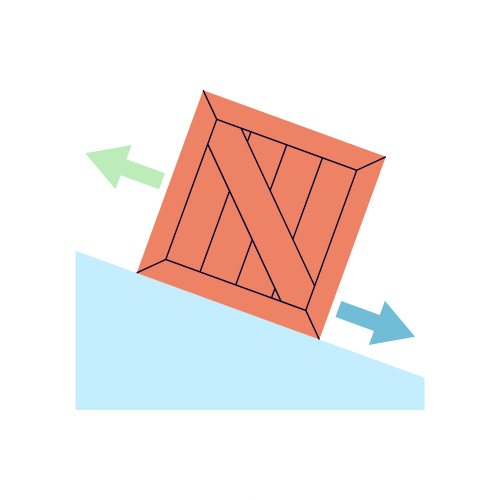
An inclined plane, or ramp, is a classic physics problem that illustrates how forces, motion, and energy interact on a sloped surface. Objects sliding down inclines are governed by the interplay of gravity, friction, and the normal force, making this a foundational concept in mechanics. Whether you are a student exploring Newton’s laws, an engineer evaluating material handling systems, or a hobbyist designing a ramp, understanding the dynamics of an object on an incline is essential. The Toolraxy Inclined Plane Calculator provides a straightforward way to compute key parameters for an object sliding down a slope from rest. By entering the object’s mass, the incline angle, the friction coefficient, and the vertical height, you can instantly determine the acceleration, sliding time, final velocity, and energy lost to friction. This tool is designed to support physics education and practical problem-solving, offering clear results and helpful explanations.
Select an Object Preset (Optional): Use the dropdown menu to select a preset object (e.g., Baseball, Bowling Ball, Concrete Block). This will automatically fill the mass field. Choose “Custom” to enter your own mass.
Enter Mass: Input the mass of the object and select its unit (kg, g, or lbs). If you used a preset, this field is already filled.
Set the Angle: Input the angle of the incline in degrees (0° to 90°). This is the angle between the slope and the horizontal ground.
Set the Friction Coefficient: Input the coefficient of kinetic friction between the object and the surface. A value of zero represents a frictionless surface.
Enter the Height: Input the vertical height of the incline and select its unit (m, cm, or ft). This is the height from which the object starts its descent.
Calculate: Click the “Calculate” button or simply adjust any input, as the tool updates results automatically.
Review the Results: The results panel displays:
Acceleration (a): The net acceleration down the slope.
Sliding Time (t): The time taken to slide from the top to the bottom.
Final Velocity (V): The speed of the object at the bottom of the incline.
Energy Loss (ΔE): The energy dissipated by friction.
Status: A text description of the outcome, including whether the object slides or is held in place by friction.
The Toolraxy Inclined Plane Calculator analyzes the forces acting on an object on a slope and applies the equations of motion with constant acceleration. The object is assumed to start from rest and slide down the incline.
Force Analysis:
Weight (W): The force of gravity acting on the object, W=m⋅gW=m⋅g, where g=9.81 m/s2g=9.81m/s2.
Parallel Component (F_parallel): The component of weight acting down the slope, F∥=m⋅g⋅sin(θ)F∥=m⋅g⋅sin(θ).
Normal Force (N): The component of weight acting perpendicular to the surface, N=m⋅g⋅cos(θ)N=m⋅g⋅cos(θ).
Friction Force (F_friction): The force resisting motion, Ff=μ⋅N=μ⋅m⋅g⋅cos(θ)Ff=μ⋅N=μ⋅m⋅g⋅cos(θ), where μμ is the coefficient of friction.
Net Force and Acceleration:
The net force acting on the object along the incline is:
Fnet=F∥−Ff=m⋅g⋅sin(θ)−μ⋅m⋅g⋅cos(θ)Fnet=F∥−Ff=m⋅g⋅sin(θ)−μ⋅m⋅g⋅cos(θ)
If FnetFnet is greater than zero, the object accelerates down the slope. If FnetFnet is less than or equal to zero, the object does not slide (static equilibrium or too much friction).
The acceleration is:
a=Fnetm=g⋅(sin(θ)−μ⋅cos(θ))a=mFnet=g⋅(sin(θ)−μ⋅cos(θ))
Length of Incline:
The length of the slope, LL, is calculated from the height using:
L=Hsin(θ)L=sin(θ)H
Kinematic Equations:
Since the object starts from rest (v0=0v0=0), the time to slide down the incline is:
t=2⋅Lat=a2⋅L
The final velocity at the bottom is:
V=a⋅tV=a⋅t
Energy Loss:
The energy lost to friction is the work done by friction:
ΔE=Ff⋅L=μ⋅m⋅g⋅cos(θ)⋅LΔE=Ff⋅L=μ⋅m⋅g⋅cos(θ)⋅L
This energy is dissipated as heat and sound.
Let’s calculate the motion of a 10 kg box sliding down a 30° incline with a height of 3 meters and a friction coefficient of 0.2.
Input Values:
Mass: 10 kg
Angle: 30°
Friction Coefficient: 0.2
Height: 3 m
Gravity: 9.81 m/s²
Force Calculations:
F∥=10⋅9.81⋅sin(30°)=49.05F∥=10⋅9.81⋅sin(30°)=49.05 N
N=10⋅9.81⋅cos(30°)=84.96N=10⋅9.81⋅cos(30°)=84.96 N
Ff=0.2⋅84.96=16.99Ff=0.2⋅84.96=16.99 N
Fnet=49.05−16.99=32.06Fnet=49.05−16.99=32.06 N
Acceleration:
a=32.06/10=3.206a=32.06/10=3.206 m/s²
Length of Incline:
L=3/sin(30°)=6L=3/sin(30°)=6 m
Time to Slide:
t=2⋅6/3.206=12/3.206=3.743=1.935t=2⋅6/3.206=12/3.206=3.743=1.935 s
Final Velocity:
V=3.206⋅1.935=6.20V=3.206⋅1.935=6.20 m/s
Energy Loss:
ΔE=16.99⋅6=101.94ΔE=16.99⋅6=101.94 J
Final Results:
Acceleration: 3.21 m/s²
Sliding Time: 1.94 s
Final Velocity: 6.20 m/s
Energy Loss: 101.94 J
What is an inclined plane in physics?
An inclined plane is a flat surface tilted at an angle to the horizontal. It is used to study the effects of gravity, friction, and motion on objects, as the force of gravity is resolved into components parallel and perpendicular to the slope.
How do you calculate acceleration on an inclined plane?
Acceleration is calculated using the formula a = g · (sin(θ) − μ · cos(θ)). This formula accounts for the component of gravity pulling the object down the slope and the friction force opposing motion.
What is the coefficient of friction?
The coefficient of friction is a dimensionless number that represents the ratio of the friction force to the normal force between two surfaces. It depends on the materials in contact and their surface roughness.
How does the angle of the incline affect the motion?
A steeper angle increases the parallel component of gravity, leading to higher acceleration and faster motion. Conversely, a shallower angle reduces acceleration, and if friction is sufficient, the object may not slide at all.
What happens if the incline is frictionless?
On a frictionless incline (μ = 0), the acceleration is a = g · sin(θ), and there is no energy loss. The object’s mechanical energy is conserved, and it reaches the bottom with a speed determined by the height.
How is the sliding time calculated?
The sliding time is calculated from the formula t = √(2 · L / a), where L is the length of the incline and a is the acceleration. The length is derived from the height and angle: L = H / sin(θ).
What does the energy loss value represent?
The energy loss is the amount of mechanical energy dissipated by friction as heat, sound, or deformation. It is calculated as the work done by the friction force over the length of the incline.
Can the calculator determine if the object won’t move?
Yes, the calculator checks the net force. If the friction force is greater than or equal to the parallel component of gravity, it reports that the object does not slide and shows zero acceleration and infinite time.
What is the relationship between height and the length of the incline?
The length of the incline is related to the height by the formula L = H / sin(θ), where θ is the angle of the incline. A given height results in a longer slope for a smaller angle.
How does mass affect the motion on an incline?
Mass cancels out in the acceleration formula for a given friction coefficient. However, mass affects the normal force, friction force, and energy loss. A heavier object experiences more friction and dissipates more energy.
ADVERTISEMENT
ADVERTISEMENT