
Compute horizontal range, time of flight, and maximum height
Powered by Toolraxy · Physics & kinematics calculator

Founder & CEO, Toolraxy
Faiq Ur Rahman is a web designer, digital product developer, and founder of Toolraxy, a growing platform of web-based calculators and utility tools. He specializes in building structured, user-friendly tools focused on health, finance, productivity, and everyday problem-solving.
User Ratings:
ADVERTISEMENT
ADVERTISEMENT
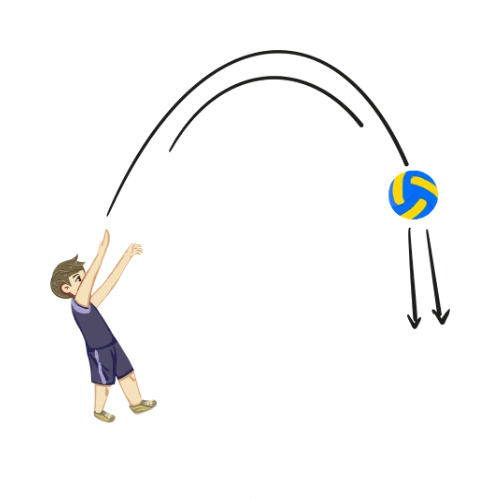
Whether you’re launching a cannonball, kicking a soccer ball, or analyzing a rocket’s trajectory, understanding how far a projectile will travel is fundamental to physics. The horizontal range depends on launch speed, angle, initial height, and the gravitational pull of your chosen planet. This projectile range calculator handles all these variables, giving you a complete picture of projectile motion.
Physics students studying kinematics will find this tool essential for homework verification. Sports scientists can analyze optimal launch conditions for different activities. Engineers and military professionals use similar calculations for trajectory planning and safety assessments. The calculator computes not just the range, but also time of flight, maximum height, time to peak, impact speed, and impact angle.
Toolraxy developed this projectile range calculator to make complex kinematic calculations accessible. Everything runs locally in your browser, so your data stays private while you explore the fascinating world of projectile motion.
Enter the launch velocity in your preferred unit — m/s, km/h, mph, or ft/s.
Set the launch angle between 0 and 90 degrees above the horizontal.
Adjust the initial height if launching from an elevated position, like a cliff or platform.
Choose a gravity preset for Earth, Moon, Mars, or Jupiter, or enter a custom value.
Review all six results instantly range, time of flight, maximum height, time to peak, impact speed, and impact angle.
Copy your full results or share them directly from the calculator.
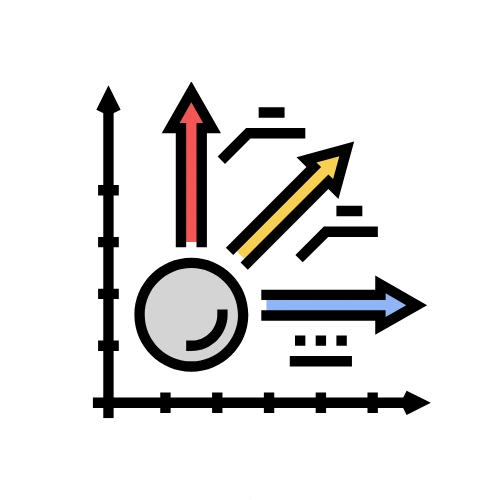
Projectile motion follows kinematic equations with horizontal and vertical components. The calculator determines six key parameters using standard physics formulas:
Horizontal Range: R = v₀ · cos(θ) · t_total
The range equals the horizontal velocity component multiplied by the total time of flight. On level ground with no initial height, this simplifies to R = v₀² · sin(2θ) / g.
Time of Flight: t_total = (v₀·sin(θ) + √((v₀·sin(θ))² + 2g·h₀)) / g
This solves the quadratic equation h₀ + vᵧ·t – ½g·t² = 0, accounting for both launch height and vertical velocity.
Maximum Height: H = h₀ + (v₀² · sin²(θ)) / (2g)
The peak height equals the initial height plus the vertical distance gained from upward velocity.
Time to Peak: t_peak = v₀ · sin(θ) / g
At the apex, vertical velocity becomes zero. This is the time to reach maximum height.
Impact Speed: v_impact = √(vₓ² + (vᵧ - g·t_total)²)
The speed at ground impact combines constant horizontal velocity with the final vertical velocity component.
Impact Angle: θ_impact = arctan(|vᵧ_impact| / vₓ)
The angle below horizontal at which the projectile strikes the ground.
A golfer hits a ball with an initial speed of 45 m/s at a 25-degree launch angle from a 10-meter-high tee. Let’s find how far the ball travels.
Step 1: Identify the inputs — v₀ = 45 m/s, θ = 25°, h₀ = 10 m, g = 9.81 m/s².
Step 2: Calculate components — vₓ = 45 × cos(25°) = 40.78 m/s, vᵧ = 45 × sin(25°) = 19.02 m/s.
Step 3: Time of flight — t_total = (19.02 + √(19.02² + 2×9.81×10)) / 9.81 = (19.02 + √(361.8 + 196.2)) / 9.81 = (19.02 + 23.62) / 9.81 = 4.35 seconds.
Step 4: Calculate range — R = 40.78 × 4.35 = 177.4 meters.
Step 5: Maximum height — H = 10 + (19.02²) / (2 × 9.81) = 10 + 361.8 / 19.62 = 10 + 18.44 = 28.44 meters.
Step 6: Impact speed — vᵧ_impact = 19.02 – 9.81 × 4.35 = 19.02 – 42.67 = -23.65 m/s, v_impact = √(40.78² + 23.65²) = √(1663 + 559) = √2222 = 47.14 m/s.
The ball travels about 177 meters, reaches a peak height of 28 meters, and impacts the ground at approximately 47 m/s at an angle below horizontal. This information helps the golfer understand how tee height affects overall distance.
The horizontal range formula is R = v₀·cos(θ)·t_total, where v₀ is launch speed, θ is launch angle, and t_total is the time of flight. On level ground with no initial height, this simplifies to R = v₀²·sin(2θ)/g.
The launch angle determines the balance between horizontal and vertical velocity. On level ground, 45 degrees gives maximum range because it splits velocity equally between directions. Angles below 45 produce flatter trajectories with shorter flight times. Angles above 45 produce higher trajectories with longer flight times but less horizontal speed.
Launching from an elevated position gives the projectile more time in the air before hitting the ground. The vertical motion equation h₀ + vᵧ·t – ½g·t² = 0 shows that a larger h₀ increases the positive root (flight time). More flight time means more time for horizontal motion, increasing the range.
Gravity pulls the projectile downward, limiting flight time and range. Stronger gravity reduces flight time and range for a given launch. On the Moon (1.62 m/s²), the same launch would travel about six times farther than on Earth. On Jupiter (24.79 m/s²), the range would be much shorter.
Impact speed depends on both horizontal and vertical velocity components. The horizontal component remains constant, but the vertical component changes due to gravity. On level ground, launch speed equals impact speed (energy conservation), but launching from height increases impact speed because the projectile has additional gravitational potential energy.
Yes, the calculator includes presets for Earth (9.81 m/s²), Moon (1.62 m/s²), Mars (3.71 m/s²), and Jupiter (24.79 m/s²). You can also enter a custom gravity value for any celestial body or simulation.
The calculations assume ideal projectile motion with no air resistance, constant gravity, and a flat Earth. Real-world projectiles experience drag, wind, varying gravity, and other effects that cause deviations. Results are excellent for educational purposes, approximations, and initial planning, but professional applications should account for additional factors.
Velocity accepts m/s, km/h, mph, and ft/s. Initial height accepts meters, feet, and kilometers. Gravity presets are in m/s². Results appear in meters with conversions to feet, yards, and kilometers for range and height. Impact speed shows conversions to km/h, mph, and ft/s.
The impact angle indicates how steeply the projectile strikes the ground. A 0° impact means it lands horizontally, while 90° means it strikes vertically. This information is useful for understanding impact dynamics, such as the required armor thickness or the trajectory of a golf ball rolling after landing.
ADVERTISEMENT
ADVERTISEMENT