
Estimate volume, bags & cost for slabs, footings & columns
Powered by Toolraxy · Concrete estimator

Founder & CEO, Toolraxy
Faiq Ur Rahman is a web designer, digital product developer, and founder of Toolraxy, a growing platform of web-based calculators and utility tools. He specializes in building structured, user-friendly tools focused on health, finance, productivity, and everyday problem-solving.
User Ratings:
ADVERTISEMENT
ADVERTISEMENT
A Concrete Calculator is a must‑have tool for any construction or DIY project involving poured concrete. Whether you’re planning a patio slab, a deck footing, a retaining wall base, or a cylindrical column, knowing exactly how much concrete you need saves you from costly over‑ordering and from the headache of running short mid‑pour. This Toolraxy calculator supports three common shapes, rectangular slab, square footing, and round column and instantly converts your dimensions into cubic feet, cubic yards, and cubic meters. It then translates that volume into the number of pre‑mixed concrete bags you’ll need, using real‑world bag yields and an adjustable waste factor, and it can even show the total material cost if you enter a price per bag. The tool runs completely on your device, so your project details stay private.
Choose the shape of your pour: Slab/Rectangle, Footing/Square, or Column/Cylinder.
Enter the corresponding dimensions in your preferred units (feet, meters, inches, or centimeters for thickness).
Set a waste factor (typically 5–10%) to account for spillage, over‑excavation, and uneven formwork.
Select the bag size you plan to buy — 40, 50, 60, 80, or 90 pounds — which determines the yield per bag.
Optionally, input the price per bag to see the total estimated cost.
The results update automatically; you can also click Calculate.
Read the volume in cubic feet, yards, and meters, plus the number of bags and total cost. Use Copy or Share to save your estimate.
The calculator first computes the volume of the chosen shape in cubic feet, then applies the waste factor. It divides the adjusted volume by the yield of one bag (in cubic feet) to find the raw number of bags, and rounds up to the nearest whole bag. Finally, it multiplies bags by price per bag to get the material cost.
Volume Formulas
All dimensions are converted to feet before calculation.
Slab / Rectangle: Volume (ft³) = Length × Width × Thickness
Footing / Square: Volume (ft³) = Side² × Depth
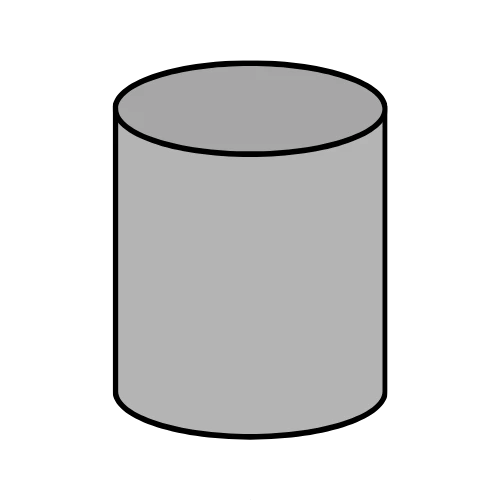
Column / Cylinder: Volume (ft³) = π × (Diameter ÷ 2)² × Height
Waste FactorAdjusted Volume = Volume × (1 + Waste% ÷ 100)
Example: a waste factor of 5% multiplies the volume by 1.05.
Bag Yield by Size (pre‑mixed concrete, US standard)
40 lb → 0.30 ft³
50 lb → 0.375 ft³
60 lb → 0.45 ft³
80 lb → 0.60 ft³
90 lb → 0.675 ft³
Bags NeededBags = Ceil(Adjusted Volume ÷ Bag Yield)
Total CostTotal Cost = Bags × Price per Bag (shown only if price is provided).
Unit Conversions in Output
Cubic yards = Cubic feet ÷ 27
Cubic meters = Cubic yards × 0.764555
Edge Cases
If any dimension is zero or invalid, the display shows a warning and no results.
The waste factor can be set from 0% to 30%.
Bag count is always rounded up, so you never run short.
Currency selection affects only the total cost display and is formatted with the chosen symbol and two decimal places (JPY rounds to integers).
You’re pouring a standard residential patio slab.
Shape: Slab / Rectangle
Length: 10 ft, Width: 8 ft, Thickness: 0.5 ft (6 inches)
Waste factor: 5%
Bag size: 60 lb (yield 0.45 ft³ per bag)
Price per bag: $6.50
Step‑by‑step
Raw volume = 10 × 8 × 0.5 = 40 ft³
Adjusted volume with 5% waste = 40 × 1.05 = 42.00 ft³
Cubic yards = 42.00 ÷ 27 ≈ 1.56 yd³
Cubic meters = 1.56 × 0.764555 ≈ 1.19 m³
Raw bags = 42.00 ÷ 0.45 ≈ 93.33 → Ceil = 94 bags
Total cost = 94 × 6.50=∗∗6.50=∗∗611.00**
Interpretation
For a 10×8 ft slab that is 6 inches thick, you will need about 1.56 cubic yards of concrete, or 94 standard 60‑lb bags. The estimated cement cost is $611.00, with a 5% safety buffer. You can now confidently purchase your materials knowing you have enough to finish the pour without interruption.
The number depends on the bag size. Using standard US yields:
40 lb bags: ~90 bags per cubic yard (0.30 ft³ each)
60 lb bags: ~60 bags per cubic yard (0.45 ft³ each)
80 lb bags: ~45 bags per cubic yard (0.60 ft³ each)
This calculator handles the conversion for you instantly based on your selected bag weight.
Saves time: No manual unit conversions or volume arithmetic.
Reduces manual errors: The tool automatically converts inches to feet, applies the waste factor, and rounds bags up.
Instant results: Toggle between shapes and adjust any dimension to see real‑time volume and bag count updates.
Free and private: All calculations run locally in your browser; no project data is ever stored or transmitted.
Accessible on any device: Use it on your phone at the job site or on a desktop while planning.
User‑focused: Clean, intuitive interface that works for both DIYers and professional contractors.
How accurate is this concrete calculator?
The calculator uses standard volume formulas and industry‑standard bag yields. It is highly accurate for estimation, though minor variations can occur due to mix compaction and actual bag contents. Adding an appropriate waste factor compensates for most practical inaccuracies.
Can I use this for footings that are not square?
The footing shape assumes a square footprint. For a rectangular footing, use the slab shape and enter the two side dimensions as length and width, and the thickness as the footing depth.
What bag size should I use?
Select the bag size that matches the product sold at your local supplier. The 60‑lb and 80‑lb bags are the most common for home projects, but smaller 40‑lb or 50‑lb bags are easier to handle. The calculator adjusts automatically.
Why is the waste factor important?
Without waste, you may end up short of concrete if the ground is uneven, the form isn’t perfectly rectangular, or some material is lost during mixing and pouring. A 5% waste factor is a safe minimum.
Does this tool calculate in metric units?
Yes. You can select meters and centimeters from the unit dropdowns, and the results display cubic meters alongside cubic feet and yards.
How do I calculate concrete for a circular column?
Choose the “Column / Cylinder” shape, enter the diameter and height in your desired units. The calculator applies the formula π × (diameter/2)² × height to determine the volume.
Can I use this for quick‑setting concrete?
Absolutely. Quick‑setting concrete has the same volume yield per bag as standard concrete. Select the bag size you’re using, and the calculation remains identical.
What is the difference between this and a ready‑mix order?
This calculator tells you the volume you need and how many bags that equals. If you plan to order a ready‑mix truck, use the cubic yards figure to place your order. The bag count is irrelevant for truck deliveries.
How do I convert cubic yards to cubic meters?
Multiply cubic yards by 0.764555. The calculator does this automatically and displays both units.
What if my project has multiple sections of different shapes?
Calculate each section separately using the appropriate shape and note the volumes. Then sum the cubic yards or bags across sections. The tool handles one shape at a time for clarity.
Can I save my concrete estimate?
The tool does not store data, but you can use the Copy button to save the summary to your clipboard, or Share to send the results via messaging or email.
ADVERTISEMENT
ADVERTISEMENT