What is EPF?
EPF usually means Employees’ Provident Fund.
It is a retirement savings scheme where an employee and/or employer contributes money regularly to a fund. The accumulated money can generally be withdrawn when the employee retires, leaves employment, or meets certain withdrawal conditions.
Simple example:
Suppose your monthly salary is ₹50,000 and the applicable EPF contribution is 12%:
| Item | Amount |
|---|
| Employee contribution | ₹6,000/month |
| Employer contribution | ₹6,000/month |
| Total going into EPF | ₹12,000/month |
The money earns interest over time, so the account can grow substantially over many years.
Salaried employees in India contribute to EPF every month. The money sits there, earning compound interest, until retirement. Most people have a rough idea of what their PF balance looks like today. Far fewer know what it’ll look like in 25 or 30 years.
That’s the gap this EPF calculator fills. It takes your basic pay and DA, splits the employer’s contribution into EPF and EPS portions, applies your expected salary hike each year, and compounds the balance at the interest rate you enter. The result is a year-by-year projection showing exactly how your retirement corpus builds up. Whether you’re 24 and just started working or 45 and checking whether you’re on track, the numbers here give you something concrete to plan around.
How to Use the EPF Calculator
Pick your currency from the dropdown at the top.
Enter your monthly basic pay and dearness allowance in the salary fields.
Set your present age and the age you plan to retire.
Adjust the employee contribution rate if you contribute more or less than the standard 12%.
Enter the EPF interest rate you expect (the default is 8.5%, though EPFO declared 8.25% for FY 2024-25).
Add your current EPF balance if you have one from previous employment.
Choose a schedule view: annual, every five years, or summary only.
Check the verdict banner and the full breakdown table for your projection.
How the EPF Calculator Formula Works
The calculator runs a year-by-year loop. Each year, it adds your contributions to the opening balance, compounds the total at the interest rate, and carries the result forward. Here’s the structure.
For the employee’s monthly contribution:
Formula: Employee EPF = (Basic + DA) × Employee Contribution Rate
For the employer’s split between EPF and EPS:
Formula: EPS Monthly = 8.33% × min(Basic + DA, ₹15,000)
Formula: Employer EPF = (12% × (Basic + DA)) − EPS Monthly
For the year-end balance:
Formula: Closing Balance = (Opening Balance + Annual Contributions) × (1 + Interest Rate)
Salary hikes apply to basic and DA at the start of each year. The hike rate compounds annually, so a 5% hike on a ₹20,000 basic becomes ₹21,000 in year two, ₹22,050 in year three, and so on.
Three validation rules kick in. If your retirement age is not greater than your present age, the tool shows no projection. If basic plus DA is zero, there’s nothing to calculate. And the employer’s EPF contribution never goes below zero, even when the EPS diversion would exceed the 12% employer share on a low salary.
The EPS wage ceiling matters here. The employer diverts 8.33% of basic + DA to the pension scheme, but only up to ₹15,000 of wages. If your basic + DA is ₹40,000, the EPS portion is still capped at ₹1,249.50 (8.33% of ₹15,000). The rest of the employer’s 12% goes to EPF.
 How your monthly EPF contribution is structured
Worked Example: Projecting a Corpus from ₹22,000 Basic Pay
Priya is 29. Her basic pay is ₹22,000 per month and she gets ₹3,000 as dearness allowance. Her total EPF-eligible salary is ₹25,000. She plans to retire at 58, so she has 30 years of accumulation ahead. Her current EPF balance is ₹85,000.
Employee contribution: 12% of ₹25,000 = ₹3,000 per month.
Employer EPS diversion: 8.33% of ₹15,000 (capped) = ₹1,249.50 per month. This goes to the pension scheme, not EPF.
Employer EPF contribution: (12% of ₹25,000) − ₹1,249.50 = ₹3,000 − ₹1,249.50 = ₹1,750.50 per month.
Total monthly into EPF: ₹3,000 + ₹1,750.50 = ₹4,750.50.
With a 5% annual salary hike and 8.5% interest rate, the calculator runs 30 compounding cycles. By year 30, her monthly basic + DA has grown to about ₹1,03,000, and the closing balance reaches approximately ₹1.14 crore. Of that, around ₹34.5 lakh comes from total contributions and the rest from compound interest.
EPF vs PPF vs NPS: Which Is Better for Retirement?
Each serves a different purpose. EPF is employer-linked and mandatory for most salaried workers, with an 8.25% fixed rate and EEE tax status. PPF is voluntary, offers 7.1%, and has a 15-year lock-in. NPS is market-linked, has equity exposure, and can deliver 9% to 12% over long periods, but returns aren’t guaranteed. EPF and PPF are safe and predictable. NPS carries more risk but potentially higher reward. The calculator benchmarks your EPF rate against all three, plus 401(k) and UK workplace pensions.
Frequently Asked Questions
How much EPF will I get at retirement?
Enter your basic pay, DA, age and retirement age into the calculator. It projects the maturity amount using your contribution rate, salary hike assumption and interest rate. A ₹25,000 basic with 30 years of service and 5% hikes lands around ₹1.12 crore at 8.25%.
What is the EPF interest rate for FY 2024-25?
The EPFO declared 8.25% for FY 2024-25, unchanged from the previous year. The calculator defaults to 8.5%, but you can adjust it to match the current rate or model a range of scenarios.
How do I calculate EPF contribution from my salary?
Your contribution is 12% of basic pay plus DA. Your employer also contributes 12%, but 8.33% of basic+DA (capped at ₹15,000) goes to EPS. The rest goes to EPF. The calculator handles this split automatically.
Is EPF interest taxable?
Interest is tax-free if you’ve completed five years of continuous service and your annual employee contribution stays under ₹2.5 lakh. Above that, the interest on the excess is taxable. Withdrawals after five years are fully exempt.
Can I use this EPF calculator for VPF?
Yes. Increase the employee contribution rate above 12% to model Voluntary Provident Fund contributions. VPF earns the same interest rate as EPF. The calculator will still apply the ₹2.5 lakh tax threshold on employee contributions.
What happens if my basic salary crosses ₹15,000?
The EPS diversion stays capped at ₹1,249.50 per month (8.33% of ₹15,000). Everything above that ceiling in the employer’s 12% goes to EPF. So a higher basic means a larger employer EPF contribution, even though the EPS portion doesn’t change.
Does the calculator account for salary hikes?
Yes. The hike rate you enter compounds annually on your basic and DA. A 5% hike means your contribution base grows 5% each year, which flows through to both employee and employer contributions.
Why is my corpus showing a negative verdict?
A negative or very low verdict means the projected corpus is under 2 times your final annual basic. That’s a sign the EPF alone won’t sustain retirement. The tool suggests adding VPF, NPS or mutual fund SIPs to strengthen the kitty.
Can I withdraw EPF before retirement?
Yes, under specific conditions: housing, medical emergencies, marriage, education, or unemployment. The calculator doesn’t model partial withdrawals. Early withdrawals reduce the compounding base significantly. A ₹1 lakh withdrawal at 35 can cost you several lakhs by retirement.
How does the EPS pension affect my EPF corpus?
The 8.33% employer diversion to EPS doesn’t sit in your EPF account. That money funds a separate pension scheme. The calculator shows the EPS portion in the breakdown so you can see exactly how much is leaving the EPF side each month.
Does the EPF calculator work for multiple jobs?
Enter your current basic pay and your existing EPF balance from previous employment. The calculator treats the existing balance as a starting point and compounds it alongside new contributions. It doesn’t model gaps between jobs.
What is the retirement age for EPF?
The standard retirement age in India is 58. The calculator accepts retirement ages from 40 to 75. If you plan to work past 58, enter your actual planned retirement age.
Disclaimer
This EPF calculator gives estimates, not guarantees. Actual returns depend on the interest rate declared by the EPFO each year, your actual salary growth, and any changes to contribution rules or wage ceilings. The projections assume a constant hike rate and a constant interest rate, which won’t match reality exactly. Tax rules referenced here reflect the current framework and may change. For decisions about your retirement portfolio, consult a qualified financial adviser.



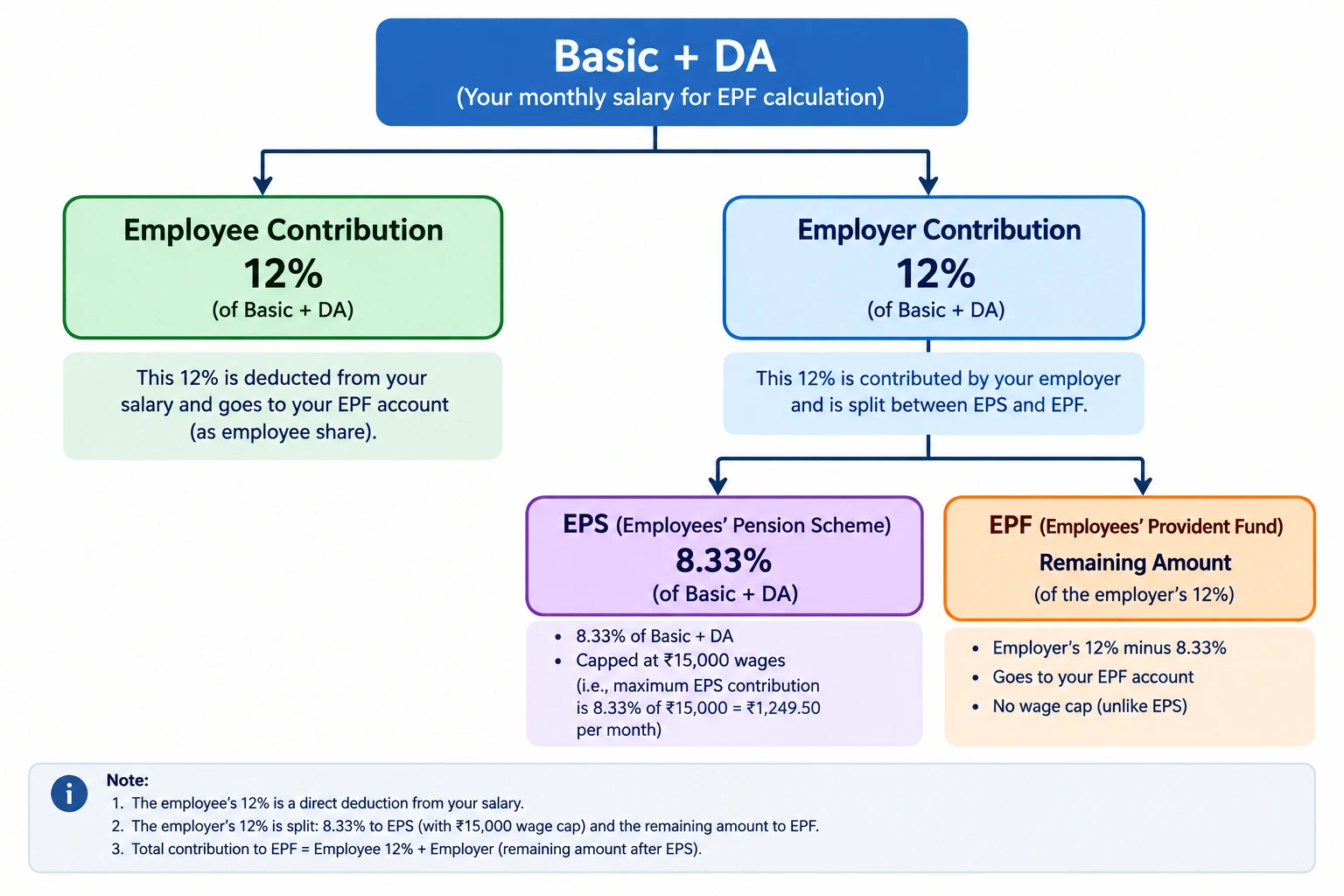 How your monthly EPF contribution is structured