A personal loan EMI calculator tells you what you’ll pay every month before you sign anything. That matters because personal loans are unsecured. Lenders charge more when there’s no collateral, and the difference between a 12% rate and an 18% rate on a ₹5,00,000 loan is real money. This tool handles the math in one pass. You’ll get your monthly EMI, the total interest you’ll hand over, and a full amortization table that shows how each payment splits between principal and interest. There’s also a prepayment simulator: add an extra monthly amount and watch the interest fall. If you use the loan for business, the tool estimates your Section 37(1) tax shield.
How to Use the Personal Loan EMI Calculator
Pick your currency from the dropdown. Default is INR.
Enter the loan amount you plan to borrow.
Type the annual interest rate your lender quoted.
Set the loan tenure in years. The tool accepts 1 to 10.
Choose your rate type: fixed, floating, or reducing balance.
Adjust the processing fee percentage if your lender charges one.
Select your applicant type: salaried, self-employed, or NRI.
Optionally add an extra monthly payment and a start month to see prepayment savings.
How the Personal Loan EMI Formula Works
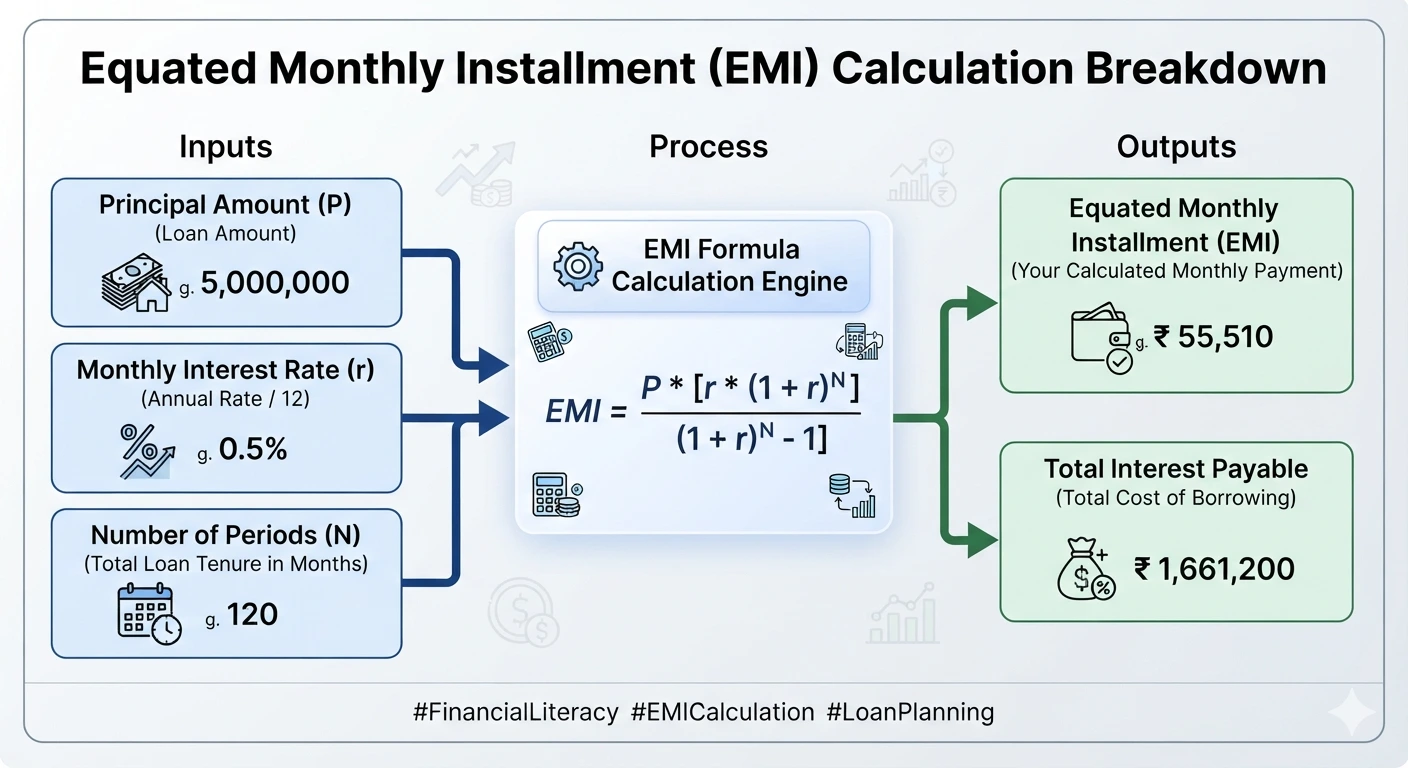
The formula is the standard reducing-balance EMI equation. Every lender in India uses it.
Formula: EMI = [P × r × (1 + r)^n] ÷ [(1 + r)^n − 1]
Here’s what each variable means. P is the principal, the amount you borrow. r is the monthly interest rate, which you get by dividing the annual rate by 12 and then by 100. n is the total number of monthly instalments. For a 3-year loan, n is 36.

Worked Example
Take a ₹4,50,000 personal loan at 15.5% annual interest over 4 years. That’s 48 monthly instalments.
The monthly rate is 15.5 ÷ 12 ÷ 100, which equals 0.012917. Plug those numbers into the formula. You’ll get an EMI of ₹12,660.48.
Over the full 48 months, you’ll pay ₹6,07,703. That’s ₹1,57,703 in interest alone. The interest-to-principal ratio is 35.0%, which the tool classifies as “Average” for a 3-to-4-year personal loan at market rates.
Add a 2% processing fee and the upfront cost is ₹9,000. Your effective cost of borrowing climbs to ₹1,66,703.
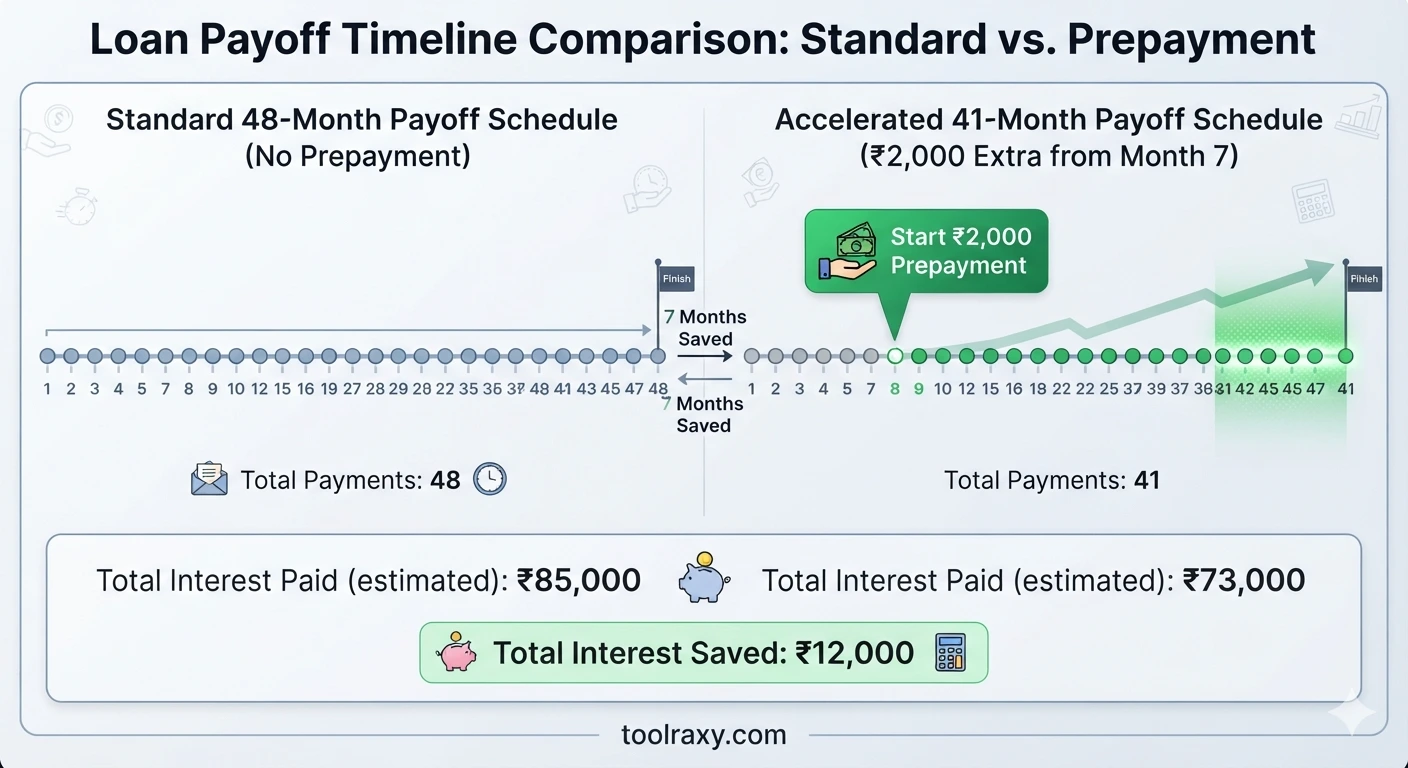
Now try prepaying ₹2,000 a month starting from EMI #7. The loan closes in 41 months instead of 48. Interest drops to roughly ₹1,36,000. You save around ₹21,700 and wrap up seven months early.
What Is a Good Interest Rate for a Personal Loan?
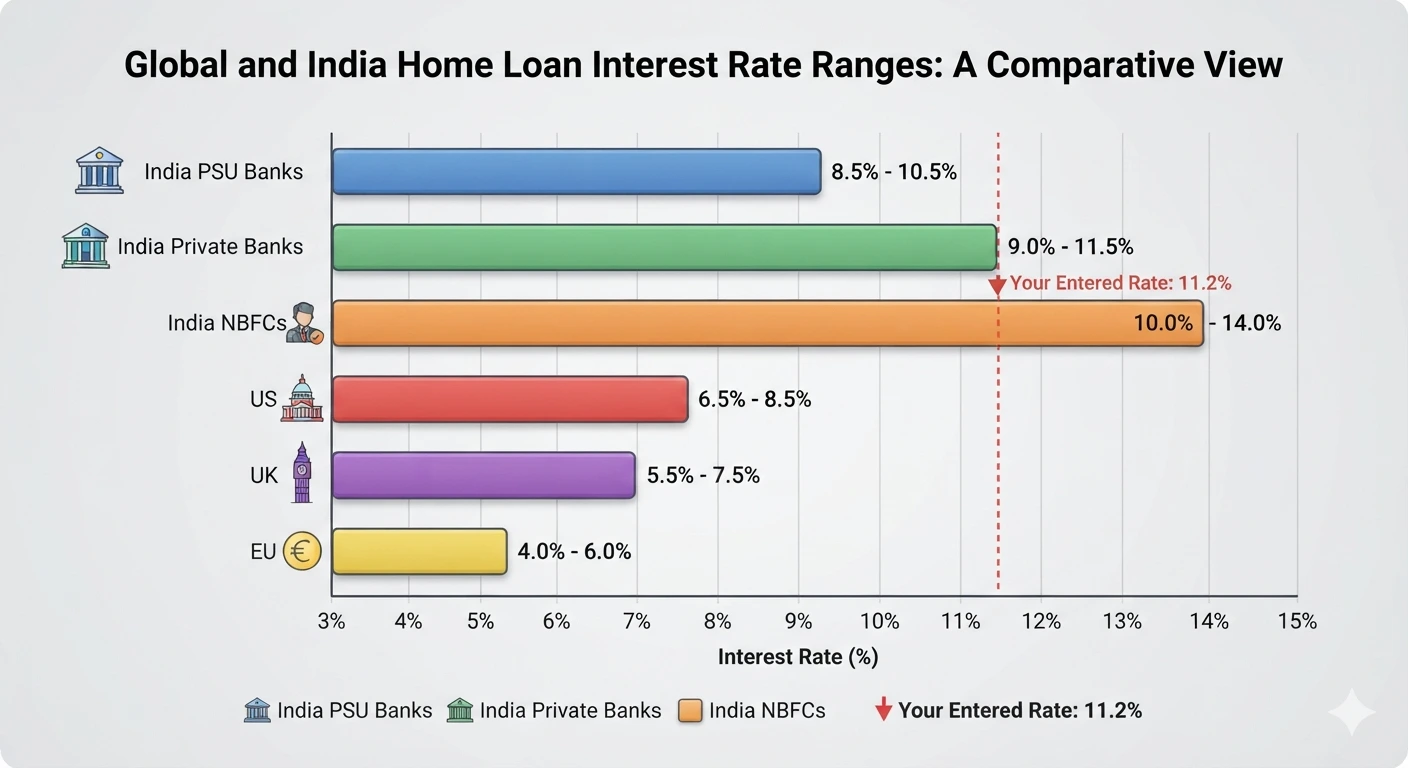
A good personal loan rate depends on where you live and your credit profile. In India, PSU banks currently offer personal loans in the 10.5%–15% range. Private banks sit at 11%–18%. NBFCs and fintech lenders charge 14%–24%. In the US, average rates for 24-month personal loans run roughly 9%–13% for borrowers with good credit.
The tool includes a benchmark table that compares your entered rate against these regional ranges. Enter your rate, pick your region, and the tool tells you whether you’re below, within, or above the typical range. A rate below the range is excellent. A rate above it means you’re paying more than most borrowers with similar profiles.
Real-World Example: Business Loan Tax Shield
Suppose you’re a freelance consultant. You borrow ₹6,00,000 at 13% for 5 years to buy equipment. You’re in the 30% tax slab, and 100% of the loan goes to business use.
The calculator shows an EMI of ₹13,653. Over the first year, you’ll pay ₹76,043 in interest. Because the loan is used wholly for business, that interest is deductible under Section 37(1). At a 30% slab, the tax saved is ₹22,813.
That doesn’t change your EMI. It changes your tax bill. The effective cost of the loan drops by nearly ₹23,000 in year one alone. Over the full loan term, the tax shield compounds.
If only 60% of the loan went to business use, the deduction would apply to 60% of the interest, and the tax saved would drop to ₹13,688. The tool handles the mixed-use calculation automatically.
Frequently Asked Questions
How is personal loan EMI calculated?
EMI = [P × r × (1 + r)^n] ÷ [(1 + r)^n − 1], where P is the principal, r is the monthly interest rate (annual rate ÷ 12 ÷ 100), and n is the number of monthly instalments. The formula assumes a constant reducing-balance rate. Every major bank uses this equation.
What is a good EMI for a personal loan?
A good EMI keeps your total monthly debt payments below 40–50% of your net income. If you earn ₹50,000 a month and your only debt is this loan, an EMI up to ₹20,000–₹25,000 is manageable. Above that, lenders start seeing risk.
Does prepaying a personal loan reduce EMI or tenure?
Prepayment in this calculator reduces tenure, not the EMI. The extra monthly amount goes entirely to principal. The EMI stays fixed, the balance drops faster, and the loan closes earlier. You save interest because fewer months of interest accrue.
Is there a prepayment penalty on personal loans?
Floating-rate personal loans in India carry no prepayment penalty for individual borrowers. Fixed-rate loans typically charge 2–4% of the outstanding balance as a foreclosure fee. Check your loan agreement before making extra payments.
Can I claim a tax deduction on personal loan interest?
Only if the loan funds are used for business purposes. Section 37(1) allows you to deduct the business-use portion of the interest from your taxable business income. Personal loans used for consumption, travel, or medical expenses give no deduction.
How does loan tenure affect total interest?
Longer tenure means lower EMI but higher total interest. A 3-year loan at 14% on ₹5,00,000 costs about ₹1,15,000 in interest. A 6-year loan at the same rate costs about ₹2,43,000. The monthly EMI drops, but you pay more than double in interest.
What is the difference between fixed and floating personal loan rates?
Fixed rates stay the same for the entire tenure. Floating rates move with a benchmark like the repo rate or KIBOR. Floating loans are usually cheaper to prepay because most lenders waive the foreclosure fee. Fixed loans offer certainty but cost more to exit early.
Personal loan vs home loan: which has a higher EMI?
Personal loans have higher EMIs because the tenures are much shorter. A ₹20,00,000 home loan at 8.5% over 20 years costs about ₹17,356 a month. A ₹5,00,000 personal loan at 14% over 3 years costs about ₹17,089 a month. Similar EMI, far less borrowed.
How do I lower my personal loan EMI?
Three levers: extend the tenure, negotiate a lower rate, or borrow less. Prepaying reduces tenure, not the EMI. If your credit score has improved since you took the loan, refinancing at a lower rate is another option.
What happens if I miss an EMI payment?
Missed payments trigger late fees and hurt your credit score. Most lenders report to credit bureaus after 30 days. If you’re struggling, contact the lender before the due date. Many will restructure the loan or offer a short moratorium.
Does the processing fee affect my EMI?
No. The processing fee is a one-time upfront cost. It doesn’t change the monthly EMI, but it does increase your effective cost of borrowing. The calculator adds it to the total interest to show the real cost.
Can I use this calculator for a business loan?
Yes, if the loan uses the same reducing-balance EMI structure. Most term loans do. The tax deduction section applies specifically to Section 37(1), which is relevant for business loans and business-use personal loans.
Disclaimer
This calculator is for educational and planning purposes. It’s not financial advice. Actual EMIs depend on your lender’s terms, credit assessment, and any fees not captured in the inputs. Tax deductions depend on your individual filing situation and current tax law. Verify all figures with your lender and a qualified tax professional before making borrowing decisions.