
Calculate free recoil energy from bullet weight, velocity, powder charge and firearm weight
| Recoil energy | Class | Typical firearms |
|---|
| Cartridge | Bullet | Velocity | Recoil (ft-lbs) | Class |
|---|

Founder & CEO, Toolraxy
Faiq Ur Rahman is a web designer, digital product developer, and founder of Toolraxy, a growing platform of web-based calculators and utility tools. He specializes in building structured, user-friendly tools focused on health, finance, productivity, and everyday problem-solving.
User Ratings:
ADVERTISEMENT
ADVERTISEMENT
This tool calculates free recoil energy in foot-pounds and joules from four inputs: bullet weight in grains, muzzle velocity in fps, powder charge in grains, and firearm weight. It also returns recoil velocity and recoil impulse. Use the ammunition presets to load common cartridges like .223 Rem, .308 Win, and 9mm Luger, or enter custom values. Results update as you type, and nothing leaves your browser.
Recoil is physics. A bullet leaves the muzzle, and an equal and opposite reaction pushes the firearm back into your shoulder or hand. How much push you feel depends on bullet weight, velocity, powder charge, and how heavy the gun is. This recoil energy calculator turns those four numbers into free recoil energy in foot-pounds and joules. It also shows recoil velocity and recoil impulse. Hunters use it to compare loads before a hunt. Reloaders use it to stay inside comfortable recoil limits. A .300 Win Mag pushing a 180-grain bullet at 2,960 fps generates about 30 ft-lbs of recoil in an 8.5 lb rifle. A 9mm pistol with a 115-grain bullet at 1,180 fps generates roughly 5 ft-lbs. That gap is why one gun is fun at the range and the other isn’t.
Pick an ammunition preset from the dropdown, or leave it on Custom / manual input.
Enter the bullet weight in grains. Most rifle bullets run 40 to 660 grains.
Type the muzzle velocity in feet per second. A .223 Rem typically leaves the barrel at 3,240 fps.
Fill in the powder charge in grains. This is the weight of the propellant, not the bullet.
Set the firearm weight. Choose pounds, kilograms, or ounces from the unit selector.
Watch the hero number update as you type. No button press required.
Read the recoil velocity and impulse tiles for a fuller picture.
Check the recoil class banner to see how the kick compares to common firearms.
Free recoil energy equals the kinetic energy of the firearm moving backward after the shot. It depends on the momentum of the bullet and powder gas, and the weight of the gun. The calculation happens in three steps: find the impulse, find the recoil velocity, then find the energy.
Formula: Gas velocity ≈ 1.5 × muzzle velocity (SAAMI approximation)
Formula: Impulse (lb·s) = (bullet weight × velocity + powder weight × gas velocity) ÷ 7000
Formula: Recoil velocity (fps) = impulse × 32.174 ÷ gun weight (lb)
Formula: Recoil energy (ft-lbs) = gun weight × recoil velocity² ÷ (2 × 32.174)
The first step finds the total momentum leaving the barrel. Bullet momentum is bullet weight times velocity. Gas momentum is powder weight times gas velocity. The 1.5 multiplier for gas velocity is a standard approximation from SAAMI. Divide the sum by 7,000 to convert grains to pounds.
The second step converts impulse into recoil velocity. Impulse is momentum, so dividing by gun weight gives velocity. Multiply by the gravitational constant (32.174) to keep units consistent.
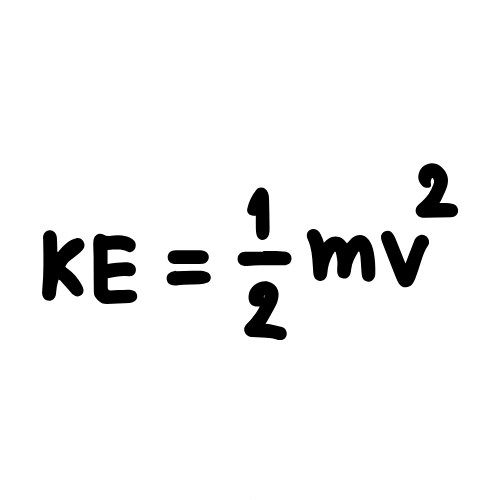
The third step computes kinetic energy using the classic ½mv² formula, adapted for the gun’s weight and recoil velocity. The result is free recoil energy in foot-pounds.
Load the .22 LR rifle preset. Bullet weight is 40 grains. Muzzle velocity is 1,200 fps. Powder charge is 2 grains. Firearm weight is 6.5 lb.
Step 1: Calculate gas velocity. 1,200 × 1.5 = 1,800 fps.
Step 2: Find bullet momentum. 40 × 1,200 = 48,000.
Step 3: Find gas momentum. 2 × 1,800 = 3,600.
Step 4: Add and convert to pounds. (48,000 + 3,600) ÷ 7,000 = 7.371 lb·s.
Step 5: Calculate recoil velocity. 7.371 × 32.174 ÷ 6.5 = 36.48 fps.
Step 6: Calculate recoil energy. 6.5 × 36.48² ÷ (2 × 32.174) = 134.4 ft-lbs.
The calculator reports 134.4 ft-lbs, which is about 182.2 joules. It also shows recoil velocity of 36.48 fps (11.12 m/s) and recoil impulse of 7.371 lb·s. The class banner labels this “Moderate” recoil. A .22 LR is a light-kicking cartridge, so the number may look high compared to what you feel at the range. That’s because the formula captures the raw physics, not the subjective experience.
Recoil energy is the kinetic energy of the firearm moving backward when a shot is fired. It equals the energy of the bullet and gas leaving the barrel, transferred to the gun. It’s measured in foot-pounds or joules.
Multiply bullet weight by velocity, add powder weight times 1.5 times velocity, divide by 7,000, then use that impulse to find recoil velocity and energy. The calculator does all of this automatically.
Most shooters find 10 to 20 ft-lbs comfortable for extended shooting. Above 30 ft-lbs, flinching becomes common. The calculator’s class labels give a rough guide from “Very light” to “Extreme.”
Heavier guns recoil less because the same impulse produces less velocity. Recoil velocity is impulse divided by gun weight, so doubling the weight halves the velocity and cuts energy to a quarter.
Stock fit, recoil pad, muzzle brake, and shooting position all change how recoil feels. Semi-automatic actions spread the recoil over time, reducing peak force. The calculator doesn’t account for these.
Using the wrong powder charge, forgetting to convert gun weight to pounds, or assuming the formula predicts felt recoil perfectly. It’s a physics estimate, not a subjective rating.
Yes. The presets include 9mm Luger, .40 S&W, .45 ACP, .357 Magnum, and .44 Magnum. Enter the pistol’s weight in pounds or ounces, and the tool handles the rest.
The calculator shows both. If you’re doing it manually, multiply ft-lbs by 1.3558. A 10 ft-lb recoil equals about 13.56 joules.
Recoil impulse is the total momentum transferred to the firearm, measured in lb·s. It’s the first step in the recoil calculation. Higher impulse means more recoil velocity for a given gun weight.
The formula uses a standard SAAMI approximation for gas velocity and doesn’t account for stock fit, recoil pads, or shooting technique. Use it as a comparison tool, not a prediction of felt recoil.
Free recoil is the raw physics calculation. Felt recoil is what you actually experience, which depends on gun design, fit, and technique. The calculator gives free recoil.
Yes. The 12 gauge slug preset is included. You can also enter custom values for any shotshell load. Just make sure the powder charge and gun weight are accurate.
ADVERTISEMENT
ADVERTISEMENT