
Calculate bullet kinetic energy from mass and velocity
| Energy range | Category | Typical use |
|---|

Founder & CEO, Toolraxy
Faiq Ur Rahman is a web designer, digital product developer, and founder of Toolraxy, a growing platform of web-based calculators and utility tools. He specializes in building structured, user-friendly tools focused on health, finance, productivity, and everyday problem-solving.
User Ratings:
ADVERTISEMENT
ADVERTISEMENT
A bullet’s kinetic energy tells you how much work it can do on impact. Hunters use the number to compare cartridges. Reloaders use it to check whether a load is in the right ballpark for a given game animal. This calculator does one thing: it takes mass and velocity and returns energy in joules and ft-lbs. That’s it. You won’t find trajectory tables or wind drift here. What you will find is a fast, client-side tool that handles the unit conversion and the squaring for you. Enter a 150-grain bullet at 2,800 fps and you’ll see the number a reloading manual would give you, minus the table-flipping.
Pick an ammunition preset from the dropdown, or leave it on “Custom / manual input.”
Type the bullet mass in grams into the first field. A 9mm 115-grain bullet weighs about 7.45 g.
Enter the bullet velocity in meters per second. Most 9mm loads leave the muzzle around 350–400 m/s.
Watch the energy fields update as you type. No button press required.
Check the hero number for total kinetic energy in joules.
Look at the ft-lbs field if you think in foot-pounds.
Read the category row to see which game class the energy falls into.
Use the Quick Examples buttons to load common cartridges instantly.
The formula is the standard kinetic energy equation from first-year physics, adapted for bullet units.
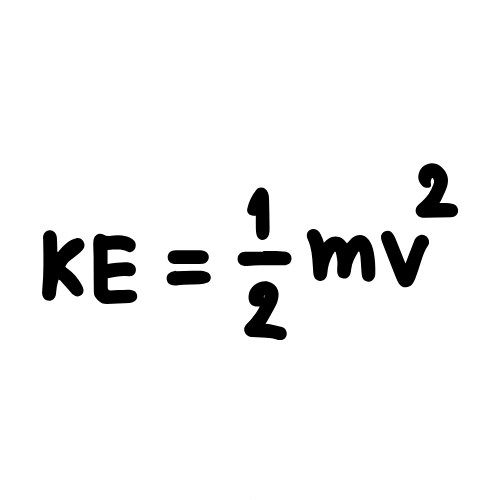
Formula: E = ½ × m × v²
E is energy in joules. m is mass in kilograms. v is velocity in meters per second. The calculator converts grams to kilograms by dividing by 1,000 before plugging the number into the formula.
That’s the whole calculation. There’s no drag coefficient, no ballistic coefficient, no atmospheric correction. The tool assumes the bullet is at the muzzle, where velocity is highest. If you want energy at 200 yards, you need a ballistic calculator that accounts for velocity loss. This one doesn’t.
Let’s run a .30-06 Springfield load through the calculator. A 180-grain bullet weighs 11.66 grams. Muzzle velocity is 823 m/s. That’s a real load you’d find in a reloading manual, not a round number pulled from thin air.
Step 1: Convert mass to kilograms. 11.66 ÷ 1,000 = 0.01166 kg.
Step 2: Square the velocity. 823 × 823 = 677,329.
Step 3: Multiply mass by squared velocity. 0.01166 × 677,329 = 7,899.65.
Step 4: Divide by 2. 7,899.65 ÷ 2 = 3,949.83 joules.
The calculator reports 3,950 J. In ft-lbs, that’s about 2,913. The category is “Very large / magnum,” which lines up with elk at long range, moose, or brown bear. Momentum works out to 9.60 kg·m/s. A 180-grain .30-06 at the muzzle is a serious load, and the numbers show it.
Bullet energy is the kinetic energy a projectile carries, calculated as one-half times mass times velocity squared. It’s measured in joules or foot-pounds. The number tells you how much work the bullet can do on impact, though it doesn’t account for bullet construction or shot placement.
Multiply the bullet’s mass in kilograms by the square of its velocity in meters per second, then divide by two. A 10-gram bullet at 500 m/s gives 0.01 × 250,000 ÷ 2 = 1,250 joules. Unit conversion is the only tricky part.
About 1,000 ft-lbs (1,356 J) is the commonly cited minimum for deer-sized game. Many states use that figure as a legal threshold for rifle cartridges. Some hunters prefer 1,200–1,500 ft-lbs for a margin of error on larger deer or longer shots.
A typical 115-grain 9mm load at 1,180 fps produces around 500 joules or 370 ft-lbs. Heavier subsonic loads run closer to 450 joules. That’s enough for self-defense and close-range varmint hunting, but below the threshold for medium game.
Because kinetic energy is defined as the work needed to accelerate an object from rest to its current speed. The math works out to ½mv². Doubling velocity quadruples energy, which is why light, fast bullets can rival heavier, slower ones in the energy department.
No. Energy is one factor among several. Bullet construction, expansion, penetration depth, and shot placement all matter more. A full metal jacket and a hollow point with the same energy will perform very differently in tissue. Energy tells you how much work is available, not how that work gets done.
Muzzle energy is measured at the barrel. Impact energy is measured at the target, after the bullet has slowed during flight. Impact energy is always lower. A bullet that starts at 3,000 J might have 1,800 J at 300 yards. This calculator gives you the muzzle figure.
Yes, as long as you know the pellet mass in grams and the velocity in meters per second. Most airgun pellets weigh between 0.5 and 1.5 grams, and velocities range from 150 to 350 m/s. The formula is the same. Just be aware that airgun energy is much lower than firearm energy, typically under 50 joules.
The math is exact. The formula is a fundamental physics equation. The accuracy of the result depends entirely on the accuracy of your inputs. If your chronograph reading is off by 20 fps, your energy number will be off by roughly 5–10%, depending on the velocity.
A joule is the SI unit of energy. One joule equals one kilogram times one meter squared per second squared. For reference, a 9mm round carries around 500 joules, a .223 Remington carries around 1,700 joules, and a .50 BMG carries more than 17,000 joules.
Momentum (mass × velocity) scales linearly with velocity, while energy scales with velocity squared. Seeing both numbers helps you understand why a heavy, slow bullet and a light, fast bullet can have similar energy but very different recoil characteristics. Momentum is a better predictor of recoil than energy.
Divide the energy in joules by 1.3558. A 1,000-joule result equals about 738 ft-lbs. The calculator does this automatically and displays both numbers side by side.
This calculator is an educational tool for estimating muzzle energy from mass and velocity. It does not account for drag, atmospheric conditions, or bullet deformation, and it should not be used as the sole basis for hunting, self-defense, or reloading decisions. Always consult published load data from a reputable manual, follow local laws, and verify your own measurements with a chronograph before drawing conclusions about terminal performance.
ADVERTISEMENT
ADVERTISEMENT