
Compute trajectory, range, time of flight, and maximum height
Powered by Toolraxy · Physics & kinematics simulator

Founder & CEO, Toolraxy
Faiq Ur Rahman is a web designer, digital product developer, and founder of Toolraxy, a growing platform of web-based calculators and utility tools. He specializes in building structured, user-friendly tools focused on health, finance, productivity, and everyday problem-solving.
User Ratings:
ADVERTISEMENT
ADVERTISEMENT
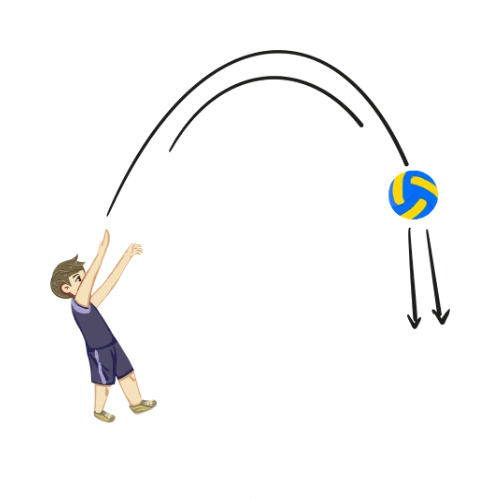
Projectile motion is a form of motion experienced by an object that is launched into the air and is subject only to the force of gravity. The path followed by the projectile is a parabola. This ideal model assumes that air resistance is negligible, which is a reasonable approximation for many practical situations, such as a thrown ball or a fired cannonball. The motion can be broken down into two independent components: horizontal motion with constant velocity, and vertical motion with constant acceleration (due to gravity). The study of projectile motion is a cornerstone of classical mechanics and provides the foundation for understanding more complex dynamics.
Enter Initial Velocity: Input the launch speed of your projectile. Select the unit from the dropdown (m/s, km/h, mph, or ft/s).
Set Launch Angle: Input the angle of launch above the horizontal, in degrees (0° to 90°). A 45° angle provides the maximum range for level ground.
Specify Initial Height: Input the height from which the projectile is launched. Select the unit from the dropdown (m, ft, or km). The default is 0 (ground level).
Select Gravity: Choose a gravity preset for Earth, Moon, Mars, or Jupiter, or select “Custom” to enter your own gravitational acceleration (m/s²).
Calculate: Click the “Calculate” button or simply adjust any input, as the tool updates results automatically.
Review Results: The results panel displays the Range, Maximum Height, Time of Flight, and Impact Speed. These are shown in both the primary SI unit and additional units for convenience.
Visualize Trajectory: The interactive chart plots the full parabolic trajectory of your projectile. Key points (maximum height and landing point) are highlighted. Hover over the chart to see exact coordinates.
The Toolraxy Projectile Motion Calculator uses the standard kinematic equations for motion with constant acceleration, assuming no air resistance. The motion is analyzed by separating the projectile’s velocity into horizontal and vertical components.
Horizontal Motion (x-axis): There is no acceleration in the horizontal direction (assuming no air resistance). The horizontal velocity is constant.x = v₀ · cos(θ) · t
Vertical Motion (y-axis): The only acceleration is due to gravity (acting downward). The vertical position changes according to:y = h₀ + v₀ · sin(θ) · t − ½ · g · t²
Where:
v₀ = Initial velocity (m/s)
θ = Launch angle (degrees)
h₀ = Initial height (m)
g = Acceleration due to gravity (m/s²)
t = Time (s)
Calculations:
Time of Flight: The time it takes for the projectile to return to the ground (y = 0). This is found by solving the quadratic equation for t:t_flight = [v₀·sin(θ) + √((v₀·sin(θ))² + 2·g·h₀)] / g
(Using the positive root)
Range: The total horizontal distance traveled.R = v₀ · cos(θ) · t_flight
Maximum Height: The highest vertical position reached. This occurs when the vertical velocity is zero.t_max = v₀·sin(θ) / gH_max = h₀ + v₀·sin(θ)·t_max − ½·g·t_max²
Impact Speed: The magnitude of the velocity vector at the moment of impact.v_impact = √((v₀·cos(θ))² + (v₀·sin(θ) − g·t_flight)²)
All input values are converted to SI units (m/s, m, m/s²) before calculations. The results are then converted back to the selected output units for display. The trajectory chart is generated by calculating the position at regular intervals over the flight time.
Let’s calculate the projectile motion for a ball launched from the top of a 10-meter high cliff.
Input Values:
Initial Velocity: 20 m/s
Launch Angle: 30°
Initial Height: 10 m
Gravity: 9.81 m/s² (Earth)
Velocity Components:
vx = 20 · cos(30°) = 17.32 m/s
vy0 = 20 · sin(30°) = 10.00 m/s
Time of Flight:t_flight = [10 + √(10² + 2·9.81·10)] / 9.81 = [10 + √(100 + 196.2)] / 9.81 = [10 + 17.21] / 9.81 = 2.77 seconds
Range:R = 17.32 · 2.77 = 47.98 meters
Maximum Height:t_max = 10 / 9.81 = 1.02 secondsH_max = 10 + 10·1.02 − 0.5·9.81·1.02² = 10 + 10.2 − 5.10 = 15.10 meters
Impact Speed:vy_impact = 10 − 9.81·2.77 = 10 − 27.18 = -17.18 m/sv_impact = √(17.32² + (-17.18)²) = √(299.98 + 295.15) = √(595.13) = 24.39 m/s
Final Results:
Range: 47.98 m
Maximum Height: 15.10 m
Time of Flight: 2.77 s
Impact Speed: 24.39 m/s
What is projectile motion?
Projectile motion is the motion of an object launched into the air, following a curved path called a parabola. The only force acting on it in the ideal model is gravity.
How do you calculate the range of a projectile?
Range is calculated as R = v₀ · cos(θ) · t_flight. For level ground, the formula simplifies to R = v₀² · sin(2θ) / g. The Toolraxy calculator handles both cases automatically.
What is the best angle for maximum range?
For a projectile launched from level ground, the optimal angle for maximum range is 45°. When launching from a height, the optimal angle is slightly less than 45°.
How does initial height affect the range?
A higher initial height increases both the time of flight and the range. The projectile has more time to travel horizontally before hitting the ground.
What is the maximum height of a projectile?
The maximum height is the highest point reached by the projectile. It is calculated as H_max = h₀ + v₀² · sin²(θ) / (2·g).
Why does the projectile follow a parabolic path?
The projectile follows a parabolic path because it has constant horizontal velocity and constant vertical acceleration. This combination results in a quadratic relationship between the horizontal and vertical positions.
Can I use this calculator for vertical motion?
Yes, set the launch angle to 90° for purely vertical motion. The range will be zero, and the maximum height and time of flight will be calculated correctly.
What is the impact speed of a projectile?
The impact speed is the magnitude of the velocity vector at the moment the projectile hits the ground. It is calculated from the horizontal and vertical velocity components at that moment.
Does mass affect projectile motion?
In the ideal model, mass does not affect projectile motion. The acceleration due to gravity is independent of mass. In the real world, air resistance can be mass-dependent.
What is the difference between trajectory and range?
The trajectory is the full path (curve) of the projectile. The range is just the total horizontal distance covered along that path from launch to landing.
ADVERTISEMENT
ADVERTISEMENT