Introduction
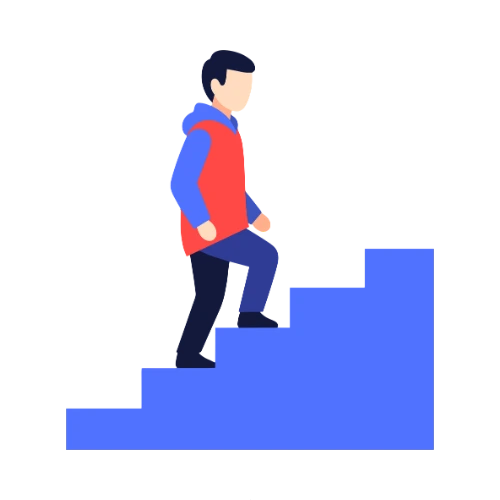
Climbing stairs is one of the most efficient and accessible forms of cardiovascular and lower-body exercise, requiring you to lift your entire body weight vertically against gravity with every step. A Stairs Calorie Calculator estimates the energy cost of stair climbing using physics-based work calculations rather than generic activity METs, giving you a precise measure of calories burned based on your body weight, the number of steps, step height, and your climbing speed. Whether you are taking the stairs instead of the elevator at work, training on a stair machine, or running stadium bleachers, this tool shows you exactly how much energy you expend and how that translates to fat loss. Toolraxy provides a physics-grounded, client-side calculator that helps you quantify every floor climbed.
How to Use the Stairs Calorie Calculator
Enter your body weight in kilograms.
Enter the number of steps you climbed or plan to climb.
Enter the height of each step in centimeters. Standard steps are approximately 17 cm.
Select your climbing intensity: slow, moderate, fast, or enter a custom speed in steps per minute.
Click Calculate. The tool displays total vertical ascent, physical work done in kilojoules, calories burned, weight loss equivalent, calorie burn rate per minute, estimated climbing time, and MET equivalent.
How the Tool Works
This Stairs Calorie Calculator uses fundamental physics rather than activity look-up tables to calculate energy expenditure. The calculation follows the mechanical work required to lift a mass against gravity, adjusted for the human body’s metabolic efficiency.
The vertical ascent is calculated as:
Total Height (m) = Number of Steps × Step Height (cm) ÷ 100
The physical work done against gravity is:
Work (joules) = Body Weight (kg) × Gravity (9.81 m/s²) × Total Height (m)
The human body is approximately 20% efficient at converting metabolic energy into mechanical work when climbing stairs. Therefore, the metabolic energy required is:
Metabolic Energy (joules) = Work ÷ 0.20
Calories burned are derived from the joule-to-kilocalorie conversion:
Calories = Metabolic Energy (joules) ÷ 4,184
The result is rounded to the nearest whole number.
Climbing time is estimated from the selected speed:
Slow: 70 steps per minute
Moderate: 90 steps per minute
Fast: 120 steps per minute
Custom: user-defined steps per minute
Time (minutes) = Number of Steps ÷ Speed (steps per minute)
Calorie burn rate is calculated as Total Calories ÷ Time. MET equivalent is back-calculated from the calorie output relative to body weight and time: MET ≈ Calories per Hour ÷ Body Weight.
Worked Example
Consider a 70 kg individual climbing 100 steps with a standard step height of 17 cm at a moderate pace of 90 steps per minute. Here is the step-by-step physics calculation:
Total height: 100 × 17 cm = 1,700 cm = 17.0 meters.
Physical work: 70 kg × 9.81 m/s² × 17.0 m = 11,674 joules = 11.7 kilojoules.
Metabolic energy (accounting for 20% efficiency): 11,674 ÷ 0.20 = 58,370 joules.
Calories: 58,370 ÷ 4,184 ≈ 13.95, rounded to 14 calories.
Climbing time at 90 steps per minute: 100 ÷ 90 ≈ 1.1 minutes.
Burn rate: 14 calories ÷ 1.1 minutes ≈ 12.7 calories per minute.
MET equivalent: approximately 10.9 METs, reflecting the high intensity of stair climbing.
If the same person climbed 500 steps instead, the total height would be 85 meters, work would be 58.4 kJ, metabolic energy 292 kJ, and calories approximately 70. The climbing time at moderate pace would be about 5.6 minutes, with a burn rate of 12.5 calories per minute. This example demonstrates that stair climbing burns calories at a remarkably high rate comparable to vigorous running due to the continuous vertical lifting involved.
How Many Calories Does Climbing Stairs Burn?
Climbing stairs burns approximately 0.12 to 0.18 calories per step for a 70 kg person, depending on step height and speed. A standard flight of 10 steps at 17 cm each burns about 1.4 calories. Climbing 100 steps burns roughly 14 calories. The burn rate per minute is high around 11 to 15 calories per minute because stair climbing involves lifting your entire body weight vertically with no rest phase as in running or walking on flat ground.
Why Is Stair Climbing Such an Effective Calorie-Burning Exercise?
Stair climbing is effective because it works against gravity continuously, requiring significant muscular force from the quadriceps, glutes, and calves with each step. The vertical displacement means every step contributes directly to mechanical work, unlike horizontal movement where momentum can reduce effort. The calculator’s physics-based approach captures this fundamental energy cost.
How Does Step Height Affect Calories Burned on Stairs?
Taller steps require more vertical lift per step, directly increasing the work done and calories burned. A 20 cm step burns approximately 18% more calories per step than a 17 cm step for the same person. The calculator’s step height input allows you to match your specific staircase dimensions for an accurate estimate.
How Does Climbing Speed Affect Calorie Burn?
Climbing speed affects calories per minute but not total calories for a fixed number of steps. The physics work is the same regardless of speed because the mass and total height are unchanged. A faster speed reduces the time taken, resulting in a higher burn rate per minute but the same total calorie expenditure. The calculator reflects this principle.
What Is the Physics Behind the Stairs Calorie Calculation?
The calculation is based on the mechanical work formula: Work = mass × gravity × height. The energy required to lift a 70 kg person 17 meters is about 11.7 kilojoules of pure mechanical work. Because the human body is only about 20% efficient at converting food energy into mechanical work during stair climbing, the actual metabolic energy expended is roughly five times the mechanical work. This yields a realistic calorie estimate grounded in physics rather than population averages.
How Does Stair Climbing Compare to Running for Calorie Burn?
Stair climbing at a moderate pace burns approximately 11–13 calories per minute, comparable to running at 8–10 km/h. The MET values for stair climbing range from about 8 to 15 depending on speed, placing it among the highest-calorie-burning everyday activities. However, most people can sustain stair climbing for only a few minutes, whereas running can be sustained for longer durations.
Can I Use This Calculator for a Stair Machine or StairMaster?
Yes. Enter the total number of steps displayed on the machine and measure or estimate the step height. Stair machines typically have step heights around 15–20 cm. The physics-based calculation applies equally to real stairs and stair-climbing exercise equipment.
Common Misconceptions About Stair Climbing Calories
A common misconception is that descending stairs burns as many calories as ascending. Descending burns roughly one-third as many calories because gravity assists rather than resists the movement. This calculator is designed for climbing only; descending requires separate MET values. Another misconception is that stair climbing primarily burns leg calories; in reality, it is a full-body cardiovascular workout that elevates heart rate significantly.
Real-World Scenario for a Stairs Calorie Calculator
An office worker commits to taking the stairs instead of the elevator. Her office is on the 5th floor, and she climbs 80 steps (4 flights of 20 steps at 17 cm each) three times per day. Each ascent burns approximately 11 calories. Over a 5-day work week, she climbs 15 flights totaling 165 calories. Over 50 working weeks, this adds up to 8,250 calories, equivalent to over one kilogram of fat. The calculator helps her quantify how a small daily habit compounds into meaningful annual energy expenditure.
Benefits of Using This Stairs Calorie Calculator
Saves time by using a physics-based formula that requires no activity look-up tables.
More accurate than generic MET calculators because it accounts for actual step height and count.
Displays physical work in kilojoules for educational and scientific context.
Provides burn rate and MET equivalent for comparison with other activities.
Free and private, with all calculations running in your browser.
Supports custom speeds for personalized time and rate estimates.
FAQs
How accurate is this stairs calorie calculator?
The calculator uses fundamental physics with a 20% efficiency factor, which is the accepted value for human stair climbing. It provides a more direct estimate than activity-based calculators, though individual efficiency varies slightly.
Why is the efficiency only 20%?
The human body loses energy as heat during muscle contraction, and not all metabolic energy converts to mechanical work. The 20% efficiency is a well-established figure in exercise physiology for vertical lifting activities.
Does the calculator include the calories burned while descending stairs?
No. This calculator estimates the energy cost of climbing stairs only. Descending burns fewer calories and is not included in the total.
What is a standard step height?
Residential stairs typically have step heights of 17–20 cm. Commercial buildings often use 15–18 cm. Measure your actual stairs or use 17 cm as a reasonable default.
How do I count steps accurately?
Count the number of individual steps you climb, not the number of floors. A typical floor has 10–15 steps. Multiply floors by steps per floor to get the total step count.
Can I use this calculator for hiking uphill on a trail?
This calculator is designed for stairs. For hiking, use a dedicated hiking calculator that accounts for terrain, distance, and Naismith’s rule for a more accurate estimate.
How does body weight affect the stair climbing calorie estimate?
Calorie burn is directly proportional to body weight in the physics formula. A 90 kg person burns about 29% more calories than a 70 kg person climbing the same stairs.
Does climbing speed change the total calories burned?
No. Total calories depend on total work done, which is weight × gravity × height. Speed changes the burn rate per minute but not the total for a fixed number of steps.
Can I share my stair climbing results?
Yes. Use the Copy button to save all results to your clipboard, or the Share button to send a summary that includes calories, ascent, work done, and time.
Does this calculator store my personal data?
No. All calculations run entirely in your browser. No personal data is saved or transmitted.